Supervolcano discovered underneath flat landscape on the east coast of England was thousands of times more powerful than Mount Etna
By
Scientists at the British Geological Survey (BGS) and the University of Oslo have uncovered evidence of a 454-million-year-old supervolcano located underneath the east coast of England.
The supervolcano, found under the flat landscape of The Wash and stretching into Norfolk and Lincolnshire, was thousands of times more powerful than Mount Etna. Experts believe that it erupted with the force of several thousand hydrogen bombs around 200 million years before dinosaurs roamed the planet.
Enjoying this article? Check out our related reads…
Scientists found the supervolcano after analysing tiny crystals of zircon – smaller than the diameter of a human hair – taken from boreholes. These samples, which were first taken around 80 years ago, were kept by the BGS in their archives, before being re-analysing during the COVID-19 lockdown.
‘This work is an important step forward in piecing together the geological history of the UK, and understanding that subsurface is important for lots of reasons linked to our sustainable use of resources, like water and minerals,’ said University of Bristol volcanologist Professor Jenni Barclay.
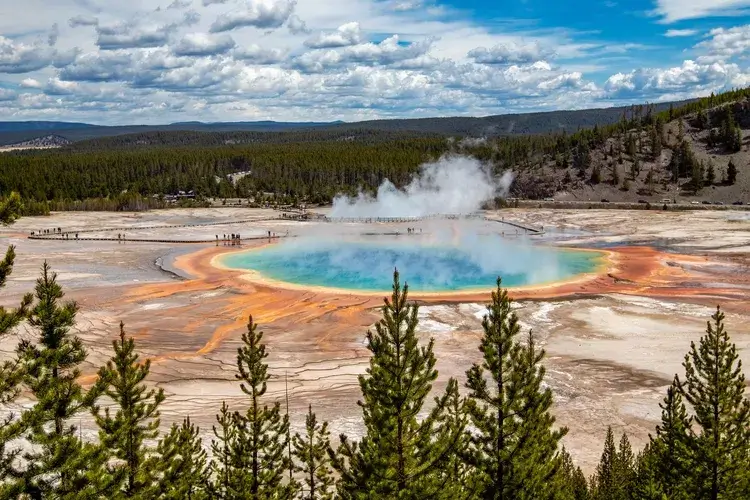
Around 20 supervolcanoes exist in the world today, and they are coined as such after erupting more than 1,000 cubic kilometres of material. Hot avalanches of volcanic ash, pumice, gases and rocks can reach up to 500°C in these explosions, moving at more than 300 kilometres per hour and travelling for more than 100 kilometres.
Eruptions of this magnitude are very rare, however supervolcanoes are known to produce smaller eruptions.
The last supervolcano to erupt was New Zealand’s Taupō volcano, around 26,500 years ago. For comparison, the largest eruption in living memory was the 1991 Pinatubo volcano in the Philippines, around 100 times smaller than the benchmark for a supervolcano.
Some people argue that we may be ill-prepared for when the next large eruption occurs, pointing to the devastation caused by the 2022 eruption of the Hunga Tonga-Hunga Ha’apai in the South Pacific. The eruption cut off Tonga’s communications for days after undersea cables were cut, as well as leading to tsunamis and dropping ash across hundreds of kilometres.