

Unpack the geography of global instability – from contested borders to forced displacement in nations around the world
By
For much of the past century, global conflict was dominated by imperial ambition. Major powers fought openly or by proxy to control territory, secure resources or assert strategic dominance. Smaller states were often battlegrounds for larger geopolitical rivalries. Today, the picture is more fragmented. The violence is less easily defined, the causes more entangled.
Take Russia’s war in Ukraine, which has redrawn Europe’s security map and hardened military lines across the continent. In Sudan, civil conflict has spilled into neighbouring states, deepening instability across the Sahel. Along the Himalayan frontier, China, Pakistan and India continue to fortify one of the world’s most heavily militarised high-altitude borders. In Myanmar, the persecution of the Rohingya has produced one of the largest stateless populations on Earth.
Enjoying this article? Check out our related reads…
These crises differ in intensity and form. Some are active battlefields; others are slow-burning contests over territory, identity or access to resources. Yet each sits at a geographical pressure point — and each is driven by a complex mix of forces. The age-old struggle to secure oil, minerals or rare earth elements still shapes tensions in places such as the Middle East and Venezuela. Demographic pressures strain fragile regions from the Sahel to the Himalayan arc. Ethnic and sectarian divisions continue to fracture societies, as in Myanmar. Rarely is there a single cause; more often, several pressures converge at once.
Taken together, these regions reveal less about isolated conflicts than about a shifting and more volatile global order. Local wars now ripple outward in ways they rarely did before, threatening supply chains, migration routes, energy markets and climate cooperation. Physical landscapes still shape political risk — but in a world of tighter interconnection, the stress fractures that begin in one corner of the map can rapidly become everyone’s concern.
Here, we look at how these pressure points emerge and why each represents a distinct type of geopolitical stress.
Ukraine and Western Sahara – territorial wars
In February 2022, Russia launched the largest land invasion in Europe since the Second World War. Nearly four years on, the war in Ukraine has hardened into a grinding contest over territory, infrastructure and political survival.
According to the UN Office of the High Commissioner for Human Rights, thousands of civilians have been killed or injured since the invasion began — a humanitarian catastrophe that Geographical has documented first-hand. Our reporting found that those already living with chronic illness are among the hardest hit. An alarming 81 per cent of households say they are struggling to afford essential medicines, particularly for heart disease, high blood pressure and pain management — a stark reminder that war’s toll extends far beyond the battlefield.
That toll is also etched into the landscape itself. Trenches slice through farmland, disrupting harvests and hollowing out rural economies. Entire cities, including Mariupol and Bakhmut, have been reduced by sustained bombardment, with widespread destruction of housing, hospitals and energy infrastructure.
At its core, this is a territorial war. Moscow has sought to consolidate control over annexed regions in the east and south, attempting to redraw borders by force — a move widely rejected by the international community, including the UN General Assembly. For Kyiv, the conflict is existential: a defence of sovereignty and internationally recognised boundaries.
Geography has shaped the war’s trajectory. The open plains of eastern Ukraine favour artillery and armoured manoeuvre, while the Dnipro River acts as both barrier and supply route. Crimea’s position in the Black Sea remains strategically central, influencing maritime security and grain exports. Disruption to Ukrainian grain shipments in 2022 triggered global food price spikes, according to the Food and Agriculture Organisation, underlining how a regional war can reverberate worldwide.
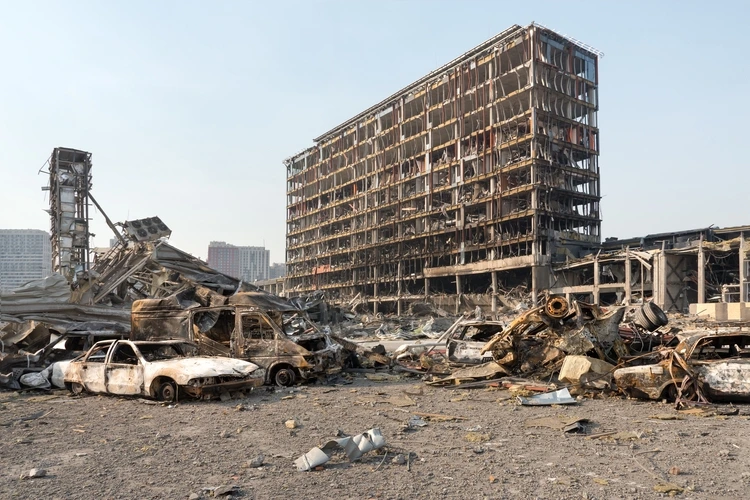
Beyond the battlefield, the conflict has reshaped European security. Defence spending across NATO countries has increased significantly since 2022, with Finland and Sweden seeking membership in response to Russia’s invasion, as outlined by NATO. Energy markets have also been transformed, with Europe reducing reliance on Russian gas supplies, a shift analysed by the International Energy Agency.
But it’s not just Ukraine that bears the brunt of territorial wars. Thousands of kilometres away, in Western Sahara, one of the world’s longest-running unresolved sovereignty disputes continues to shape lives and landscapes in quieter but no less consequential ways.
Western Sahara, a sparsely populated territory along the Atlantic coast of North Africa, was administered by Spain until 1975. When Madrid withdrew, Morocco moved to annex the territory, prompting armed conflict with the Polisario Front, which seeks independence for the Sahrawi people. In its 1975 advisory opinion, the International Court of Justice (ICJ) concluded that while historical ties existed between tribes in the territory and Morocco, they did not amount to sovereignty, and that the principle of self-determination should apply.
War continued until a UN-brokered ceasefire in 1991, which established the UN Mission for the Referendum in Western Sahara (MINURSO) and promised a vote on independence. More than three decades later, that referendum has yet to take place. The United Nations continues to list Western Sahara as a Non-Self-Governing Territory.
Today, Morocco controls roughly 80 per cent of the territory, including major urban centres and the Bou Craa phosphate mine. The Polisario Front administers a smaller eastern strip beyond the 2,700km-long sand and stone barrier known as the Berm, widely described as one of the world’s longest military fortifications.
Tensions resurfaced in November 2020 following clashes in the Guerguerat buffer zone, leading the Polisario Front to declare the 1991 ceasefire void. In 2020, the United States recognised Moroccan sovereignty over Western Sahara as part of a diplomatic agreement normalising relations between Morocco and Israel.
Like Ukraine, Western Sahara illustrates how territorial disputes frozen in the twentieth century continue to reverberate. Borders unresolved do not disappear; they harden into protracted geopolitical fault lines, where sovereignty, identity and control over land remain central to global politics.
Arctic – climate-driven strategic competition
For decades, the Arctic was protected by ice. That protection is rapidly disappearing.
The region is warming nearly four times faster than the global average, according to the Intergovernmental Panel on Climate Change (IPCC). Satellite observations from the National Snow and Ice Data Center show a sustained decline in summer sea ice extent and thickness. What was once a frozen barrier is becoming seasonally navigable water.
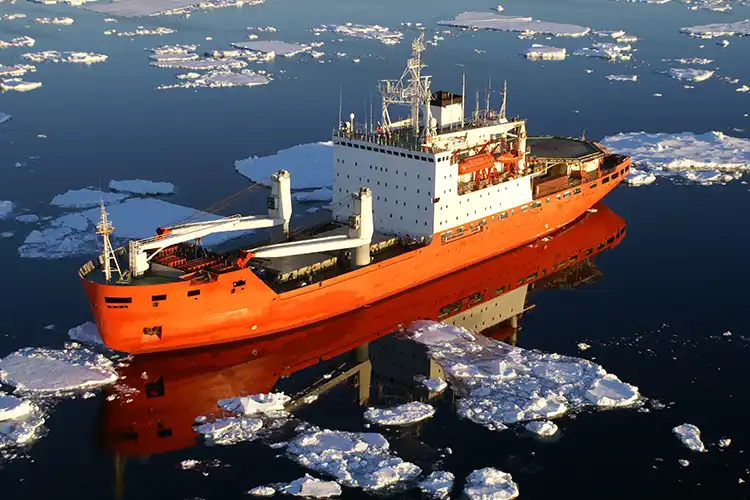
As ice retreats, commercial and strategic interest intensifies. The Northern Sea Route along Russia’s coastline can shorten shipping times between Asia and Europe. Beneath Arctic waters, the US Geological Survey estimates there may be 13 per cent of the world’s undiscovered oil and 30 per cent of its undiscovered natural gas. Even if extraction remains technically and environmentally difficult, the prospect alone raises stakes.
As Geographical has explored in its analysis of the region’s future, the Arctic is no longer a remote periphery but an emerging arena where environmental transformation intersects with hard power. Melting sea ice is accelerating long-simmering sovereignty claims under the United Nations Convention on the Law of the Sea, as Arctic states map their continental shelves in an effort to extend jurisdiction over seabed resources. At the same time, maritime law is being tested by new shipping lanes that were once impassable, forcing governments to reconsider search-and-rescue responsibilities, environmental protections and military presence.
Our reporting also examined the human dimension of this transformation. Indigenous communities, from Greenland to northern Canada and Siberia, face a double-edged reality: greater economic opportunity through shipping, mining and hydrocarbons, but heightened risks to fragile ecosystems that underpin traditional livelihoods. The thawing of permafrost, coastal erosion and shifting wildlife patterns are not abstract projections — they are lived changes, altering settlement patterns and food security in real time.
Ultimately, the Arctic represents a distinct type of geopolitical stress. There are no trenches or active battlefields. Instead, the pressure builds gradually as melting ice opens routes, exposes resources and redraws the strategic map. The landscape itself is changing — and with it, the balance of power — illustrating how climate change can become a catalyst for strategic competition long before a shot is fired.
Sahel – state fragmentation
Stretching from the Atlantic coast of Senegal to the Red Sea, the Sahel is a vast ecological transition zone — and increasingly, a geopolitical one. Over the past decade, it has become one of the world’s fastest-deteriorating security environments.
Mali, Burkina Faso and Niger have all experienced military coups since 2020, displacing elected governments and reshaping alliances. Armed Islamist groups affiliated with al-Qaeda and Islamic State operate across borders that are expansive, remote and difficult to police. According to the Global Terrorism Index, the Sahel is a ‘global epicentre of terrorism’, accounting for a significant share of terrorism-related deaths, with violence spreading southwards into coastal West Africa.

Yet this is not a conventional war between states. It is fragmentation. Governments retain formal sovereignty, but effective territorial control is uneven. In rural areas, state services are often absent, allowing armed groups to embed themselves within local economies and governance structures. The International Crisis Group has documented how weak institutions, corruption and unresolved communal tensions create fertile ground for insurgency.
In the Sahel, pressure accumulates through erosion — of governance, economic stability and territorial authority. What emerges is not interstate war, but a corridor of fragility where local grievances intersect with transnational armed networks and global strategic interests.
Venezuela and Zimbabwe – economic collapse
Venezuela’s northern belt — stretching from the Caribbean-facing capital Caracas westwards to Maracaibo and east along the oil-producing Orinoco corridor — has long anchored the country’s political and economic life. Today, it has become a different kind of geopolitical pressure point: one shaped less by armed conflict than by economic implosion, institutional erosion and mass displacement.
At the centre of the crisis lies the collapse of the petrostate. Venezuela possesses the world’s largest proven oil reserves, yet production has fallen dramatically from its early-2000s peak.
The economic consequences have been profound. Hyperinflation eroded savings. Shortages of food, medicine and fuel became commonplace. Public services — from electricity grids to healthcare — deteriorated sharply. The result has been one of the largest displacement crises in contemporary history. According to the UN, more than seven million Venezuelans have left the country since 2015, primarily relocating to Colombia, Peru, Brazil and Ecuador.
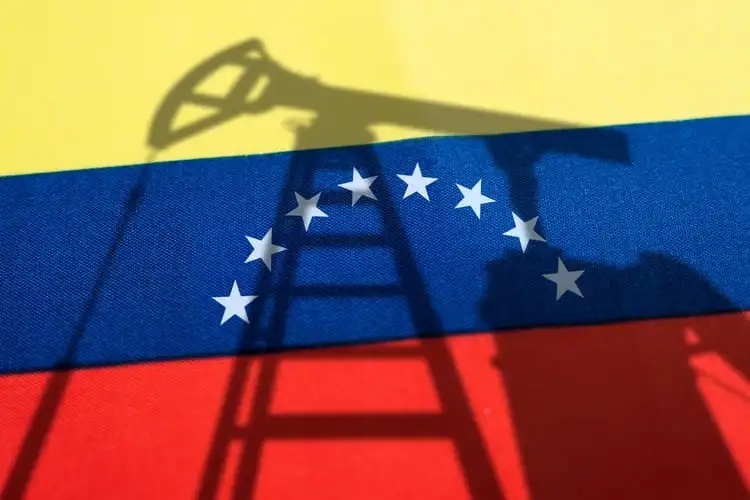
Political uncertainty deepens the volatility. Disputed elections, contested legitimacy and fractured governance have prompted sanctions and diplomatic tension. The International Crisis Group warns that a prolonged political stalemate risks further economic deterioration and regional instability.
In Venezuela, instability spreads not through invasion but through contraction. As state capacity weakens, pressure migrates across borders, embedding Venezuela’s domestic crisis within the wider geopolitics of the Americas.
Leading from Venezuela’s economic implosion, another example of systemic collapse reshaping a nation’s geopolitical footprint can be found in Zimbabwe. Once regarded as one of southern Africa’s more diversified economies, Zimbabwe has endured decades of economic contraction marked by hyperinflation, currency instability and sustained outward migration, transforming domestic crisis into a regional pressure point.
The downturn accelerated in the early 2000s following the Fast Track Land Reform Programme, which dramatically reduced large-scale commercial agricultural production — previously a cornerstone of export earnings and foreign exchange. As agricultural output fell and investor confidence deteriorated, GDP contracted sharply. By 2008, Zimbabwe experienced one of the most severe hyperinflation episodes recorded in modern history. The International Monetary Fund (IMF) documented inflation rates reaching astronomical levels before the Zimbabwe dollar was abandoned in 2009 in favour of a multicurrency system.
Stabilisation proved temporary. Currency reforms in 2019 reintroduced a local dollar, but inflation surged again. According to the World Bank, annual inflation exceeded 500 per cent in 2020, severely eroding household purchasing power. The African Development Bank has repeatedly highlighted how exchange-rate volatility and fiscal pressures continue to constrain growth and investor confidence.
Both Zimbabwe’s and Venezuela’s geopolitical stress unfold through attrition rather than artillery. There are no front lines cutting across both countries. Yet erosion — of economic output, institutional trust and public services — has radiated outward, influencing migration policy debates.
Middle East – strategic chokepoints
Few regions concentrate geopolitical pressure as intensely as the Middle East. Here, rivalries overlap: state against state, state against non-state actor, and external powers competing for influence across energy corridors and contested capitals.
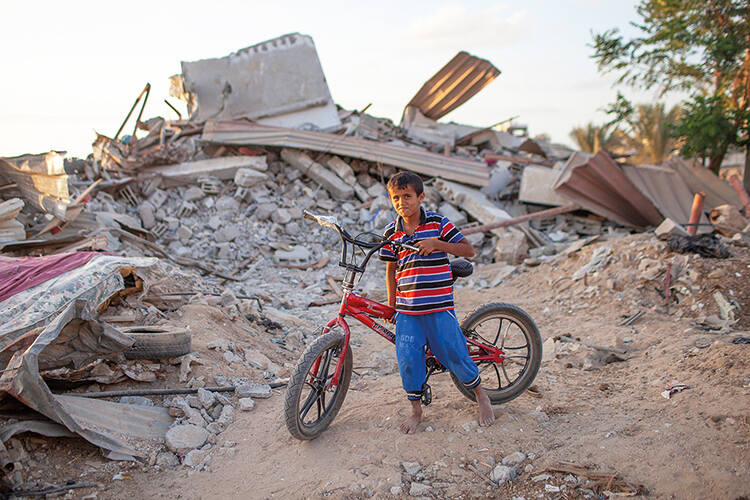
The war between Israel and Hamas, which escalated sharply in October 2023, has reshaped regional calculations. The United Nations Office for the Coordination of Humanitarian Affairs (OCHA) has documented severe humanitarian consequences in Gaza, highlighting the conflict’s broader regional implications. Cross-border exchanges involving Hezbollah in southern Lebanon have raised fears of escalation beyond Israel and Gaza, underscoring how quickly localised violence can spill across boundaries.
Iran remains central to these dynamics. Through alliances and support for armed groups including Hezbollah in Lebanon and affiliated militias in Iraq and Yemen, Tehran exerts influence across multiple theatres. The International Institute for Strategic Studies (IISS) notes that Iran’s strategy relies on projecting power indirectly, enabling regional reach without direct conventional confrontation. This approach complicates efforts by Israel, Gulf states and the United States to contain Iranian influence.
Energy geography further amplifies the region’s significance. The Middle East accounts for a substantial share of global oil exports, and maritime chokepoints such as the Strait of Hormuz remain critical to international trade. The US Energy Information Administration identifies the Strait of Hormuz as one of the world’s most strategically important oil transit chokepoints. Even limited disruptions can send ripples through global markets.
Meanwhile, fragile states including Syria and Iraq continue to grapple with the aftermath of prolonged conflict.
Unlike Ukraine’s territorial war or the Sahel’s fragmentation, the Middle East represents layered geopolitical stress: overlapping conflicts, proxy rivalries and energy vulnerability. Geography anchors each tension point — from contested borders to narrow sea lanes — ensuring that local confrontations retain global consequences.
China, Pakistan and India border – militarised ambiguity
Where the three nuclear-armed states of China, Pakistan and India converge, geopolitics is shaped by altitude. The Himalayan and Karakoram ranges form one of the world’s most militarised frontiers — a landscape where sovereignty is contested across glaciers, ridgelines and high-altitude desert.
At the centre of tensions between China and India lies the Line of Actual Control (LAC), a loosely defined de facto boundary rather than a formally demarcated border. Its ambiguity has repeatedly generated friction, most dramatically in June 2020, when clashes in the Galwan Valley resulted in the first combat fatalities between Indian and Chinese troops in decades.

Geography magnifies the risk. Infrastructure that once consisted of seasonal tracks has been transformed into permanent roads, bridges and forward positions.
Pakistan adds a third axis. China’s Belt and Road Initiative runs through Pakistan via the China–Pakistan Economic Corridor (CPEC), linking western China to the Arabian Sea. India has formally objected to the corridor because parts of it pass through territory India claims in Kashmir.
This frontier represents a different form of geopolitical stress: militarised ambiguity. There is no declared war, yet tens of thousands of troops face one another across an undefined line. In these mountains, geography entrenches vigilance, ensuring that elevation, infrastructure and perception remain central to regional power dynamics.
Rohingya and Syria – forced displacement
The Rohingya — a Muslim minority long denied citizenship under Myanmar’s 1982 Citizenship Law — represent a form of geopolitical stress rooted not in territorial invasion, but in the denial of belonging.
The crisis escalated dramatically in August 2017, when Myanmar’s military launched operations in northern Rakhine State following attacks by the Arakan Rohingya Salvation Army. The UN High Commissioner for Human Rights described the campaign as a ‘textbook example of ethnic cleansing‘ in a 2017 statement to the Human Rights Council.
More than one million Rohingya refugees remain in Cox’s Bazar today, making it the largest refugee settlement in the world.— a vast and densely packed landscape of bamboo shelters and tarpaulin roofs stretching across once-forested hills in southern Bangladesh. As Geographical reported in its coverage of life inside the camp, displacement here is not a temporary emergency but a protracted state of limbo. Families who fled violence in Myanmar in 2017 continue to live in conditions shaped by uncertainty: restricted movement, limited access to formal education and employment, and growing dependence on dwindling humanitarian aid.
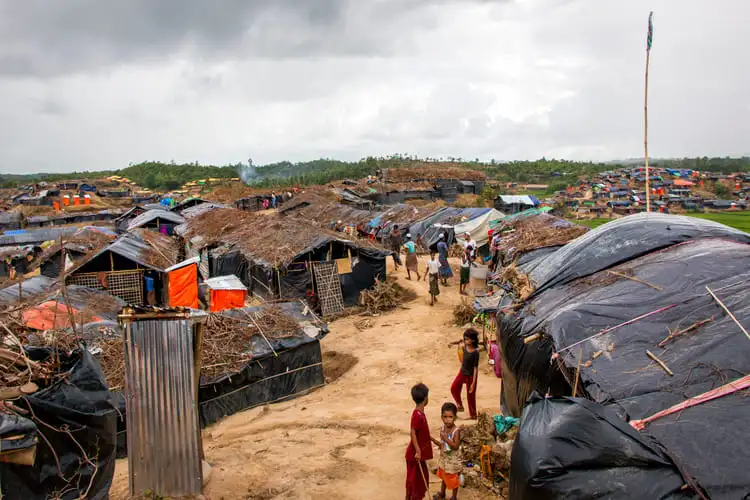
The camps themselves have transformed the physical geography of the region. Hills have been levelled to make space for shelters; monsoon rains trigger landslides and flooding; deforestation has accelerated as land was cleared to accommodate new arrivals. Humanitarian agencies warn that overcrowding and underfunding are compounding risks to health and safety. For many Rohingya, the future remains suspended between an unsafe homeland and an increasingly fragile refuge.
In this sense, the Rohingya crisis represents another form of geopolitical stress: not territorial war or resource competition, but the weaponisation of identity and citizenship, played out across borders and etched into the geography of exile.
The Rohingya crisis is not unique in illustrating how the denial of belonging can reshape regional politics. Thousands of kilometres west, the Syrian refugee crisis represents one of the most consequential displacement events of the twenty-first century — not only in humanitarian terms, but in its geopolitical ripple effects.
Since the outbreak of Syria’s civil war in 2011, more than five million Syrians have fled the country, according to the UN Refugee Agency (UNHCR), with millions more displaced internally. Turkey hosts the largest number — over three million — followed by Lebanon and Jordan. What began as a domestic uprising evolved into a multi-layered conflict involving regional and global powers, but its most enduring legacy may be demographic rather than territorial.
The scale of displacement has reshaped the politics of host states. In Lebanon, where refugees at one point accounted for roughly a quarter of the population, infrastructure and public services have faced sustained strain. In Turkey, refugee policy has become a defining electoral issue, with the government negotiating financial support agreements with the European Union under the 2016 EU–Turkey Statement. In Europe, the arrival of large numbers of asylum seekers in 2015 prompted reforms to border management and asylum policy, reshaping debates over migration across the bloc.
As in Cox’s Bazar, geography plays a defining role. Refugee flows have followed accessible corridors — across the Turkish border, through the eastern Mediterranean and along the Balkan route — transforming coastlines, border towns and transit cities into frontline spaces of humanitarian and political negotiation.
If the Rohingya crisis demonstrates how citizenship can be stripped away, Syria shows how state collapse and protracted war can displace a generation. In both cases, geopolitical stress is etched not only into contested territory but into human movement itself — into the routes, camps and host communities that become part of the new political landscape.
Iran – regional rivalry, nuclear standoff and internal pressure
Iran occupies a central but volatile position in Middle Eastern geopolitics. Its fusion of state, religious authority and regional ambition has generated sustained tensions with the United States, Israel and several Gulf states, making Tehran a perennial pressure point in global strategic calculations.
A core source of instability is Iran’s nuclear programme. Although Tehran asserts its activities are for peaceful purposes, Western powers and Israel have long accused Iran of pursuing a nuclear weapons capability. The 2015 Joint Comprehensive Plan of Action (JCPOA) was designed to constrain Iran’s enrichment activities in exchange for sanctions relief, but that deal unravelled over the past decade. In October 2025, Iran formally withdrew from the JCPOA, signalling a breakdown in one of the few diplomatic frameworks that had managed nuclear tensions.
Diplomatic engagement continues alongside pressure. In early 2026, Iran was set to attend indirect nuclear talks with the United States and other mediators in Geneva aimed at de-escalation and potential sanctions relief, even as both sides remain far apart on core demands. Recent rounds of negotiation reflect a geopolitical stalemate rather than resolution.
Beyond the nuclear issue, Iran’s foreign policy is shaped by broader regional rivalry and domestic dynamics. Tehran has long leveraged networks of allied non-state actors — most notably Hezbollah in Lebanon and allied militias in Iraq and Yemen — as part of its strategic posture in the Levant and Gulf. Research briefs on Iran’s position in the Middle East note that its identity as a majority Shia Muslim state in a predominantly Sunni-led region underpins many of its security relationships and rivalries, particularly with Saudi Arabia.
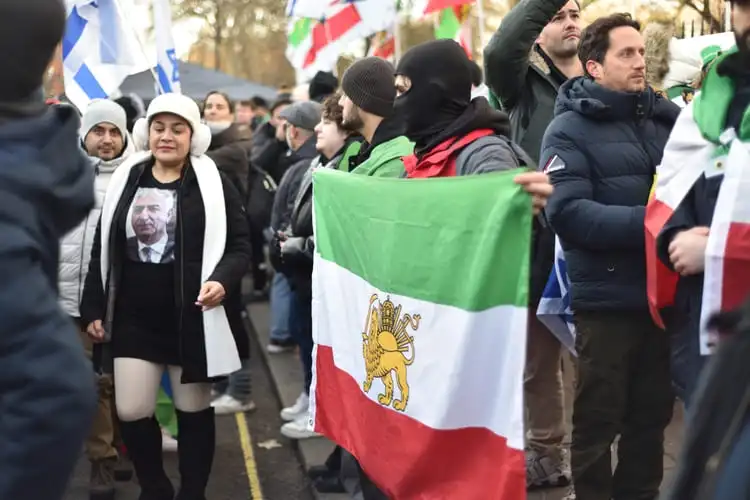
Internal pressures are also reshaping Iran’s geopolitical behaviour. A pattern of protests over economic hardship and political repression has persisted for years, with recent crackdowns signalling deep societal frustration and eroding domestic legitimacy.
Iran’s current geopolitical stress is therefore multi-layered: it stems from international nuclear standoffs, regional rivalries and proxy networks, and internal political and social tensions. These intersecting pressures — diplomatic isolation, sanctions-driven economic contraction and contested regional influence — make Iran both a central actor and a chronic point of friction in Middle Eastern geopolitics.


