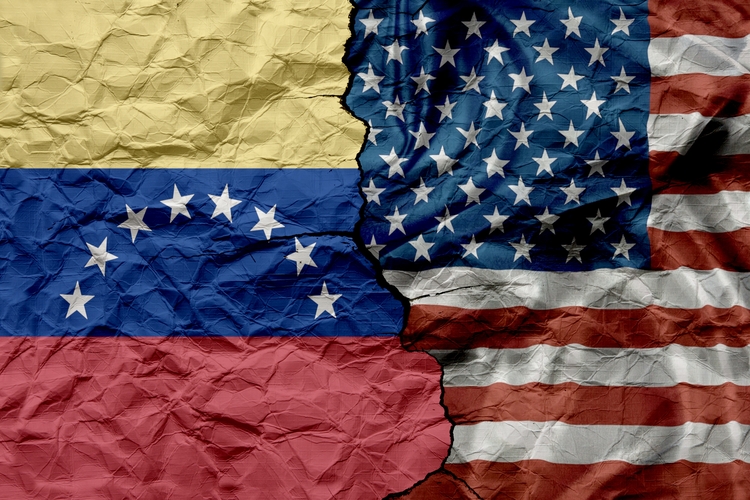

Trump’s Caribbean armada isn’t diplomacy but dominance, reviving a century-old American doctrine
By
War on Drugs, you say? Send an aircraft carrier to Venezuela. And some destroyers. Plus around 4,500 troops, along with some special forces. Throw in a nuclear-powered submarine and a few B-52 bombers just in case the smugglers get some funny ideas.
That’s what the US says is required for its counter-narcotics operation against the Venezuelan cartels moving cocaine north towards the US border. In the last few weeks, America has launched at least ten air strikes on what it says were drug-trafficking vessels, killing more than 50 people.
Washington has not assembled as many warships in the Caribbean since the 1962 Cuban missile crisis, and that tells us what this is really about – regime change in Venezuela, and a renewed focus on the Monroe Doctrine.
Enjoying this article? Check out our related reads:
In 1823, President James Monroe made it clear that Washington regarded Latin America as within its sphere of influence.
If outside powers interfered in its backyard, then the US would intervene, with or without the consent of local governments. In 1904, a bullish President Theodore Roosevelt extended the doctrine, stating that it ‘may force the United States, however reluctantly, in flagrant cases of such wrongdoing or impotence, to the exercise of an international police power.’
The Doctrine was invoked several times, including in 1962, and during other attempts by Moscow to create pro-Soviet regimes
in Central and South America. Russian influence almost collapsed at the end of the Cold War, but has been rising slowly this century, as has that of China.
Last month, the Russian parliament ratified a new military agreement between Moscow and Havana to ‘facilitate the development and strengthening of military cooperation’. Some pro-Kremlin Russian commentators say this could lead to Moscow deploying missiles in Cuba, although that’s more probably just Russia using strategic signalling to warn the Americans not to send Tomahawk cruise missiles to Ukraine.
Russian military advisers operate in Venezuela, and the Kremlin has sold Caracas about $10billion worth of weapons, including a sophisticated missile defence system. Iran has conducted joint military exercises in Venezuela, while China is a major investor both there and throughout Latin America. Which brings us to President Nicolas Maduro.
His government has facilitated the presence of these outside powers. That may be its sovereign right, but from Washington’s Monroe Doctrine perspective – it’s wrong.
Venezuela is not a major producer of cocaine, but it is a transit corridor from Bolivia, Peru and Colombia. It has two major drug gangs: the Cartel of the Suns and Tren de Aragua. One of President Trump’s first executive directives when he returned to power this year was to classify cartels as terrorist organisations. The administration then accused Maduro and other top officials of being part of the Cartel of the Suns and announced a reward of $50 million for information leading to Maduro’s arrest.
From the administration’s perspective, it is legal to use military force against the ‘terrorist’ drug gangs, such as air strikes against their vessels. However, that hardly takes an entire aircraft carrier strike group. Its real purpose may become clearer over the next few months. At the time of writing, the air strikes have all been in international waters. If we see a strike inside Venezuela’s territorial waters or land mass, it will signal an escalation that may not end with attacks on drug labs or gang camps but on government infrastructure.
Subscribe to Tim Marshall’s Substack here: https://substack.com/@itwitius
The American armada is positioned to be able to apply long-range pressure on Caracas, which can be ratcheted up and down, without having to land substantial ground forces. It is backed up with fighter jets and Reaper drones stationed in Puerto Rico and has logistical support in Guantánamo Bay. Denying freedom of movement along the entire Venezuelan coastline would be easily achievable.
You don’t need an aircraft carrier to catch or kill drug smugglers, but you might need one to enforce the Monroe Doctrine and warn Russia and China to keep their distance.
President Trump says this is about drugs and that ‘I think we’re just going to kill people that are bringing drugs into our country… you know, they’re going to be, like, dead.’ Roosevelt’s maxim was ‘speak softly and carry a big stick’. President Trump carries a big stick, waves it about a lot and shouts. He could get louder.