In Namibia, Cape fur seals and hake fishers are competing for the same catch. Tommy Trenchard joins scientists testing an acoustic technology designed to protect both
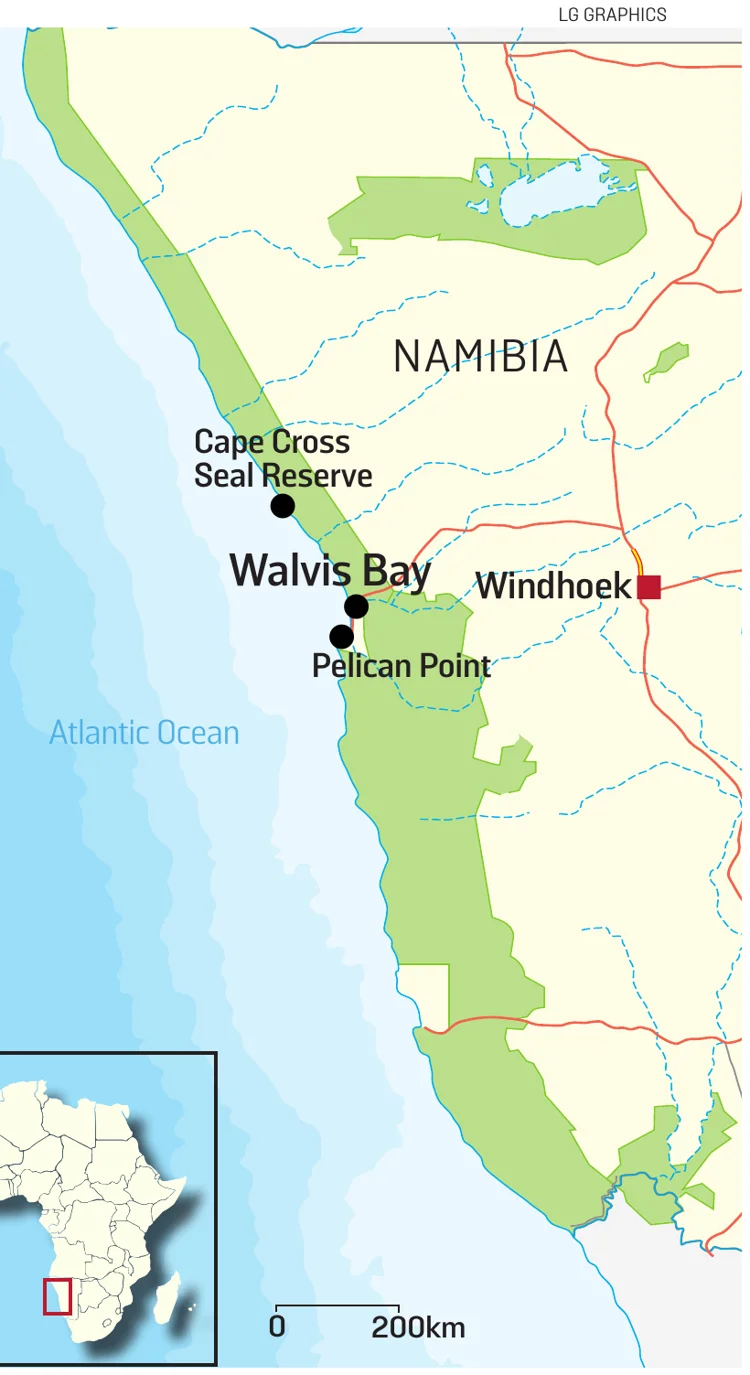
On a sandy spit opposite the bustling port of Walvis Bay on the coast of Namibia, vast colonies of Cape fur seals huddle together against the frigid fog blowing in off the icy Atlantic Ocean. Jackals lurk among them, scanning for the weak and injured, while gulls wheel overhead. Behind the seal colonies, fishing vessels weave past container ships across a glistening bay on their way out to sea.
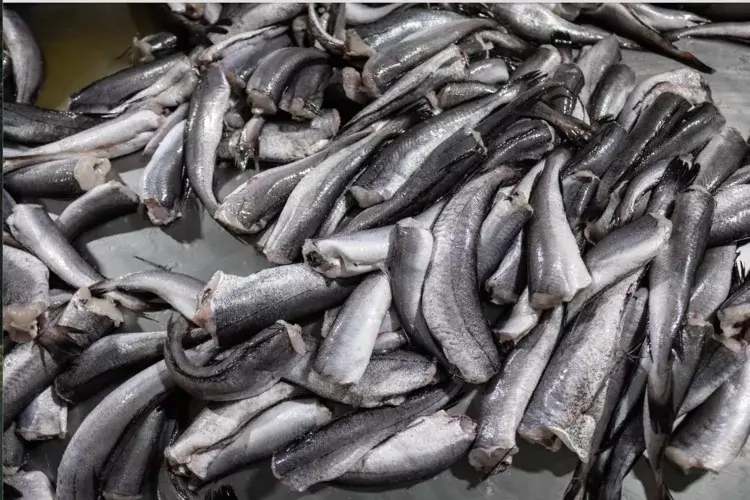
Both the seals and the fishing fleet are here because of an ocean current that brings vital nutrients up from the deep, fuelling one of the world’s richest marine ecosystems. Yet increasingly, they are finding themselves in competition. As seal populations have grown, more and more have turned to raiding the nets and lines of hake fishing boats in search of an easy meal. Each year, hundreds of seals are thought to die from entanglements in fishing gear, while the hake fishery — the cornerstone of the town’s economy — suffers damaging losses.
Enjoying this article? Check out our related reads…
Now, researchers are collaborating with Walvis Bay’s hake fishery to develop a new form of acoustic deterrent that they hope will keep seals safe and make life easier for fishers. If successful, it could not only bring enormous benefits to both the Namibian hake fishery and the local fur seal population, but could also have major implications for other fisheries and marine mammal species around the world.
‘We need to find solutions that enable the coexistence of wildlife and humans,’ says Dr Thomas Götz, a bio-acoustics consultant affiliated with the University of St Andrews and the lead scientist on the project. ‘Where humans have an impact on the environment, we should strive towards developing solutions to mitigate, reduce or prevent that impact.’
Acoustic deterrents, which emit sounds designed to scare off opportunistic predators, aren’t new, and many are already used in fisheries around the world. Yet until now, so-called ‘seal scarers’ have been comparatively crude instruments that work only until the seals become habituated to the sound and learn that it poses no threat. Because they typically rely on frequent blasts of sound, often at high volumes, they can also disturb a wide range of marine life.
With funding from the Marine Stewardship Council’s (MSC) Ocean Stewardship Fund, Götz and his team have developed a system intended to overcome both problems. Now the challenge is to fine-tune it for the seals of Walvis Bay. The new technology, known as Targeted Acoustic Startle Technology (TAST), was developed at the University of St Andrews and is manufactured by the acoustic technology firm GenusWave. To reduce disruption to marine life, its signals are emitted infrequently and last less than half a second. It can also be tuned to different target species — in this case, Cape fur seals — to minimise the impact of noise pollution on the wider ecosystem. Fish, for example, typically hear only very low-frequency sounds and are oblivious to the noises emitted by the de-vice. During early tests in Scotland, the team found that they could even target specific types of marine mammals, using a frequency that was effective on seals but had little impact on porpoises.
What really sets the project apart from previous acoustic deterrents is that TAST is designed to trigger the part of the brain responsible for the so-called ‘startle reflex’.
‘Basically, it’s that sudden flinching response when you hear an unexpected sound with certain acoustic properties,’ says Götz, who first fell in love with the ocean during boating holidays as a child.
Because the startle reflex is an instinctive, involuntary response rather than a conscious one, seals can’t simply learn to ignore it. ‘We found that the animals habituate very quickly to the majority of stimuli,’ says Götz. ‘So we designed stimuli specifically to elicit a startle response, and that’s when we found a very different type of response that’s sustainable over longer periods.’
Naude Dreyer, a Namibian conservationist and founder of Ocean Conservation Namibia, understands all too well the urgent need for a solution to the human–wildlife conflict playing out in the town. Since 2020, his team has had to disentangle more than 5,000 seals. On one occasion, the organisation disentangled 60 in a single day.
‘You’ve got a fully functional food-chain ecosystem out here,’ says Dreyer, as he scans the seal colonies through binoculars in search of entangled animals. ‘It’s also a very sensitive system. Everything is on such a fine balance, and I just feel we need to do everything we can to maintain this… If there are effective deterrents to keep these seals away from the boats, this would be brilliant because it will reduce that interaction. It will reduce the conflict.’

For residents of Walvis Bay, the stakes are high. Namibia’s second-largest town lies on the country’s Skeleton Coast, where the towering dunes of the Namib Desert meet the relentless waves of the Atlantic. Out here, fishing is one of the few viable sources of income. The hake fishery alone directly employs some 17,000 people, most of them women, and indirectly supports livelihoods for three times that number.
‘It’s our bread and butter,’ says Lino Rossini, factory manager for Seawork, one of the town’s biggest fish processors, which employs more than 2,000 people. ‘It’s what Walvis is all about.’
A few kilometres from the seal colonies, in a sprawling factory by the docks, hundreds of women stand alongside conveyor belts as hake at various stages of processing slide endlessly past. The fish enter the factory on ice, straight off the boats. By the time they leave, they’ve been transformed into immaculate frozen fillets packed into branded boxes for export around the world.
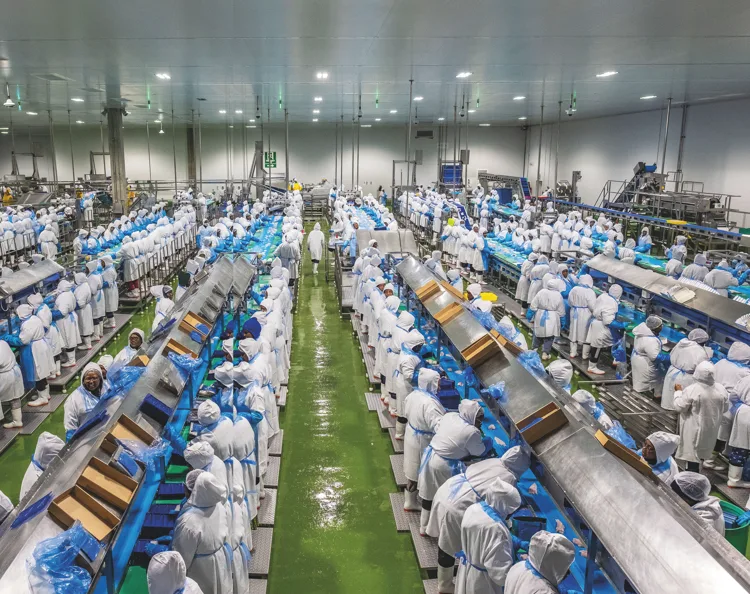
Namibia’s hake fishery is something of a success story. Until independence in 1990, the country’s waters were heavily overfished by foreign vessels. Hake were processed and frozen at sea and shipped directly to Europe. Stocks plummeted and Namibia lost out.
After independence, the government imposed strict regulations that have allowed hake stocks to recover to roughly double their level at their nadir, when overfishing was at its peak. Rigorous quotas were imposed, observers installed on boats, measures introduced to reduce bycatch and quotas restricted to Namibian-owned or -controlled entities. In 2020, the fishery became one of only four on the African continent to be certified as sustainable by the MSC.
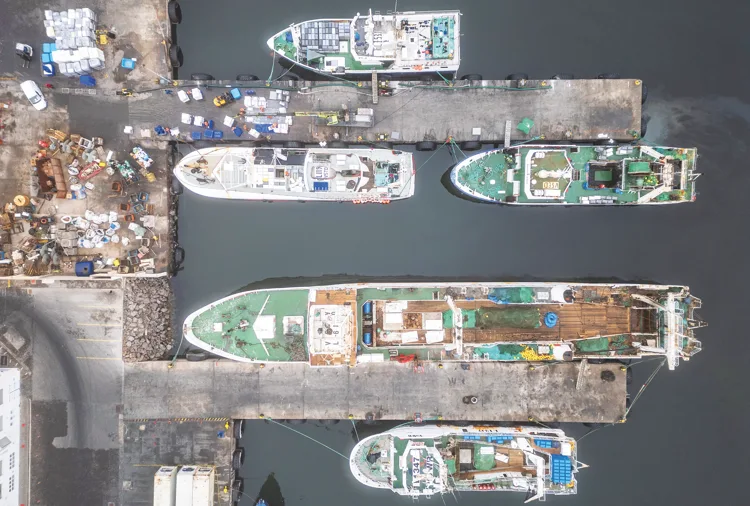
The fishery’s collaboration with Götz not only offers the prospect of reducing the costly and worsening problem of seal predation and entanglement, but also helped secure its recertification by the MSC in January 2026, one requirement of which is that steps are taken to reduce unintended bycatch. The certification gives Namibian hake exporters access to high-value markets in Europe where consumers will pay more for sustainably caught fish.
‘Certification is very, very important for the sector because it opens up new markets for us, markets we could not penetrate,’ says Matti Amukwa, chair of the Namibian Hake Association. ‘Worldwide, most people are more concerned about the environment, and this testifies that this is a resource being managed responsibly.’
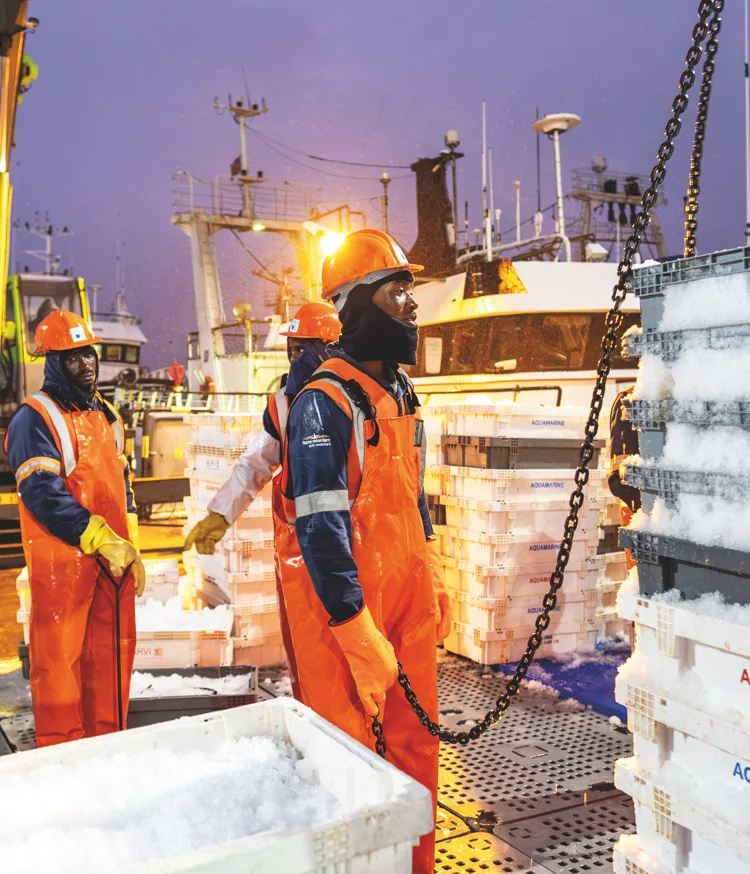
On a chilly morning last June, workers in orange jumpsuits shuttled to and fro on the docks as a crane offloaded crates of hake from the Joao N Castro, a Walvis Bay longliner. The vessel had returned from a two-week fishing trip with Götz and his team on board. While the crew worked, Götz had been testing the acoustic startle device with two transducers — effectively underwater loudspeakers — fitted to the hull, in the first field test of the system on Cape fur seals.
‘We’re definitely seeing responses that are consistent with startle-reflex elicitation,’ says Götz, who cautions that a full analysis of the data will be needed before firm conclusions can be drawn. ‘We’re seeing the seals crash-dive into the water and then the group move away… And during those times, we also see that the catch goes up and there is less predation.’
Much still needs to be done, he says, to fine-tune the system. Among other things, he plans to experiment with a version of the device that can be fitted to trawl nets, where seals periodically drown after becoming entangled and where live animals can present a serious danger to fishers once hauled on board. ‘My ambition for this project is for it not just to be a research project, but to actually go into implementation, where we can prevent the deaths of fur seals,’ says Götz. ‘And potentially use it for other applications around the world.’