Powerful typhoon hit Taiwan and Japan with winds up to 141mph, leaving one dead and 527 injured
By
The strongest storm of the year so far by maximum sustained wind speed – Typhoon Champi – has hit Taiwan and Japan’s southern islands, bringing winds of up to 227 km/hour (141mph) and two-day rainfall of more than 620mm in parts of Yilan.
Already, one person has been killed and 527 injured in Taiwan, as well as a further 1,300 people evacuated from mountainous areas in the nation. According to Taipower, more than 167,000 homes had lost electricity but most had now regained power.
Both work and classes were suspended across most of Taiwan’s counties and cities on Friday, with Taiwan’s stock exchange also closed.
On Tuesday (20 October), Champi reached its maximum wind speed of 298 kilometres per hour (185mph) across the Philippine Sea, equivalent to a Category 5 hurricane – the highest and most dangerous level on the hurricane wind scale. At that point, those wind speeds made Champi the strongest of any storm in 2026.
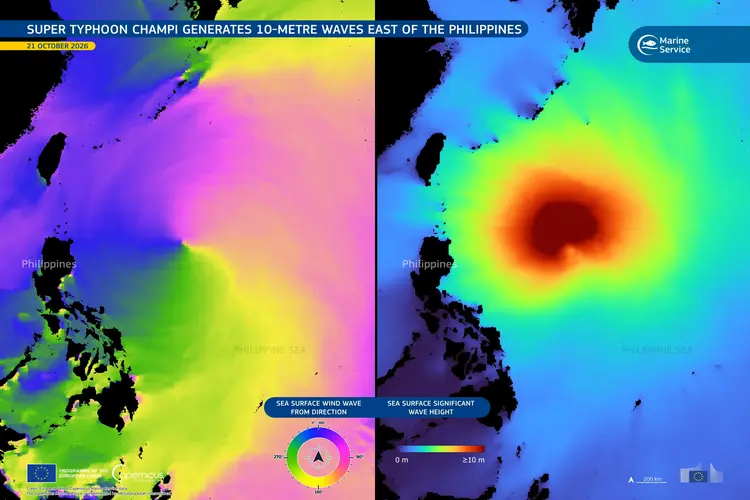
In addition, visualisations from Copernicus Marine service data showed how Typhoon Champi was generating 10-metre-high waves east of the Philippines on Thursday.
According to forecasts, the typhoon is set to pass off northeastern Taiwan before turning north toward China and moving to southern Japan. In the event that the storm ‘stalls, loops or wobbles from side to side’ as it heads towards Taiwan, it could make landfall, said Central Weather Administration forecaster Liu Pei-teng.
Rainfall is likely to reach its maximum on Saturday morning and continue until the evening.
Taiwan’s transport ministry announced all 262 of its domestic flights were cancelled on Friday, as well as 717 international ones.
The effects of Champi are also extending past Taiwan. Approximately 8,400 households in Japan’s Okinawa islands are experiencing power outages with Typhoon Champi forecast to pass close by. In addition, forecasts show how the typhoon is interacting with the jet stream and may impact weather in other parts of the world, such as Canada, well into November.
Related reads…
Experts have said that the current strong El Niño is making typhoon season more severe. According to the Japanese Meterological Agency, 10 tropical cyclones have formed in the western Pacific Ocean this year alone, the highest number in a season since 1966. Champi is Japan’s 30th typhoon of the year.
El Niños can intensify typhoons by changing wind patterns, allowing cyclones to become more easterly. This gives storms longer to form on warmer waters, growing in size and intensity before hitting land. El Niño years also tend to have lower hurricane activity in the Atlantic, with stronger activity in parts of the Pacific.