Tristan Kennedy meets ski mountaineer Jim Morrison, whose pioneering descent of Mount Everest’s north face demanded meticulous preparation and extraordinary skill
For most people who climb it, reaching the top of Mount Everest marks the achievement of a lifetime goal. But for the American ski mountaineer Jim Morrison, standing on the summit was just the start. ‘At that moment, I started getting my stuff together,’ he told me over coffee near his home in Tahoe, California, earlier this year.
‘I had to transition from being a climber and using a rope to, like, “I’m gonna put my skis on and I’m gonna ski off this.” And things got really serious for me.’
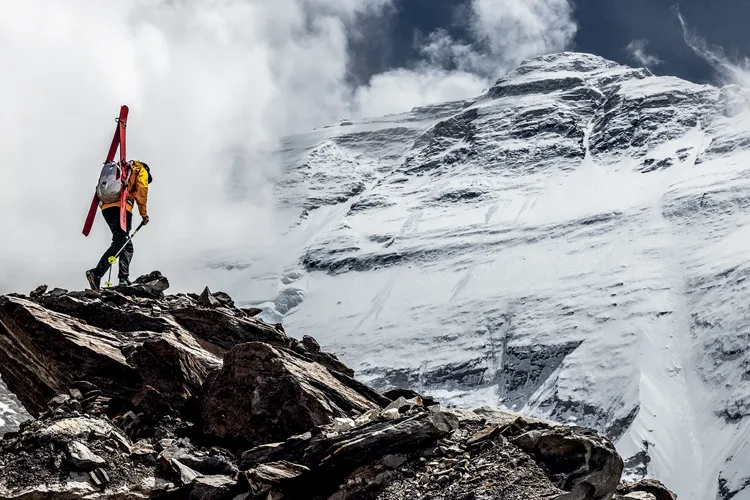
Morrison’s descent would take him down the mountain’s treacherous north face, through two narrow corridors of rock known as the Japanese and Hornbein couloirs. Once described by the legendary mountaineer Reinhold Messner as ‘the most beautiful route on Everest’, this line had only ever been climbed by five people before – and no-one had ever skied it.
The slope gradient ‘probably averages 45°’, Morrison said, with some sections as steep as 60°. Most of it is what skiers call a ‘no-fall zone’, where the slightest slip could send you tumbling to your death. ‘If I had lost an edge, there wasn’t a way to recover from a fall,’ Morrison said.
‘I remember making a turn and looking down into this… I don’t know what you would call it – a void.’
By the time he set off skiing, Morrison had spent hours in what’s known as ‘the death zone’ above 8,000 metres, where the human body and mind start to shut down, even with supplemental oxygen. On top of this, the snow conditions on the day – 15 October 2025 – were far from ideal.
‘We had this huge windstorm that blew almost all the snow away, so it’s basically like ice,’ Morrison said. ‘I just said [to myself]: “I can ski steep ice. I’ve been doing it here at my home mountain my whole life.
So just do it, and don’t think about what’s going to happen,”’ Morrison told me, gesturing to the pistes of Palisades outside the window.
Morrison’s world first is now the subject of a major new National Geographic documentary, Everest: The Other Side, in IMAX cinemas from 30 October. Directed by the Oscar-winning duo behind Free Solo, Jimmy Chin and Elizabeth Chai Vasarhelyi, the film shows not just the high-risk, high-altitude skiing, but everything that went into making it happen.
Because while the skiing itself filled the headlines, the really impressive feat is that Morrison made it to the mountain at all.
Morrison originally planned the first ski descent of this route on Everest’s north face with his life partner, Hilaree Nelson. Like him, Nelson was an accomplished ski mountaineer.
The pair had started dating in 2015, and by 2017 were ticking off high-profile Himalayan objectives together, culminating in their 2018 first descent of the Lhotse Couloir – a thin strip of snow that runs down the west face of the world’s fourth-highest mountain.
‘Hilaree and I had been talking about [the Everest north face descent] ever since we skied Lhotse,’ Morrison told me. But in 2022, with the Tibetan side of the mountain still closed because of Chinese Covid restrictions, they’d decided to try skiing down Manaslu, the world’s eighth-highest peak, instead.
Morrison skied off first, but as Nelson descended, she triggered an avalanche in a no-fall zone that swept her off the mountain to her death.
In the immediate aftermath, Morrison told me, ‘I really didn’t want to ever ski again or climb a mountain again, or be in an unsafe situation of any kind ever again.’ Slowly, however, he began to piece his life back together. ‘Day by day I started to just keep moving forward.
I eventually started finding myself looking at making ski turns again, and eventually said, “I still want to do this, I want to finish this goal because it meant a lot to us.” I kind of wanted to do it in her honour.’
Enjoying this article? Check out our related reads…
It wasn’t the first time Morrison had turned towards the mountains in the wake of a life-altering tragedy. ‘I’ve suffered some pretty serious loss in my life,’ he told me when we first met in 2019, shortly after he and Nelson had completed their groundbreaking Lhotse descent together.
‘I lost my wife and my children in a plane crash in 2011.’ Katie Morrison, who he’d met aged 22 and married shortly afterwards, was an experienced recreational pilot. She had been flying home from southern California with their two young kids, Hannah, five, and Wyatt, six, when their Cessna went down.
Trying to cope with almost unbearable grief, Morrison had thrown himself into ski mountaineering, finding that the concentration required for nerve-shredding descents left little room for intrusive thoughts. ‘I really only found myself in a good place when I was back in the mountains,’ he told me. ‘To a big degree, I think [they] rescued me.’
Of course, it wasn’t just his inner drive or his search for solace that got him to the top of Everest. Morrison, who’d already stood on the summit once before, had prepared assiduously – assembling a crack team with more than a dozen Everest summits between them, using all the latest equipment and climbing with fixed ropes and oxygen.
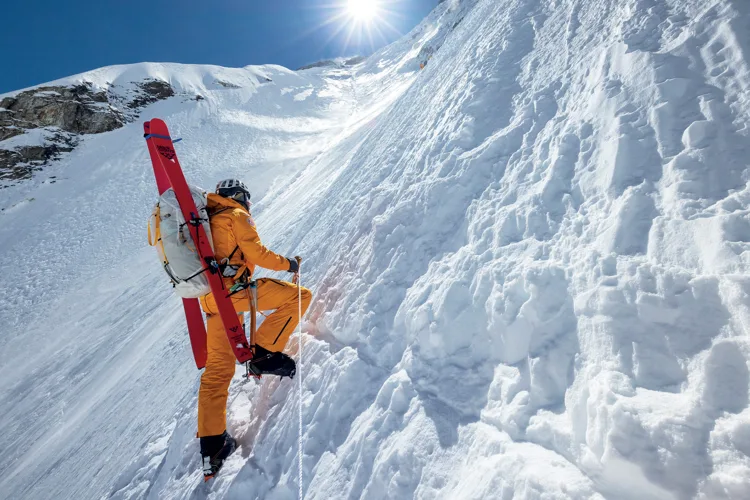
‘I had built the team around me, so that when the time came, I’d have the most energy I could to go win my race,’ he said. He had arrived at the top ‘super lucid and in a really good place physically, which had been my goal all along’.
All of which meant that when he had to, he could focus entirely on his objective and do his late partner proud. The entire descent – 3,650 vertical metres from the summit to the relative flatness of the Rongbuk Glacier – took just over four hours of unbelievable concentration.
‘I had just a crazy emotional release at the base of the whole face,’ he said. ‘I was screaming, and crying and talking to Hilaree… [I was] just in this state of disbelief.’ Watching this moment in Everest: The Other Side, and knowing how much he had endured to get there, I was close to tears myself.