A quarter of Spain’s groundwater bodies are being pumped faster than they can recover. Doñana, the country’s best-known wetland, shows who pays the price
By Eugenio Mincione
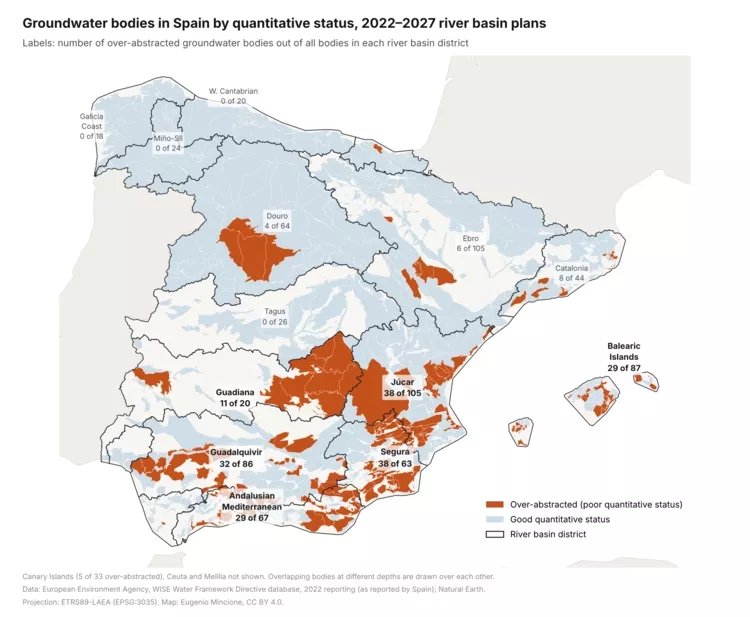
Spain does not have one water crisis but many, and most of them lie underground. Under the EU Water Framework Directive, Spain reports the state of each of its groundwater bodies to the European Environment Agency. In the current river basin plans, 203 of the country’s 804 groundwater bodies are classed as over-abstracted: more water is pumped out than rain and rivers put back.
On the map, the pattern is plain. Six river basins in the south and east, the Segura, Júcar, Guadalquivir, Guadiana, the Andalusian Mediterranean basins and the Balearic Islands, contain 177 of the 203 over-abstracted bodies, or 87 per cent, although they cover only 39 per cent of Spain. The wet northwest and the Tagus basin have none. For 182 of the 203, or 90 per cent, the authorities themselves list pumping for agriculture as a significant pressure (full analysis).
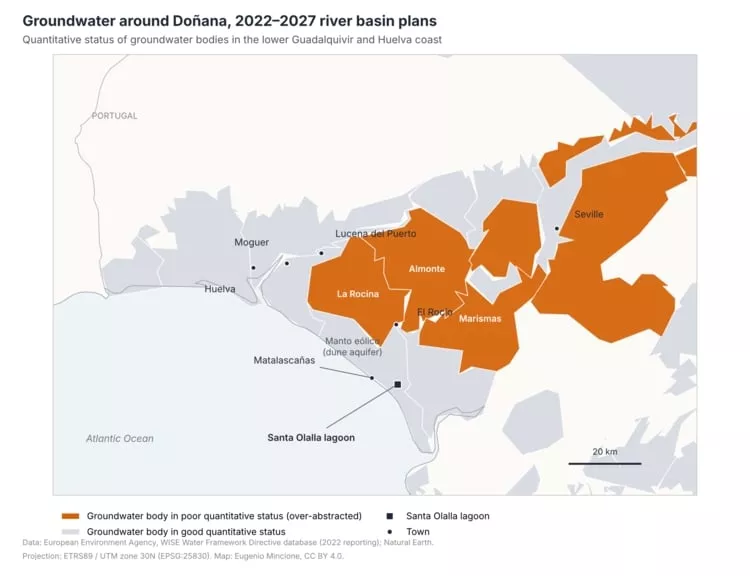
The best-known of these aquifers lies beneath Doñana, where the Guadalquivir reaches the Atlantic.
A lagoon that no longer lasts
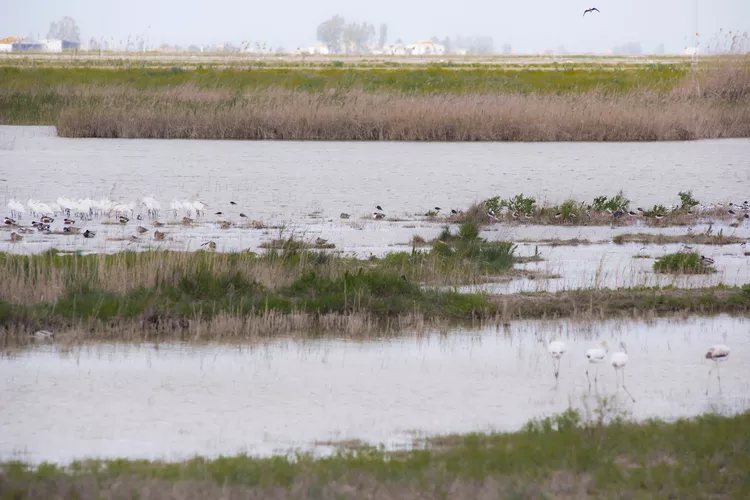
Santa Olalla is Doñana’s largest lagoon. It dried out completely in 2022, 2023 and 2024. Researchers at the Universidad Pablo de Olavide in Seville counted 109 dry days in the first year, 76 in the second, and 13 in the third. In a study published this year, they conclude that Santa Olalla now behaves like a seasonal lagoon rather than a permanent one.
In 2018, the charity WRAP noted that outside the British growing season, this region supplied up to half of the UK’s strawberry imports by value. In 2025, Spain exported 46,675 tonnes of berries worth €281 million to the UK.
One aquifer, many users
The berry farms and the wetland draw on the same aquifer. Since 2020, it has been officially classified as overexploited, and in places the water table has fallen by up to 20 metres. A synthesis by 22 scientists links groundwater pumping to extensive ecological damage in the World Heritage Site. EEA data show that the three groundwater bodies around the park, Almonte, La Rocina and Marismas, are all over-abstracted.
North of the park, berries grow under plastic. According to Spain’s environment ministry, 547 hectares, 13 per cent of that area, lie outside the land classified as irrigable and are presumed to be illegal. The Guadalquivir River Basin Authority has closed 1,214 wells since 2018. By the end of 2024, 476 of the closed wells were legal, replaced with surface water brought in from outside the area.
But Santa Olalla lies in the dunes near the beach resort of Matalascañas, and the groundwater body beneath the dunes is still rated as good. Scientists at the Biological Station have named the resort’s wells as the main pressure on the dune lagoons. Their pumping rises sharply in summer, when tens of thousands of visitors arrive. In February, Spain’s official gazette published a project to close two supply boreholes at the resort’s eastern end and replace them. The Olavide study puts most of the weight on the climate: less rain and higher temperatures.
The deal and its gaps
In 2021, the Court of Justice of the European Union ruled that Spain had failed to protect Doñana’s groundwater. Andalusia’s government nevertheless pushed a bill to expand irrigable land around the park by 800 hectares, despite objections from UNESCO and the European Commission.
In November 2023, Madrid and Seville signed a €1.4 billion agreement, and Andalusia dropped its plans. Farmers in the area’s north can receive up to €100,000 per hectare, paid over five years, if they stop farming and reforest the land. In October, the government provisionally allocated the first €28.5 million, covering 407 hectares.
Who bears the cost is another question. In May, the river basin authority gave the aristocratic House of Alba final permission to legalise wells on its Aljóbar estate near Doñana.
The Guardia Civil found nine unlicensed wells there, and the owners applied for regularisation only after they were discovered. A judicial investigation into water theft and environmental crime is still underway.
‘The problem is how it is shared out’
For Julia Martínez, who leads the New Water Culture Foundation (Fundación Nueva Cultura del Agua), Doñana is the national pattern in miniature. Asked in writing whether Spain lacks water or shares it badly, she answered: ‘The problem is how it is shared out.’ Irrigation, she notes, accounts for around 80 per cent of Spain’s consumptive water use, and farm water rights are very unevenly distributed. In a drought, the same cut is applied to every farmer.
‘Small farmers are the ones who lose out. Large companies have more flexibility to shift production.’
She describes groundwater as ‘largely ungoverned’, with illegal wells, abstraction above permitted volumes and too little inspection. ‘Too often, the authorities prefer not to confront the powerful economic interests at stake.’ Her foundation and Andalusia’s Social Water Roundtable have proposed allocating farm water according to social, environmental and territorial criteria.
After the rain
Early 2025 was exceptionally wet. Between late December and mid-March, the flooded share of Doñana’s marshes rose from 7.9 to 97.4 per cent. But the Biological Station warns that the critical state of the aquifer still limits a full recovery, and the Olavide team writes that Santa Olalla’s resilience is ‘at its limit’.
One wet spring cannot refill aquifers that have been overdrawn for decades. Whether Santa Olalla and the 200 other over-abstracted groundwater bodies recover will depend on the weather, but also on how much water the farms, resorts and cities that rely on them are each allowed to take.