Just an hour north of Luxor, on the banks of the Nile in Upper Egypt, Dandara remains largely untouched by mass tourism. The town reveals a different side of Egypt, where living heritage, strong family ties and community celebrations remain woven into everyday life
By Claire Thomas
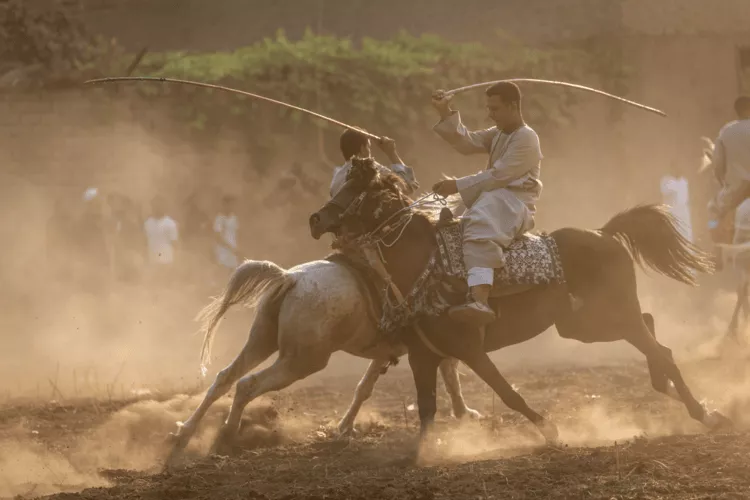
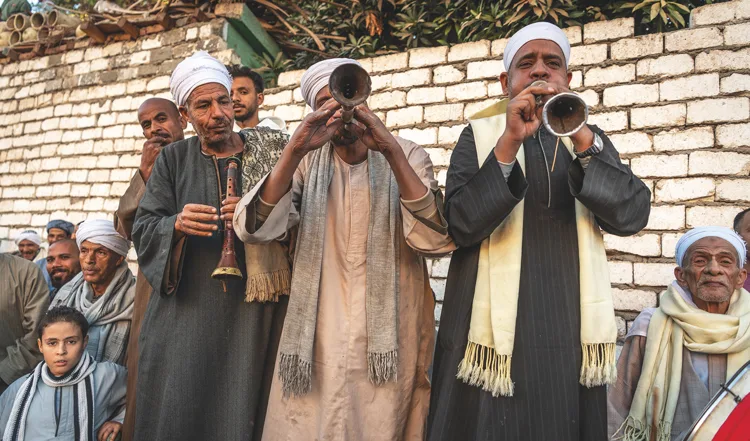
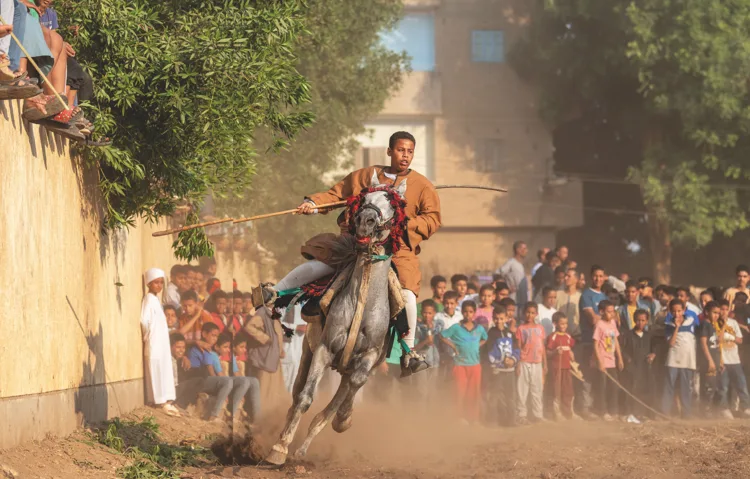
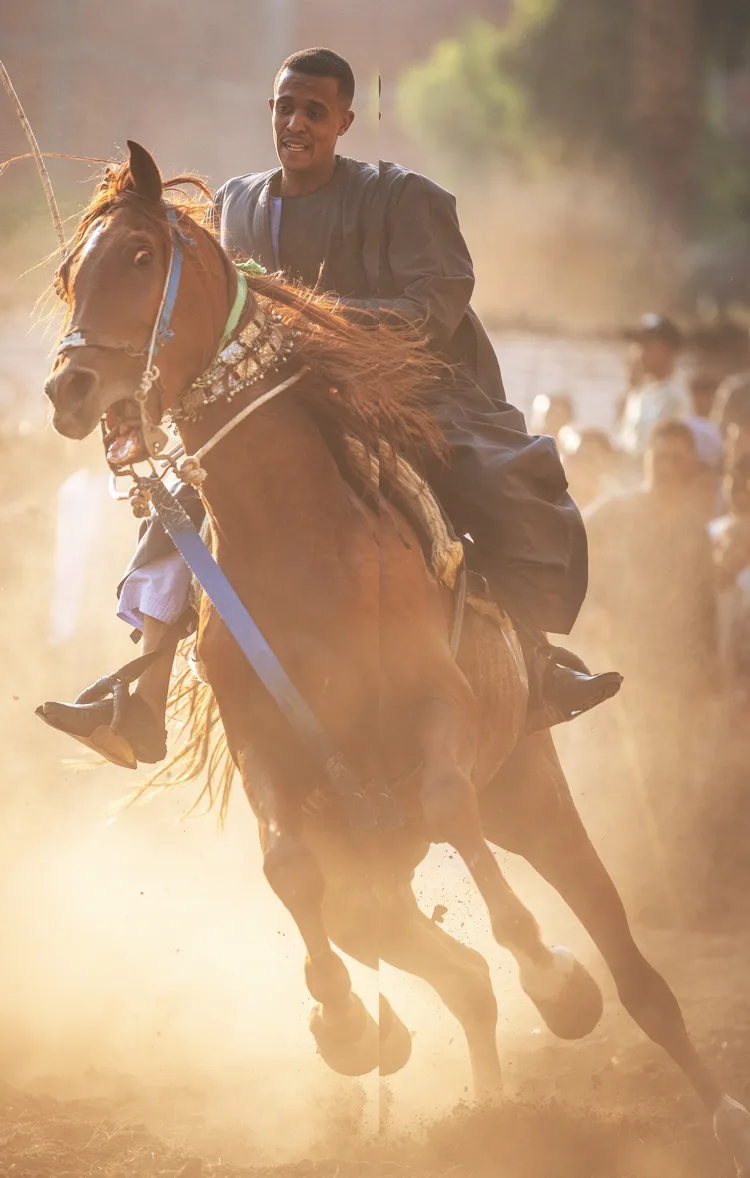
Plumes of dust hang in the air as powerful horses thunder past, so close that I feel the rush of displaced air and the sting of sand, and smell the horses’ sweat. Their riders, dressed in flowing galabeyas, brandish long, lance-like sticks. Boys standing perilously close to the galloping horses dart out of the way at the last second as the crowd erupts in cheers. The piercing cry of the mizmar, the conical reed instrument whose unmistakable sound accompanies celebrations across rural Egypt, cuts through the drum-like pounding of hooves as onlookers gather on the flat roofs of the surrounding brick buildings.
In the town of Dandara, around an hour’s drive north of Luxor, the equestrian art of Mermah takes centre stage. Although Dandara is best known internationally for the magnificent Temple of Hathor, it’s the town’s living heritage — and the remarkable community that has preserved it — that have drawn me here.
Enjoying this article? Check out our related reads…
As riders charge back and forth, showering spectators in sand and grit, I soon find myself swept up in the excitement. Spirited horses wheel through the haze while horsemen challenge one another, testing courage and control. Along the sidelines, men and boys urge the riders on as musicians are rewarded from horseback with folded banknotes in exchange for another rousing tune.
There are no barriers separating spectators from horses. Riders gallop just inches from the crowd before spinning sharply to face a new challenger, wielding the traditional bamboo zanah, a spear-like staff, in carefully choreographed contests inspired by the weapons once carried by tribal warriors.
The aim is not to strike with force but to demonstrate balance and agility by touching horse or rider with precision while avoiding being touched in return. Between contests, horses perform graceful manoeuvres to the rhythm of the mizmar, transforming an ancient martial practice into a captivating display of horsemanship.
I keep photographing until the fine sand finally overwhelms my camera and I can shoot no more.
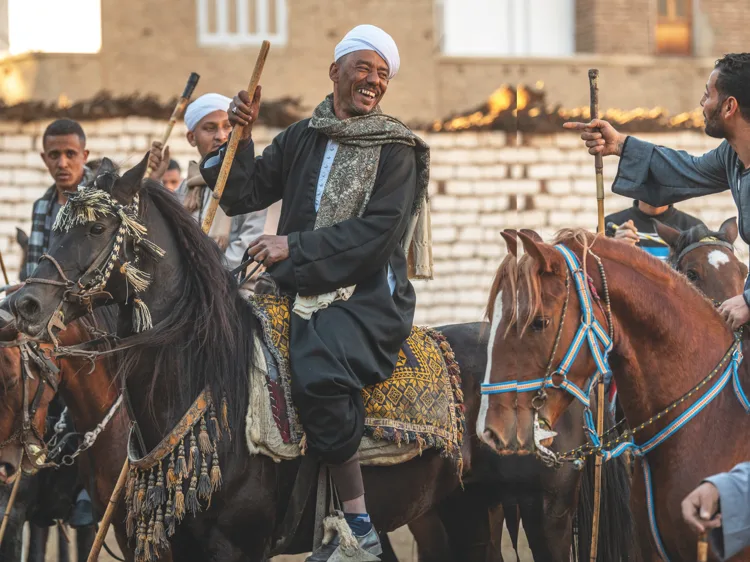
The horse has long occupied a special place in Upper Egyptian culture, associated with honour, generosity and social standing. Well-bred Arabian horses remain a source of pride among many leading families, featuring prominently in weddings, religious festivals and other major celebrations. Thought to be one of Egypt’s oldest surviving equestrian traditions, Mermah derives its name from Arabic words associated with spearing or charging at full gallop. Believed to have been introduced centuries ago by Arab and Berber tribes who settled along the Nile, it evolved from mounted-warrior training into a ceremonial display combining horsemanship, fencing and music.
Although no longer a preparation for combat, its defining qualities remain much the same: courage, discipline, agility and the partnership between horse and rider.
Today, it continues to be practised across Upper Egypt, particularly in the governorates of Luxor, Qena and Aswan. Yet nowhere is the custom more closely woven into community life than in Dandara, where it remains at the heart of some of the town’s most important celebrations.
For Hussein Mamoun, a fifth-generation horseman from Dandara, the equestrian art is not simply a spectacle but a family inheritance. He first rode with his father at the age of three and began competing on his own horse at ten. Today, he’s teaching his own son, also aged ten, to ride, carrying the family legacy forward.
‘I feel immense happiness when I demonstrate my horsemanship,’ he tells me. ‘Mermah showcases the skill of the horseman and the harmony between rider and horse.’
Successful riders, Hussein Mamoun explains, require far more than technical ability. ‘A rider needs proper training and must have confidence,’ he says. ‘A horse can sense fear.’
Another rider, 29-year-old Yassin Ali Ibrahim, believes good horsemanship begins with understanding and empathy. ‘You must understand your horse, know its abilities and recognise its physical limits,’ he says. ‘Kindness towards horses is essential.’ For Yassin, Mermah is a profound source of pride and honour. ‘It’s a feeling that can only be experienced from the back of a horse,’ he adds.
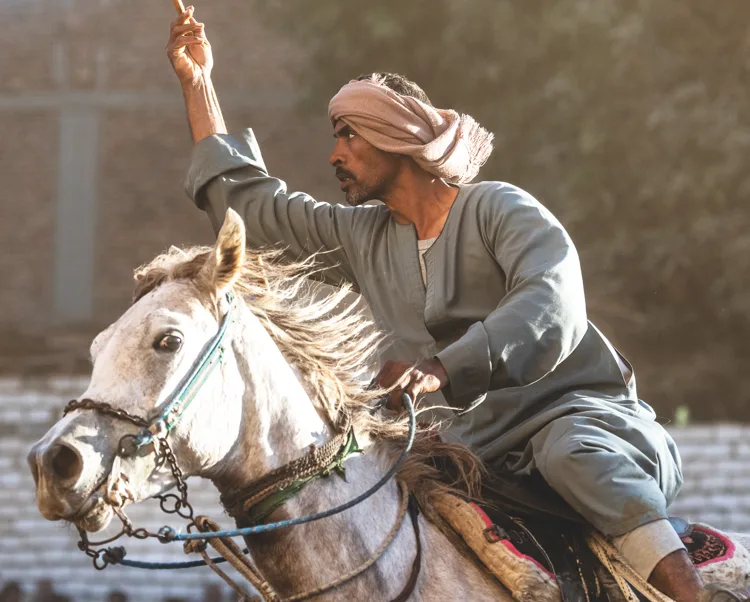
Only later that evening, as I review my photographs on a computer screen, do I notice what the excitement had hidden from me. What had seemed, in the heat of the moment, an exhilarating spectacle looks very different when viewed frame by frame. Blood streaks the mouths of several horses, their lips and gums cut by harsh metal bits, while others bear raw cuts along their sides where sharp-edged stirrups have rubbed against them. Looking more closely, I see wide, fearful eyes and tense expressions. The injuries are most obvious on the white horses, where crimson stains stand out starkly against their pale coats.
After a lifetime around horses, I recognise the unmistakable signs of animals under considerable stress.
The following day, I raise the subject with Emir Hashem El Dandarawy, head of Dandara’s leading family and a respected figure across Upper Egypt.
‘It’s shameful,’ he tells me. ‘It never used to be like this. Men took pride in showing how well they cared for their horses. Nowadays, more people are taking part and many have not received adequate training in how to ride well and care for the animals.’
He believes the event’s growing popularity has come at a cost. ‘In the past, the rules were stricter,’ he continues. ‘Riders wore full traditional dress and head turbans; saddles were beautifully decorated, sometimes with silver; the sticks were heavier. It wasn’t acceptable to participate unless everything was done properly. Now things are becoming less disciplined and more riders come from outside Dandara to participate.’
Hussein Mamoun voices a similar concern. ‘Mermah has changed compared with the past,’ he says. ‘Some riders no longer uphold the traditions of Mermah, whether in the way they train and care for their horses, their commitment to traditional dress or the code of honour and chivalry that once made horsemen models of noble character.’
Their words echo what I have begun to see for myself. Like many living traditions, this centuries-old practice has evolved to survive. Yet the changes that have helped sustain it have also introduced new challenges, raising questions about how it can adapt without losing the values that once defined it.
The future of Mermah is already the subject of discussion. In September 2025, I was invited to meet the then governor of Qena, Dr Khaled Abdel-Aal, to discuss Dandara’s tourism potential. During our conversation, I suggested that, while the event had the potential to attract visitors, the welfare of the horses would be a concern for many international travellers. The discussion soon turned to how clearer standards could help safeguard both horse welfare and the future of the tradition.
Emir Hashem El Dandarawy has already introduced initiatives encouraging riders to return to traditional equestrian dress, preserve the historic tack and restore the standards that once shaped the event. Yet, as several riders acknowledged, persuading participants to embrace those standards consistently has proved to be far more difficult. ‘We need to spread awareness about how to communicate with horses,’ Yassin Ali Ibrahim says, ‘while ensuring they are treated with kindness, compassion and proper veterinary care.’
Although Mermah is practised in other parts of Upper Egypt, Dandara occupies a special place within the tradition. Twice each year, the Dandarawy Family and Tribal Conferences transform the town into one of the area’s largest cultural gatherings, drawing thousands of members of the extended Dandarawy family and tribal network from across Egypt and overseas to renew family ties, celebrate their shared heritage and settle disputes.
Through my husband’s family, whose roots in Dandara stretch back generations, I have been welcomed into the Dandarawy Family Conferences over several years. Their warmth and generosity have transformed my experience from that of an observer into that of a welcome member of the community, allowing me to witness moments of Dandara’s cultural life that few outsiders, particularly foreign women, are able to see.
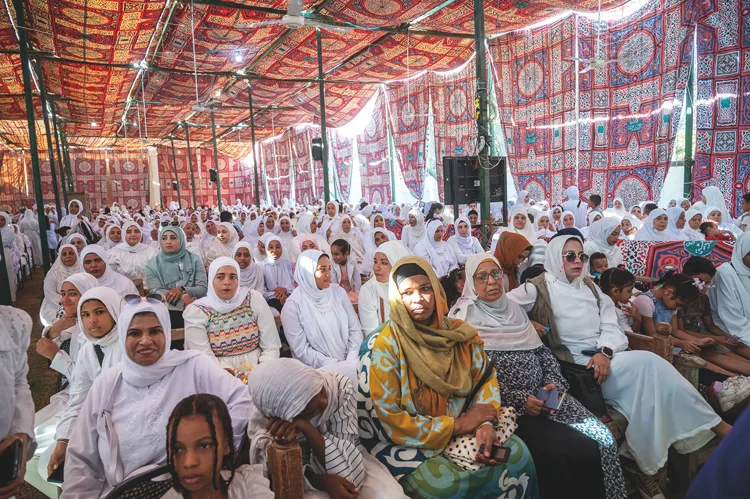
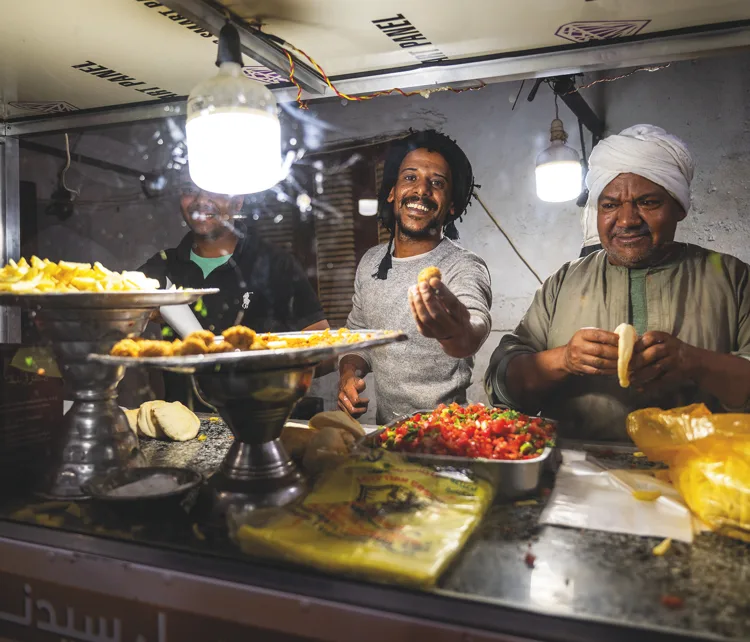
For several days, the town takes on a festive atmosphere. Streets fill with visiting families, musicians perform as crowds gather around the riding grounds and some of Egypt’s finest horses arrive to compete. Religious ceremonies, lectures, debates and public gatherings bring together scholars and leaders, while music and celebration continue long after dark.
Alongside the equestrian contests, another ancient art comes to life: Tahteeb. Recognised by UNESCO as Intangible Cultural Heritage, Tahteeb traces its roots to ancient Egypt, where scenes resembling the martial art appear on the walls of pharaonic tombs and temples. Over millennia, it evolved from military training into a highly ritualised form of stick fighting governed as much by respect and etiquette as by skill. Widely regarded as one of the world’s oldest continuously practised martial arts, it sees opponents circle one another carrying long bamboo staffs, every movement demanding discipline, precision and restraint.
Unlike the speed and energy of the horse contests, Tahteeb unfolds with deliberate patience, its measured rhythms carrying the weight of centuries of ritual. Like its equestrian counterpart, it remains an enduring expression of identity, passed from one generation to the next.
Watching the Mermah unfold over several days, I find myself torn between admiration and concern. The event is exhilarating: an extraordinary celebration of music, horsemanship and community unlike anything I’ve witnessed elsewhere in Egypt. Yet some of the horses are paying a price that shouldn’t be ignored.
Emir Hashem El Dandarawy’s concern reflects precisely that dilemma. He isn’t defending poor horsemanship; he’s lamenting the gradual erosion of standards that were once inseparable from the tradition itself. Caring for the horse, he reminds me, had always been as important as demonstrating skill in the saddle.
Looking to the future, Hussein Mamoun hopes younger riders will inherit more than riding skills. ‘I hope the younger generations will uphold the true principles of horsemanship,’ he says. ‘To take part with integrity, to welcome visiting riders with generosity and to care for the safety of others rather than seek to harm them. Horsemanship is a matter of honour.’

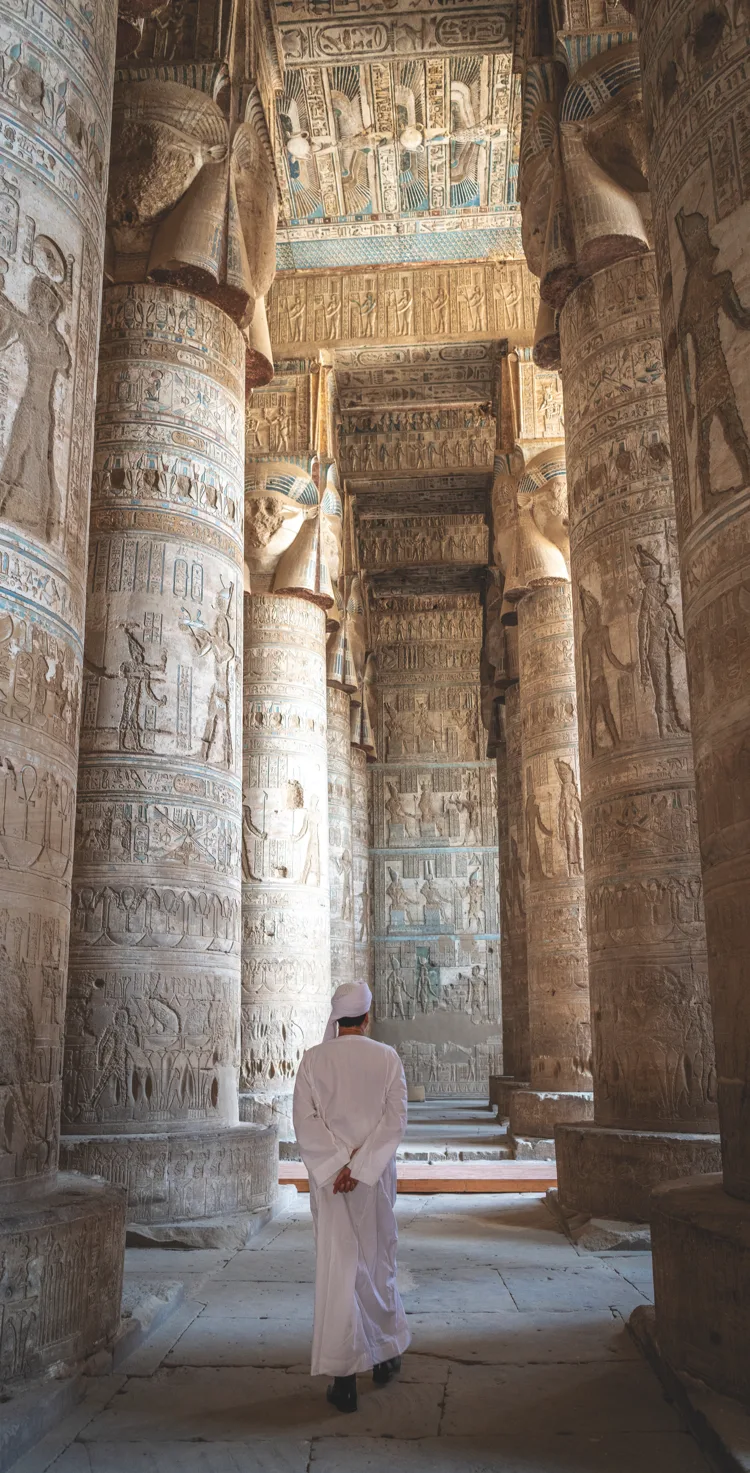
For most international travellers, Dandara begins and ends at the Temple of Hathor, one of Egypt’s best-preserved ancient temples. Every day, visitors admire its painted ceilings before climbing back onto air-conditioned coaches bound for Luxor. Few venture into the neighbouring town, where another kind of heritage continues to unfold.
Here, history isn’t confined to temple walls or museum displays; it lives in the thunder of hooves, the cry of the mizmar, the measured rhythm of Tahteeb and the families and communities determined to keep these traditions alive.