
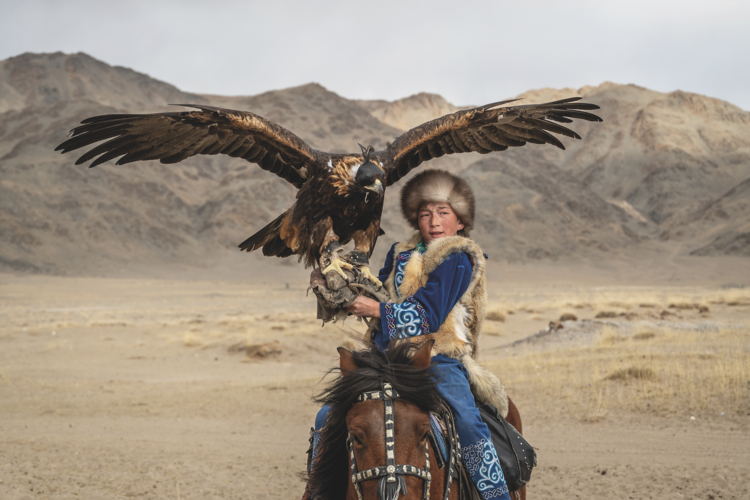
In Mongolia’s Altai, Kazakh hunters still ride with golden eagles across a landscape in which survival, skill and tradition remain intimately bound
Words and photographs by Claire Thomas
Aykerim’s high-pitched call cuts through the valley, and the horses leap into action. Responding to her signal, my horse lurches forward beneath me, and I hastily shove my camera into my bag.
It’s late winter in the Altai. The land stretches wide and open, its muted browns broken by patches of lingering snow. The mountain peaks on either side remain capped in white. A narrow river winds through the landscape, and in the distance, animals graze freely near small winter homes that sit naturally within their surroundings.
Enjoying this article? Check out our related reads…
Aykerim, just 12 years old, leans forward with a broad smile, riding bareback across the rock-strewn plain beneath the towering ridgelines. The ground is uneven, with pockets of snow caught between stones, and the sub-zero air stings my cheeks as I follow close behind her. She moves with an ease that seems instinctive, as if riding bareback were second nature to her.

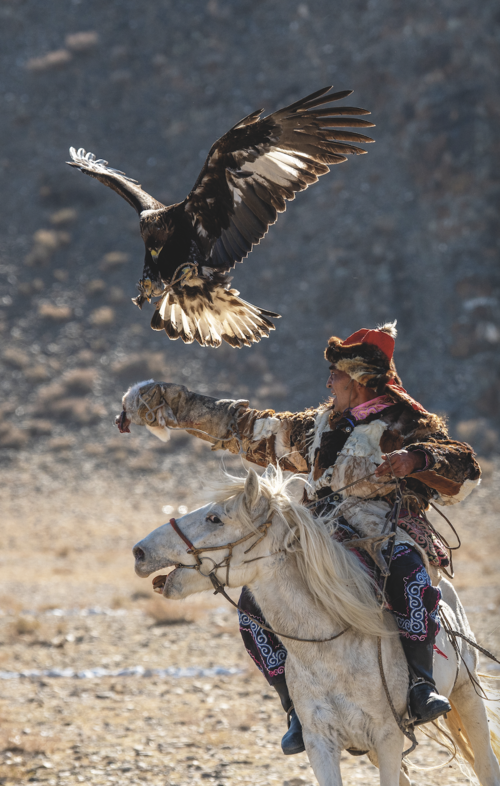
Beside us, 18-year-old Baurlas, a relative of Aykerim, rides with a golden eagle perched on his gloved arm as we head towards the mountains. We slow to a walk as we ascend the slopes, gaining a higher vantage point from which to scan the open ground below for foxes and other prey. The cold bites through our layers, and the only sound is the steady rhythm of hoofbeats.
As we crest a ridge, the eagle on Baurlas’s arm locks on to a fleeing fox. In a movement almost too quick to follow, it launches, wings slicing through the air before striking with precision. Baurlas gallops down the slope, Aykerim following close behind, riding bareback with remarkable control despite the steep, rocky ground. I rush after them, and within moments we reach the eagle and its prey. Expecting the fox to be dead, I’m surprised to see it still alive. To preserve the fox’s pelt, Baurlas distracts the eagle with a piece of meat, drawing it away and giving the fox a rare chance to escape, limping into the rocks. A narrow escape for the hunted, a fleeting mercy from the hunter.
Aykerim and Baurlas belong to a Kazakh family of semi-nomadic herders in Bayan-Ölgii, the westernmost of Mongolia’s 21 provinces, or aimags. The population here is predominantly ethnic Kazakh, and the borders of Mongolia, China and Russia meet in this remote region, with Kazakhstan lying just beyond.
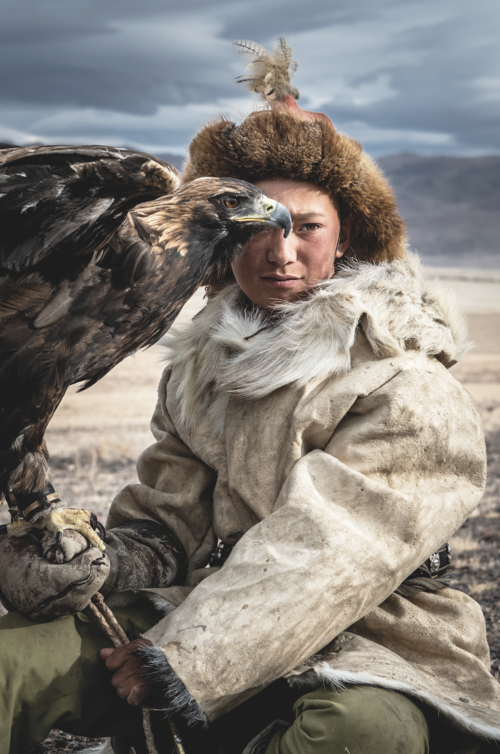
For the Kazakhs of the Altai, hunting with eagles lies at the heart of cultural identity. Known as berkutchi, eagle hunters form close partnerships with their birds, built through patience, care and mutual understanding. Golden eagles are deeply respected and treated as companions, with bonds that can take years to form.
Traditionally, these skills were passed from fathers to sons, with boys introduced to the practice from as young as ten. Today, that pattern is beginning to shift. Girls like Aykerim are increasingly taking part, learning the craft and gradually reshaping how it’s passed on.
The process begins early, for both bird and hunter. Young eagles are taken from nests high on remote cliffs or trapped in nets, marking the start of a long and delicate partnership. Training relies on quiet communication as much as discipline. The hunter learns to read subtle shifts in posture and changes in the bird’s gaze, building trust over time.
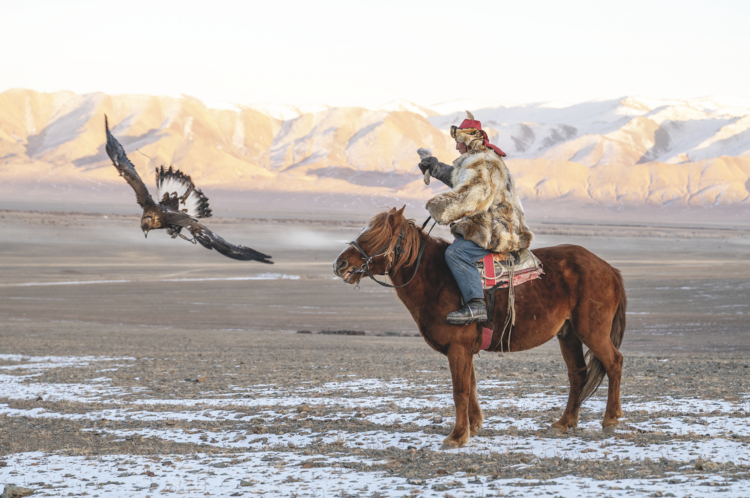
‘You must stroke the eagle’s chest and head every day to build trust,’ master hunter Khairatkhan tells me. Calmness and consistency are essential. Trust is earned, never assumed. That trust shapes every interaction, from high-speed hunts to the smallest daily routines.
Feeding, for example, is methodical. Hunters often rinse blood from raw meat to control how much the eagle eats, keeping its weight and appetite at the optimum level for hunting. The bird relies on the hunter for food and care, while the hunter depends on the eagle’s speed, vision and strength to catch prey such as hares and foxes.

‘If my eagle feels bad, I feel bad,’ says hunter Serik Jenisbek. ‘If she’s happy, I’m happy. When we go to the mountains, we share everything together.’ Alakosh, another hunter, says he cares for his eagle ‘as if she were a baby’.
Female golden eagles, preferred for their larger size and strength, can weigh up to seven kilograms, with wingspans of more than two metres. Whether perched on a hunter’s arm or cutting through the mountain air, they move with remarkable precision, well suited to the harsh conditions of the Altai.
‘All eagle hunters say an eagle can live for 100 years,’ says hunter Jargilsan, ‘but I don’t know if it’s true.’ In reality, they usually live up to 30 years in the wild, and sometimes longer in captivity.

The practical uses of hunting are still central to daily life. Fox pelts, valued for their warmth, are often used to make winter coats and hats, hand-stitched by women in the family. These garments are practical and carry the marks of labour and skill. Winters are long and unforgiving. In the colder months, families live in sheltered valleys, tending to their animals and preparing for temperatures that can drop below –30°C. Life revolves around physical work: collecting and carrying snow from the mountains for water, gathering dung and firewood, herding sheep and goats, and caring for horses, which remain central to both survival and identity.
Watching Aykerim ride across the valley, I’m often reminded of my childhood in Wales, where my days were spent on horseback, moving through open countryside and forming a connection with animals and the natural world. It’s part of what first drew me to Mongolia.
Long before I arrived, I had been captivated by images of Kazakh horsemen with golden eagles perched on their arms, set against snow-capped peaks. It felt like a place where the relationship between people, animals and land was deeply entwined, where cultural heritage was lived rather than remembered.
When I first travelled to the Altai in October 2019, after several years documenting war and displacement in northern Iraq, I was searching for a different kind of story: one still rooted in survival, but far removed from conflict. Over time, that search deepened and became more personal, as I returned to the same families year after year.
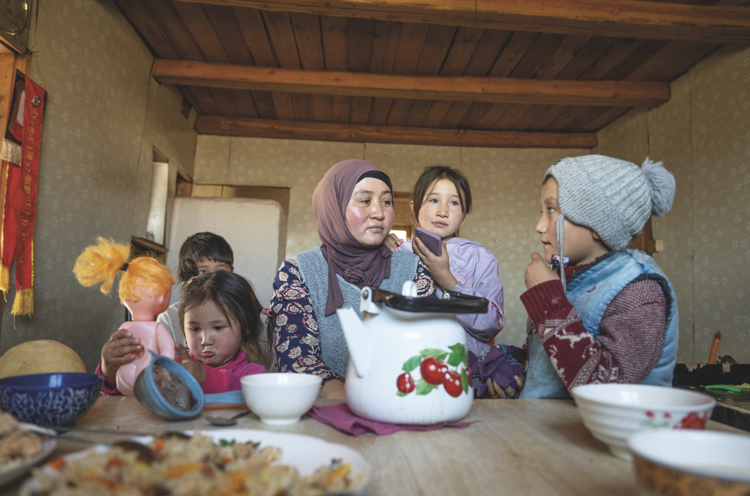
One family in particular became central to this journey: the household of eagle hunter Alakosh, his sons Arkalak and Dastan, and their grandmother Baygan.
Baygan was the heart of the home, gentle and wise, with a quiet sense of pride. From the first moment we met, I felt an unspoken closeness with her. We couldn’t share many words, but we shared smiles, gestures and a mutual understanding that went beyond language.
When I returned to the Altai in October 2024, a few months after her passing, I was moved to find one of my photographs of her framed inside the family’s ger, a traditional circular felt home. It was a simple but powerful reminder of what photography can do – not just documenting lives, but connecting and preserving them.
In the same valley, Khayni, a herder and matriarch, moves quietly between tasks, preparing food, tending to the children and managing the rhythms of the household. Several generations live under one roof, and her role, like that of many women here, is central yet often understated.
Yet even in these remote regions, change is present.
On my first visit, most families relied almost entirely on horses for transport. Today, motorbikes are increasingly common, offering speed and convenience across the open terrain. Homes that were once lit by a single bulb powered by a car battery are now, in some cases, connected to electricity, and mobile phones have become part of daily life, linking families to towns and to each other.
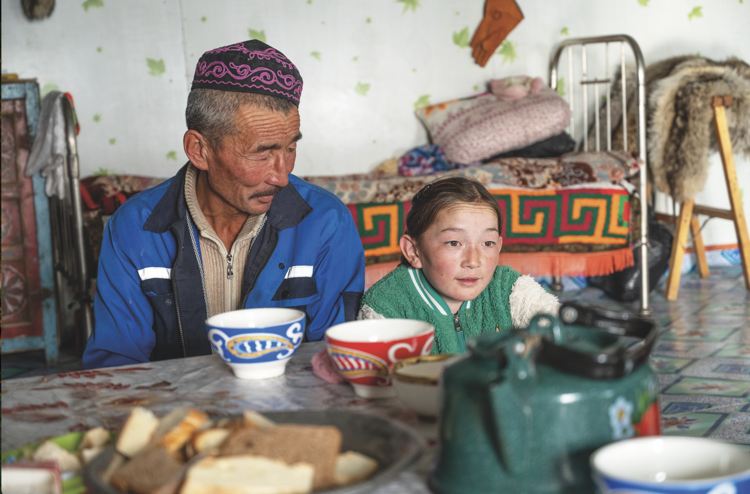
Perhaps the most significant shift is seen in education. Many families now send their children to boarding schools in nearby towns, sometimes hundreds of kilometres away. For parents, this represents opportunity, but it also introduces distance – both literal and cultural.
Despite having lived his whole life in the mountains, Alakosh hopes for a different future for his children. ‘I don’t have an education and I’m not young anymore,’ he tells me. ‘If I was young maybe I’d go to Ölgii to work, but for me it’s better to stay in the countryside. Life here is very hard, especially for children. That’s why I send my children to school. If they finish university, I hope they’ll find jobs in the city.’
As younger generations spend more time away from home, practices such as eagle hunting, which require years of commitment, are inevitably shaped by these shifting priorities.
Not all choose to leave. Some, like Arkalak, now 18, remain in the mountains, continuing to live as herders, hunting with eagles through the winter months. ‘All Kazakhs love to train eagles,’ his father Alakosh tells me. ‘Now we keep eagles mostly because it’s a traditional sport.’
I first met Arkalak when he was 12, during my first visit. Even then, his composure and focus stood out. After riding into the mountains, his father carried the eagle to higher ground while Arkalak waited below, calling the bird with a sharp command. The eagle launched from the ridge and landed flawlessly on his outstretched arm. Over the years, I’ve watched him grow into a skilled berkutchi, carrying his family’s traditions with quiet confidence.

In recent years, tourism has also become part of this evolving way of life. Eagle hunting, once purely a means of survival and cultural expression, now provides a source of income for some families. Travellers come from afar to witness the spectacle of hunters on horseback, particularly during the annual eagle festival in the town of Ölgii, first held in 1999. While this offers economic support, it also brings new dynamics and questions of authenticity and representation. What visitors see is often only a glimpse, shaped for an audience, rather than the full reality of a practice rooted in necessity, pride and lived experience.
According to Kazakh tradition, the eagle is one day to be returned to the wild. This final ritual usually comes after five to ten years of partnership. The moment is both solemn and symbolic: a hunter rides alone to a remote mountain peak, gently removes the eagle’s hood and sets it free – an act of gratitude, reverence and farewell.
They rarely see the bird again.
As the light begins to fade, Aykerim and Baurlas turn their horses towards the valley, riding side by side across the open plain. The pace is slower now, the urgency of the hunt giving way to a quieter rhythm.
In the distance, Aykerim’s family home appears, a small cluster against the open expanse. Her mother stands outside, watching for their safe arrival.
There is still work to be done. The day folds back into the rhythms of daily life, where the hunt sits alongside the tasks that sustain it all. The horses are unsaddled and let out to graze, their breath visible in the cold air.
The eagle may be the eye in the sky, but it is the horse that continues to carry the hunter and tradition across the land, as it has for generations.


