

• Skip to main content
  • Skip to secondary menu
  • Skip to primary sidebar
  • Skip to footer
Geographical

Geographical

Official magazine of the Royal Geographical Society (with IBG)

  • Home
  • Briefing
  • Science & Environment
  • Climate
    • Climatewatch
  • Wildlife
  • Culture
  • Geopolitics
    • Geopolitical hotspots
  • Study Geography
    • University directory
    • Masters courses
    • Course guides
      • Climate change
      • Environmental science
      • Human geography
      • Physical geography
    • University pages
      • Aberystwyth University
      • Brunel University
      • Cardiff University
      • University of Chester
      • Edge Hill University
      • The University of Edinburgh
      • Newcastle University
      • Nottingham Trent University
      • Oxford Brookes University
      • The University of Plymouth
      • Queen Mary University of London
    • Geography careers
      • Charity/non-profit
      • Education & research
      • Environment
      • Finance & consulting
      • Government and Local Government
    • Applications and advice
  • Quizzes
  • Magazine
    • Issue previews
    • Subscribe
    • Manage My Subscription
    • Special Editions
    • Podcasts
    • Geographical Archive
    • Book reviews
    • Crosswords
    • Advertise with us
  • Subscribe
    • Direct Debit Changes

Ozone layer remains on track to recovery in coming decades

16 September 2025
2 minutes

A new report confirms that concerted global action, driven by science, has put the Earth’s ozone layer on a successful path to recovery


A new report from the World Meteorological Organization (WMO) confirms that after decades of global action, the ozone layer is showing significant signs of recovery. ‘This achievement reminds us that when nations heed the warnings of science, progress is possible,’ says UN Secretary-General António Guterres.

For years, stratospheric ozone – the layer that shields us from the sun’s most harmful ultraviolet (UV) radiation – was being stripped away by human-made chemicals found in everything from refrigerators to hairspray. Scientists sounded the alarm in the 1970s, warning the world of the danger to people’s and the planet’s health.

The international community came together to sign the Vienna Convention, an agreement that recognised ozone depletion as a global crisis and laid the groundwork for a united scientific effort. This was followed by the Montreal Protocol, a landmark agreement that has since been hailed as one of the most successful environmental treaties in history. To date, this protocol has led to the global phase-out of over 99 per cent of the ozone-depleting substances that were wreaking havoc on our atmosphere.


Want to know more? Check out our related reads:

  • Geo explainer: What is the ozone layer and what’s happening to it?
  • What is the environmental cost of space travel?
  • The innovative solutions tackling climate change

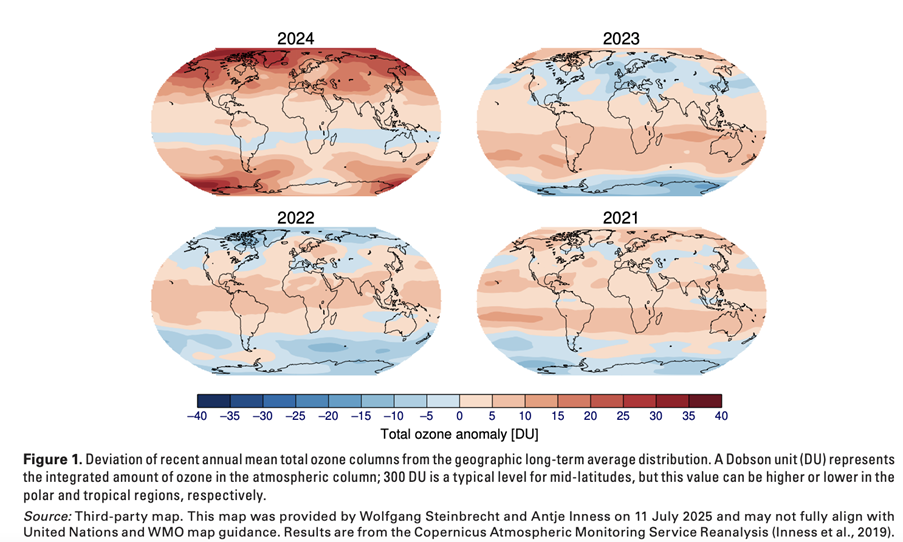
The WMO Ozone Bulletin 2024, released on World Ozone Day and the 40th anniversary of the Vienna Convention, highlights the long-term positive trend in ozone recovery. The Antarctic ozone hole, which forms annually during the Southern Hemisphere spring, had an Ozone Mass Deficit (OMD) of 46.1 million tonnes on 29 September, a figure below the 1990–2020 average. While natural atmospheric factors contribute to year-to-year fluctuations in the ozone hole’s size, the overall trajectory is a clear reflection of successful human intervention.

Continued atmospheric monitoring remains a vital component of this success. The WMO’s Global Atmosphere Watch Programme provides the essential data that informs policy-making and verifies the effectiveness of the Montreal Protocol. As Matt Tully, Chair of WMO’s Scientific Advisory Group, says: ‘There remains an essential need for the world to continue careful systematic monitoring.’

According to the most recent scientific assessment in 2022, if current policies remain in place, the ozone layer is expected to recover to 1980 levels – before the appearance of the ozone hole – by around 2066 over the Antarctic, 2045 over the Arctic, and 2040 for the rest of the world. This timeline, grounded in comprehensive scientific analysis, offers a clear and achievable goal for the international community.
Themes Science & Environment

Protected by Copyscape

Primary Sidebar

OUR UK DIRECT DEBITS ARE CHANGING
BLACK FRIDAY SALE

Geographical subscriptions

GEOGRAPHICAL WEEKLY LOGOFREE - Sign up to get global stories, told well, straight to your inbox every Friday

Popular Now

A minke whale, entangled in fishing gear, found dead on a beach on Sanday in Orkney

Why are whales stranding along Scotland’s coast?

QUIZ: Country Spotlight – Malaysia

QUIZ: Country Spotlight – Malaysia

Warren Beach, Folkestone

Where the dinosaurs last walked in Britain

QUIZ: Flags of the World – Central America

QUIZ: Flags of the World – Central America

Review: Our Bodies, Our Planet

Review: Our Bodies, Our Planet

Footer

  • Facebook
  • Instagram
  • LinkedIn
  • Reddit
  • TikTok
  • Twitter
  • YouTube

Geographical print magazine cover

Published in the UK since 1935, Geographical is the official magazine of the Royal Geographical Society (with IBG).

Informative, authoritative and educational, this site’s content covers a wide range of subject areas, including geography, culture, wildlife and exploration, illustrated with superb photography.

Click Here for SUBSCRIPTION details

Want to access Geographical on your tablet or smartphone? Press the Apple, Android or PC/Mac image below to download the app for your device

Footer Apple Footer Android Footer Mac-PC

More from Geographical

  • Subscriptions
  • Get our Newsletter
  • About Us
  • Contact Us
  • Advertise with us
  • Privacy policy
  • Terms & Conditions

Copyright © 2025 · Site by Syon Media