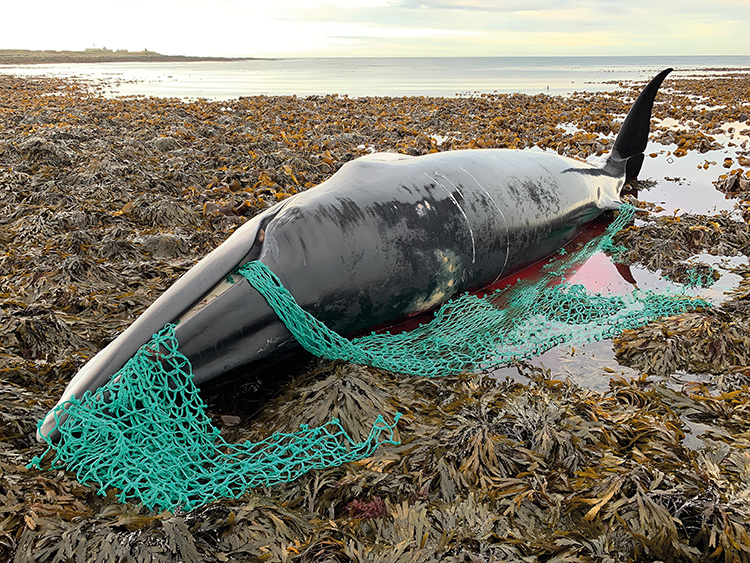
Mark Rowe investigates the surge in whale strandings along Scotland’s coast — a warning sign, scientists say, of deeper changes in the North Atlantic ecosystem
A sighting of a pilot whale along the shoreline of Orkney should be a source of joy and wonder at the beauty of the natural world. Yet the two lone pilot whales spotted in waters off the Orkney islands of Westray and North Ronaldsay in August this year appear to tell a darker tale.
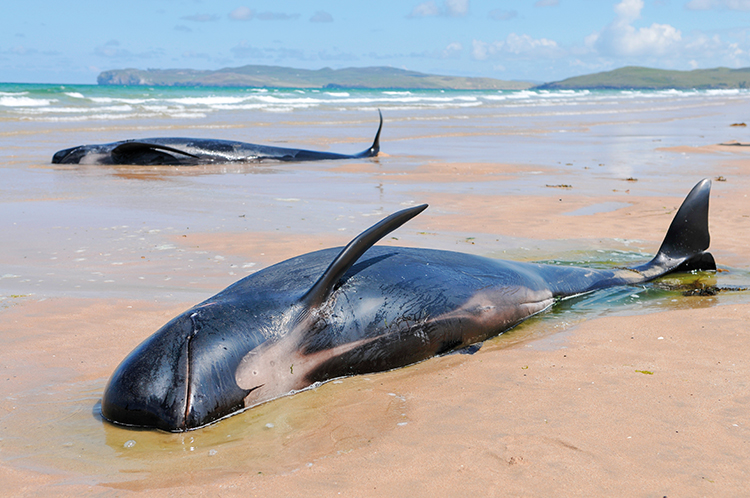
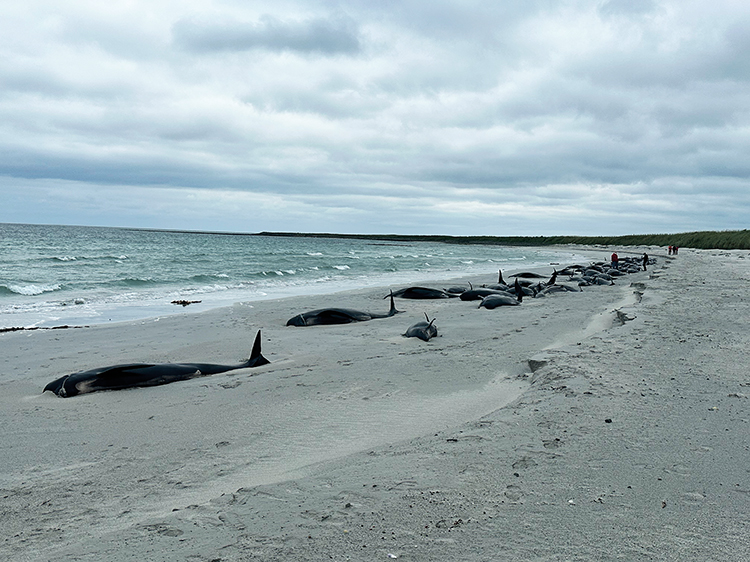
The two cetaceans are believed to have been survivors from a pod of pilot whales, 23 of which were found washed up on Roo Beach, at the northern end of Sanday, another Orcadian island, that same month.
The mass stranding came at a grim time, near the anniversary of the death of 77 pilot whales at Tresness in the southeast of Sanday in July 2024. The two events are part of a bleak trend: a marked increase in cetacean strandings, not only in Orkney but all around Scotland’s coastline.
Enjoying this article? Check out our related reads…
Other strandings this year include a female pilot whale and her calf at North Ronaldsay in Orkney and three bottlenose whales on its neighbour, Papa Westray. In July 2023, 240 kilometres away to the southwest, there was a stranding of 55 pilot whales at Tolsta on the Isle of Lewis. Only 15 of those whales were alive when they washed ashore. One was successfully re-floated while the rest had to be euthanised.
‘It seems as if something has changed,’ says Sanday resident Emma Neave-Webb, who is also science and data officer for the Orkney Marine Mammal Research Initiative and strandings coordinator for the International Whaling Commission.
‘I’ve been living in Sanday for ten years and for the first few years, we didn’t see any strandings,’ she says. That changed in 2019 when a pod of pilot whales turned up. ‘They were still swimming, so we were able to herd them back to sea – after several attempts – to save them.’ From that point, she says, there has been a steady stream of strandings.
Anecdotally, an increase has been obvious to marine scientists and coastal communities for some time, but the trend was confirmed by a University of Glasgow study this summer, which showed that numbers of whales, dolphins and porpoises getting into difficulty have risen from about 100 a year to more than 300 over a 30-year period from 1992.
Datasets collected by the Scottish Marine Animal Stranding Scheme (SMASS) show that strandings are widespread around Scotland’s liminal edge, with impacts across all cetacean species. The paper, published in Scientific Reports and titled An Approach to Using Stranding Data to Monitor Cetacean Population Trends and Guide Conservation Strategies, makes for sombre reading.
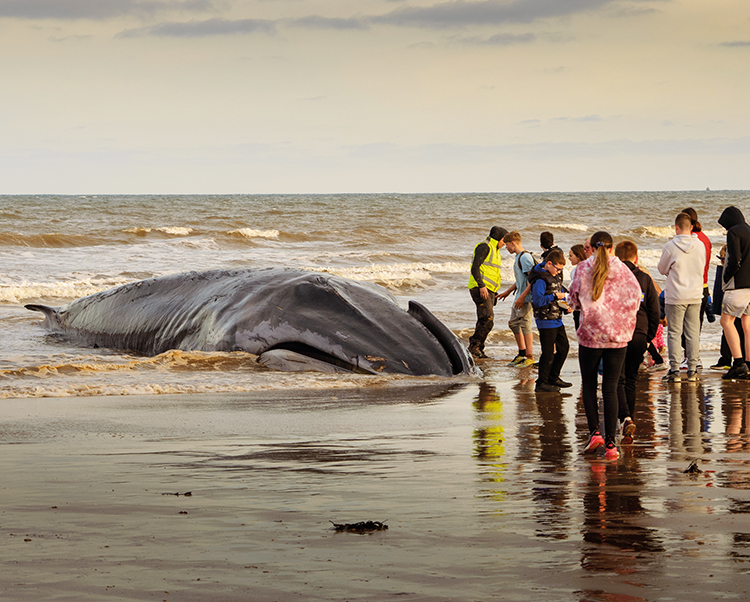
A total of 5,147 cetaceans were documented as having stranded in Scotland between 1992 and 2022. Harbour porpoises accounted for more than half (2,676, 52 per cent), followed by pelagic dolphins (1,217, 24 per cent), common dolphins (494, 10 per cent), baleen whales (479, 9 per cent), and deep diving whales (281, 5 per cent).
According to lead researcher Rachel Lennon, a PhD candidate at the University of Glasgow, the increase in strandings among common dolphins and baleen whales over the past ten years has been ‘exponential’, with strandings doubling roughly every 2.5 years. The data also revealed a disproportionate rise in strandings among juveniles. Deep divers and pelagic dolphins showed a steadier increase, while harbour porpoises had an oscillating pattern, but with an overall upward trend.
‘Strandings have always happened,’ says Lennon. ‘We’re just seeing a lot more of them nowadays and that’s concerning, particularly when it has population-level consequences. As more and more stressors are thrown at these animals, the balance of survival starts to tip the other way, and that’s when we have a problem.’
Most observers believe that no single issue is the main driver, but that instead, a complex interrelation of factors is behind the strandings, including island topography, declining fish stocks, bycatch and entanglement in fishing gear, sonar from naval activity, plastic and chemical pollution, and wind turbines.
Local reporting bias is part of the picture, says Neave-Webb. ‘It’s great how social media allows us to report and monitor more, but it does mean that when a whale dies in a remote place, it gets reported, when in the past no-one would have found it.’
Almost certainly, warming waters associated with climate change underpin the increase. The strandings of bottlenose whales in Papa Westray point to the potential impact of anthropogenic change, according to Andrew Brownlow, director of SMASS. ‘The bottlenose whale is a deep-diving mammal endemic to the North Atlantic and usually found at 800 feet [244 metres] below sea level, where there are no predators, feeding on squid. [The Papay whales] were way out of their normal feeding zones,’ he says.
Species from lower latitudes are increasingly being spotted in Scottish waters, says Neave-Webb. ‘We’re starting to see distinct changes. The striped dolphin is a warm-water species that was never seen in Sanday. White-beaked dolphins, Atlantic white-sided dolphins and common dolphins are also moving north.’ In such instances, a combination of climate change and bad luck may explain strandings – they follow fish into shallow sandy bays and suddenly get caught out.
‘It’s complicated,’ she adds. ‘You get a youngster [cetacean] that will stray and turn up, expanding the species’ range, looking for food. It ends up in an area that is more built up, or an island topography that is new to it, and gets trapped.’
If you were to design an island coastline specifically to confound cetaceans, it would probably look something like Sanday, with 25 beaches, long peninsulas, shallow seas and fast tides, suggests Neave- Webb, and that explains why the island sees more strandings than the rest of Orkney.
‘Toothed whales are particularly reliant on echolocation, and shallow, sandy bays are dangerous for them. The water gets mashed up and churned, and that scrambles their echolocation – they essentially become blind.’
Offshore wind turbines are possibly part of the picture. One argument is that they disorientate cetaceans; another is that they act as coral reefs, attracting more fish, hence more cetaceans, who are then inadvertently exposed to inshore, treacherous shallow waters. Entanglement in fishing gear associated with the inshore creel industry is an undisputed issue, with an average of six humpback whales and 30 minke whales becoming entangled annually in floating ground-lines between pots (although Brownlow estimates entanglement rates are hugely under-reported, by as much as 95 per cent). Fishing gear is, however, one area where interventions are making a difference (see TURNING THE TIDE).
Could increasing strandings be – counter-intuitively – in part a positive story? As cetacean populations begin to recover from the effects of historical whaling, reports of entanglement and strandings generally
have increased. ‘The moratorium on whaling came in 1986 and we’re now seeing increases – big population numbers that haven’t been seen in living memory,’ says Brownlow. Neave-Webb agrees this is part of the jigsaw. ‘Everywhere you have live animals you’ll have dead animals,’ she says. ‘There will always be an element of strandings. The thing we have to try to do is mitigate the human-impact element of strandings, such as noise pollution and vessel strikes.
TURNING THE TIDE
Trials of new creel gear around Scotland’s coasts suggest that a small change could make a big difference for whales. A study by the University of Glasgow found that 80 per cent of entanglements involving minke whales and basking sharks occur in floating lines linking crab and lobster pots. By contrast, early trials of sinking groundlines – ropes weighted with lead or zinc to rest on the seabed – have shown promising results.
During a 15-month pilot, 61 sets of gear were re-roped, with more than 1,500 hauls completed and few problems reported. Around 80 boats are now trialling the approach, and fishers say the lines not only make creels more stable but also attract more lobsters and crabs.
‘Strandings will always happen,’ she adds, pointing to the factors that make Scotland so ripe for them. ‘We have the continental shelf, deep water, a big range of species, the transition from warmer to cooler waters. Our waters are also warming, species are seeking higher latitudes – that all means Scotland is prime territory for more strandings. People have got to be prepared for it.’
As fish species move north, more cetaceans and pinnipeds follow them, says Brownlow. Addressing the man-made contribution to strandings needs to recognise this and involve fundamental changes to how we use the resources in the oceans, he says. ‘The waters of northern Scotland are changing in ways we don’t really understand and which may be quite profound,’ he says. ‘We’re dealing with a different set of rules – a change of prey, different predators coming in.’
Consequently, Brownlow argues that a rethink is required as to when and where fishing takes place, which species are targeted and the timing and location of marine industrial work such as pile-driving for wind turbines or port infrastructure. ‘A blanket ban won’t work,’ he says. ‘This all has to happen in ways that protect people’s livelihoods – fishing keeps other parts of communities going.’
Change will come, he believes. ‘We don’t need to be fatalistic. The advantage of marine animals is that they capture the public imagination – they’re the poster child for solving environmental problems.’