Every autumn, millions of monarch butterflies set off on a 4,800-kilometre journey to Mexico. But the forests and wildflower corridors that sustain them are changing rapidly – and the migration may be running out of time
By
Slowly, the cloud started to lift and a few timid shafts of sunlight threw a spotlight onto the fir trees that covered these high mountain slopes in central Mexico. The temperature, which just moments earlier had been cold enough to cause my breath to condense, began to rise quickly as the sun gained in confidence.
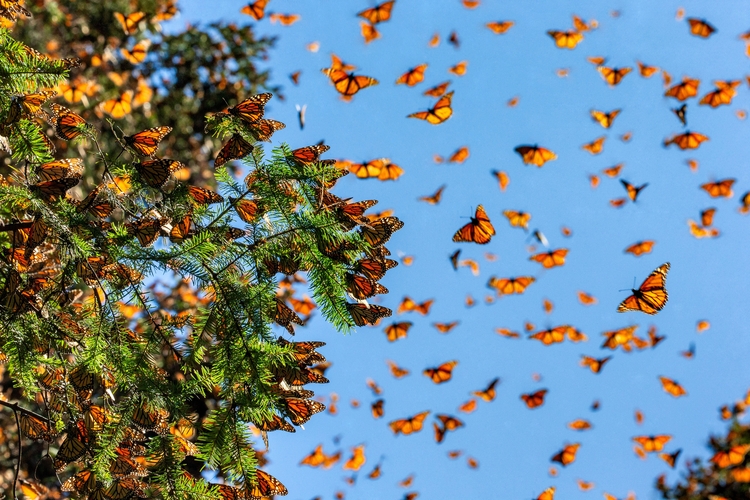
As it got warmer, a movement began to sweep through the boughs of the trees. It wasn’t one single motion; it was more of an undulation, a living, swirling wave of energy rippling along the branches of the trees. And then, suddenly, 100,000 monarch butterflies took to the air as one. Some of the more unfortunate ones were carried away on the gentle breeze until they were high above the canopy. Others gave only a few exhausted flaps of their wings before spinning down to the ground, where a host of predators awaited an easy lunch. But most of this insect mass flitted with ease around the trees in such numbers that the air all around me became a living rainbow.
Enjoying this article? Check out our related reads…
Monarch butterflies occur across large parts of North America, as well as parts of Asia, Africa and even southern Europe, but it’s the monarchs of the eastern USA that have long fascinated scientists and the general public alike.
‘I guess I’ve always been fascinated by monarch butterflies,’ Karen Oberhauser told me over the phone from her home in the northeast of the USA. ‘I live in Michigan, where the monarch butterflies spend the summer, and as a child I remember always seeing monarchs in the yard or in the fields. They were just a part of summer life around here, so they seemed like a natural thing to study.’
And study them she has. As Professor Emerita in the Department of Entomology at the University of Wisconsin–Madison and as the treasurer of the Monarch Butterfly Fund (a US-based science and conservation NGO focused on monarch butterflies throughout their range), Karen is one of the world’s leading monarch butterfly experts.
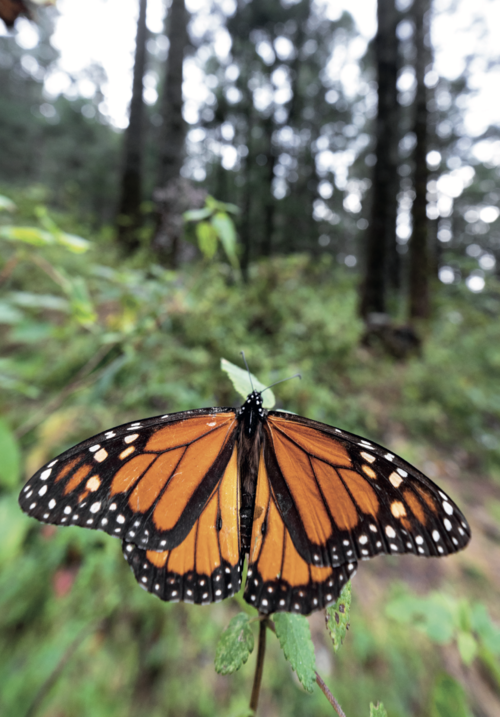
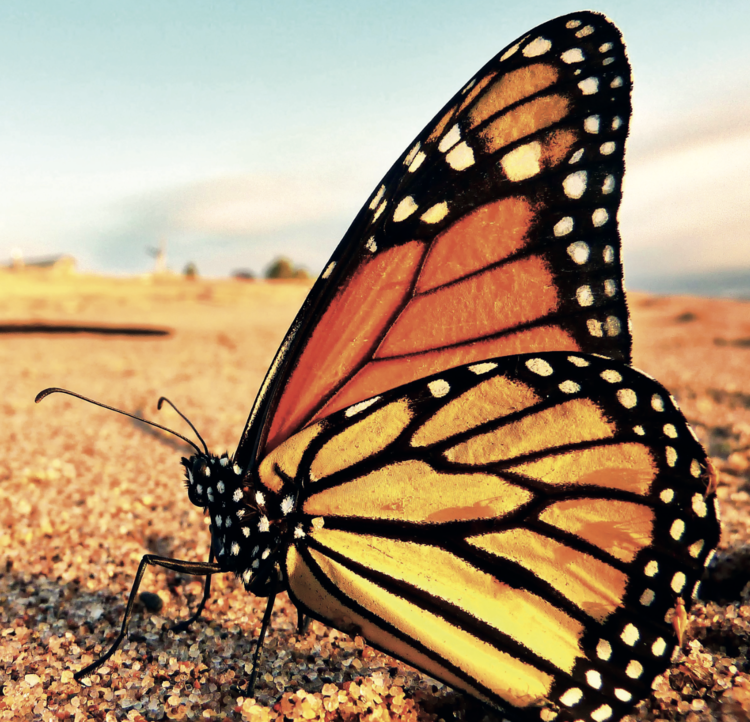
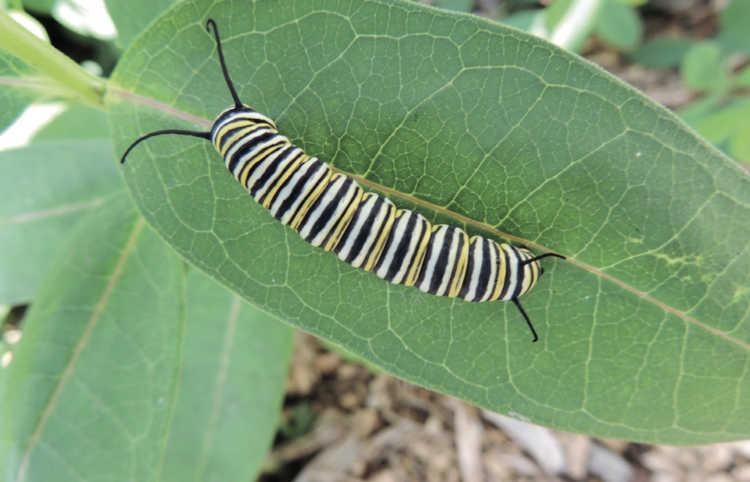
Monarchs go through several radically different stages of life. After hatching from a tiny egg, they spend the first couple of weeks of life as a caterpillar. During this stage, they feed ravenously on milkweed plants, scrubby, toxic plants commonly found on roadsides, field edges and other marginal lands throughout the USA and southern Canada (there are 73 species of milkweed in North America, with about half of them being used by monarch butterflies).
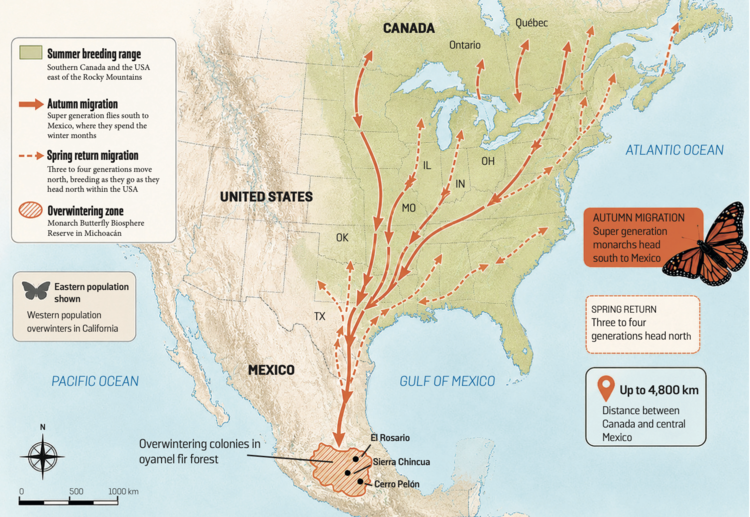
After they’ve fattened up enough, they turn into chrysalises and then, two weeks later, emerge back out into the world as beautiful butterflies. Of course, there’s nothing unusual in this. All butterflies and moths go through these same life stages. But what makes the monarchs living east of the Rocky Mountains unique among butterflies is their migration. From the corn fields of Michigan, the butterflies fly south all the way to central Mexico. It’s a journey of around 4,800 kilometres. Few other butterflies undertake anything comparable – this is the kind of journey normally associated with birds rather than insects.
The reason the butterflies migrate is because in summer, nectar-rich flowers, which the butterflies rely on for food, abound in the northern USA, as does the milkweed plant that the caterpillars are reliant upon. But come winter, Michigan, alongside much of the rest of the northern USA, is a hard, cold and snowy place – everything a sun-loving monarch butterfly hates. But while most butterfly species simply die off or go into a deep hibernation, the monarchs have other ideas and head to a handful of very specific, forested mountain slopes in central Mexico where the climate – not too hot, not too cold, not too dry and not too wet – is the ideal place to rest up for the winter.
For the most part, the butterflies spend the winter in a state of semi-hibernation, clinging to the branches of the oyamel fir trees that cover the mountain slopes. They seem to prefer certain trees, and they gather on the branches of these trees in such numbers that their combined weight has been known to snap the branches. Every now and then, though, when the afternoon sun warms the forest enough, the butterflies get a burst of energy and take off by the thousands, as I had witnessed on the day I visited the butterfly colonies. Then, in about March, as the days get steadily longer and warmer, the butterflies head back north again for the summer.
Remember how earlier on we compared monarchs to birds? Well, perhaps that statement does these beautiful butterflies a disservice because their annual migration is, in some ways, even more baffling than many avian migrations. The thing is that no single butterfly lives long enough to complete the entire there-and-back migration. Instead, this is a multi-generational migration. The first generation of monarchs, which lives for between six and nine months and is known as a ‘super generation’, are born in Michigan and surrounding states in late summer. Then, as autumn puts a chill in the air, the butterflies fly south to Mexico.
When winter ends, those same butterflies say adios to Mexico and fly around 1,000 kilometres north again to the southern USA, where they breed, lay their eggs on the milkweed plant and then die. From that moment on, it takes a further three to four successive generations of butterflies – each living only three to six weeks – to slowly continue their northbound journey back to the northern USA and southern Canada, where the next ‘super generation’ is born. The thing that baffles scientists about a multi-generational migration such as this is that with the death of each generation, there are no older butterflies present to guide the next generation on their journey. Somehow, and for the moment nobody really knows how, each new generation appears to have an imprint built into it that guides it along the next stage of the route.
Thanks to their bright colours, relatively large size and extraordinary migration, monarchs have become probably the most recognisable butterfly species in the world. And, as I stood in the forests, surrounded by countless tens of thousands of butterflies, it was hard to imagine a world without migratory monarchs. But behind the clouds of butterflies, the news is less colourful.
It’s virtually impossible to do a head count of individual butterflies and so, to come up with an idea of the size of the eastern monarch population, scientists calculate the number of hectares occupied by monarchs at their overwintering sites in Mexico. It’s estimated that six hectares is the minimum amount required to sustain the population. Between the winters of 1993/94 (when the surveys began) and 2006/07, the population was generally above or level with this minimum (only two winters saw the population fall notably below this six-hectare requirement), but since then, the population has consistently been considerably lower than that requirement every single year except during the winter of 2018/19.
‘The population of monarchs has always fluctuated on a year-by-year basis,’ Oberhauser told me. ‘But today it’s different. I think there’s a good chance that monarchs will be in a lot of trouble in 20 years’ time,’ she says with a tone of resignation in her voice. ‘The population used to fluctuate at a high value. Now the population has steadily dropped and fluctuates around a low value. The problem with that is if something terrible happens in a year when the monarch numbers are low. A big freeze in the mountains of Mexico, for instance, or a drought in the areas where they spend the summer. Then it could be catastrophic.’
Oberhauser goes on to tell me that such events have occurred in the recent past, but that fortunately they’d only ever happened in years when there were a lot of butterflies and so the population had always managed to recover. But, Oberhauser continues, ‘In the next 20 years, I think there’s a very good chance we will have a serious event like this when the population is already low and they won’t be able to recover.’
As I walked through the oyamel fir forests where the butterflies overwinter, it was hard for me to understand what was causing this steep decline in butterfly numbers. The forests here appeared to be well cared for and the butterflies highly protected. And, with so many local families earning a living through butterfly conservation, tourism or forest maintenance, it was hard to imagine what the threat might be. Oberhauser, who visits the forests every winter, agreed: ‘In Mexico, they’re doing a great job of protecting the forests and butterflies. The problem in Mexico is climate change. The butterflies need to overwinter in a very specific type of climate and as central Mexico warms, that sweet spot where the conditions are just perfect for the butterflies moves ever higher up the mountains.’
But if things continue to heat up, then eventually there won’t be any more mountain left to climb. Oberhauser takes up the story again: ‘This year, when I went to the El Rosario Reserve [the most celebrated of the several butterfly reserves in central Mexico], the butterflies were higher up the mountain than I have ever seen them and at the Cerro Pelón Reserve there weren’t really any butterflies at all. It was just so hot there this year. It was over 70°F [21°C], which is not normal for those mountains in winter. The butterflies really didn’t look well. They were all so skinny because they’d been flying around so much. It’s interesting to see them flying in warm sunshine, but they shouldn’t be doing that. They should be resting on the branches of the trees to conserve energy.’
Oberhauser explained to me that the Monarch Butterfly Fund (of which she is the treasurer) is experimenting with assisted migration, which means planting oyamel fir trees higher up the mountain to see if, as the local climate warms, they will grow there and the butterflies use them. In 2025 alone, more than 50,000 native trees were planted in and around these mountains and local communities are deeply engaged in butterfly conservation. Summarising the situation in Mexico, she tells me that while climate change is definitely a problem, ‘Overall, I would say that they’re doing a much better job in Mexico [of conserving butterfly habitat] than we are in the United States.’

Milkweed, the vital food source for the monarch caterpillars, used to be abundant throughout the US Midwest, but industrial-scale agriculture, urban and other developments, roadside mowing and the widespread use of pesticides and herbicides have all combined to lead to a huge drop in suitable monarch habitat, both in breeding areas and along migration corridors. In the past, fields tended to be smaller, and ploughing was used to rid the land of weeds.
Smaller fields meant more field edges where milkweed and other wildflowers could grow, and ploughing meant it was easier for milkweed to survive – all good news for the butterflies and their friends. But with the arrival of industrial-scale agriculture and fields so big it can be difficult to see the far side, those pockets of wildness began to decrease. But the thing that has really changed the picture for monarchs is the use of herbicides and pesticides. Oberhauser explains: ‘Farmers have to make money and to do so they need to grow crops. The more the better. But, in some cases, they have been convinced that the only way to do this is by using glyphosate-based herbicides to kill off weeds, including milkweed.’

Glyphosate is Roundup’s key active ingredient. Its use is more tightly restricted in parts of Europe than in the USA, but it remains widely used in US agriculture to clear weeds from fields. ‘Weeds are becoming resistant to Roundup,’ says Oberhauser. ‘So now they’re using even more toxic herbicides and pesticides as well as genetically modifying the crops.’ In late 2024, the US Fish and Wildlife Service proposed listing the monarch as threatened under the Endangered Species Act, but the decision has yet to be finalised. Oberhauser explains that unless restrictions similar to those that we have in Europe are brought in to control the use of Roundup and other pesticides and herbicides, then the picture for monarchs is unlikely to improve.
‘But,’ she says, ‘with the current political climate in the US, that’s unlikely to happen.’ That doesn’t mean the fight is lost, though. ‘People love monarchs,’ Oberhauser states. ‘People recognise them. Okay, it’s changing a bit now as they become less common, but people do still see them in their yard. The caterpillars are very distinctive. People recognise them when they hardly recognise any other insects. They’re beautiful, they’re impressive. And they notice the change – that they don’t see them as much as they used to. But, because they’re such a recognisable species, it’s quite easy to get people interested in conserving them.

In that sense, they rate right up there with elephants and wolves.’ She goes on to explain that a lot of the work of the Monarch Butterfly Fund in the USA and southern Canada is spent trying to convince people to grow native plants, including milkweed, wherever possible. The organisation is also pushing to ensure that land that’s been set aside by farmers, private gardens, unused government land, marginal lands and even rights of way – which can act as corridors linking landscapes together – is maintained in a butterfly-friendly manner.
Seeing the butterflies massed on those Mexican trees had been one of the most impressive wildlife experiences of my life and I wondered how Oberhauser, whose life has been devoted to the butterflies, would feel if the world of tomorrow was one without the monarch migration. ‘The phenomenon of the migration is such an incredible thing and we still have so much to learn about it. Monarchs just draw people – the amazing fact of their migration, their beauty, the fact that people like them and are familiar with them. They are a bridge between people and the natural world and so it would be profoundly sad if, in 20 years’ time, that bridge was broken and there were no monarch butterflies. We have tried so hard to save them and it would be a scary thing if all our collective efforts couldn’t save them. The world will have lost something amazing and beautiful.’