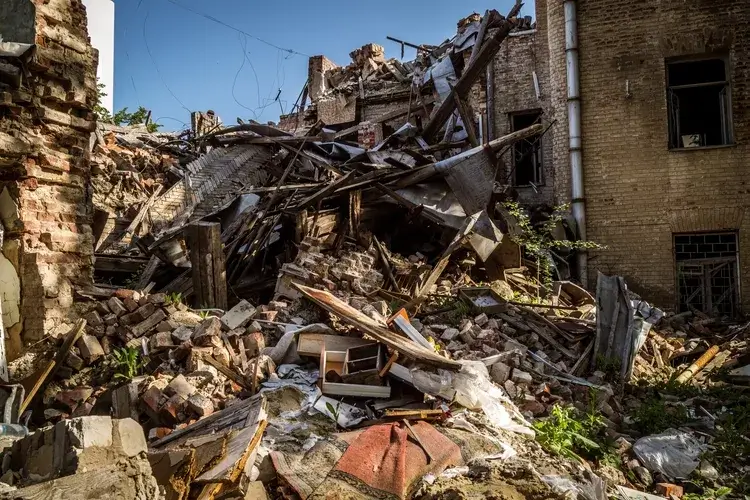

As Ukraine rebuilds amid continuing Russian attacks, communities such as Makariv are fighting to ensure their needs aren’t overlooked
By
Late on 28 August, a Russian jet-powered drone came down on an ammunition store in the village of Myla, twenty kilometres west of Kyiv. What followed was not one explosion but a night of them, as shells, mines and drone components detonated in sequence. Thirty-eight people were killed, thirty-four of them residents of the Dobryi Dim care home next door to the depot. Around 300 properties were damaged. Police closed the highway.
Keep driving west along that same road. At roughly the 51st kilometre, you come to a bridge that has been down since the spring of 2022, and shortly beyond it a town called Makariv, where an eight-kilometre commute has, for the last 4 years, become a 32km detour.
Enjoying this article? Check out our related reads…
The summer the numbers went up
July 2026 was the deadliest month for Ukrainian civilians since March 2022. UN human rights monitors verified at least 437 killed and 2,610 injured, a 70 per cent rise on July the previous year. Across the first seven months of the year, they counted 12,477 civilian casualties, up 44 per cent on 2025 and more than double 2024. The confirmed civilian death toll since February 2022 now stands at 16,874, and the UN calls that an undercount.
August brought no relief. Seventeen people died in Kyiv and the surrounding region on 19 and 20 August, as President Zelensky said his allies’ failure to replenish air-defence interceptors was costing lives. By 1 September the capital was on its sixth consecutive day of strikes. The energy system is being dismantled in parallel: national generating capacity has fallen from roughly 55 gigawatts before the invasion to under 20 by the middle of this year.
Four and a half years in, these numbers rarely break into headlines, and instead the conflict and its reconstruction rumbles on unseen by most.
Where the war goes when it leaves the page
Damage does not stop being damage when the cameras leave. Within days, Myla’s 300 wrecked properties become survey visits, registry entries, damage categories and, eventually, lines in a national costing.
That machinery is now vast. The most recent joint assessment by Ukraine’s government, the World Bank, the European Commission and the UN put reconstruction needs at almost $588billion over the coming decade, nearly three times Ukraine’s estimated GDP for 2025, with transport alone above $96billion. June’s Ukraine Recovery Conference in Gdańsk generated around 160 agreements worth over €10billion, alongside the first tranche of the EU’s €90billion support loan.
The new battle for many communities in Ukraine is how to access this money and ensure that they are visible to the behemoth reconstruction efforts.
Kilometre 51
Makariv held back Russian forces for 33 days in 2022, keeping the Zhytomyr road out of Russian hands and slowing the advance on Kyiv. Yet the town remains largely unheard of. Bucha, Irpin and Borodianka became global shorthand for what happened north-west of the capital; Makariv’s resistance went unreported, and so have its consequences. An eight-kilometre commute is now 32. Some villages are nineteen kilometres closer to the fire brigade at Byshev than to their own. A hospital appointment in Kyiv is, as one resident put it, ‘a hellish journey’.
None of that shows on a satellite image and that absence is no longer only a problem of recognition, it has become a issue in seeking reconstruction funding.
Being destroyed is not the same as being fundable. Ukraine’s recovery money travels down a pipeline that begins with a local commission inspecting a damaged building and entering it in the Register of Damaged and Destroyed Property, and ends with a costed project posted on DREAM, the state’s digital ecosystem, where communities present themselves directly to donors and development banks. At every stage, the community must supply data of the right kind, in the right format, at the right time.
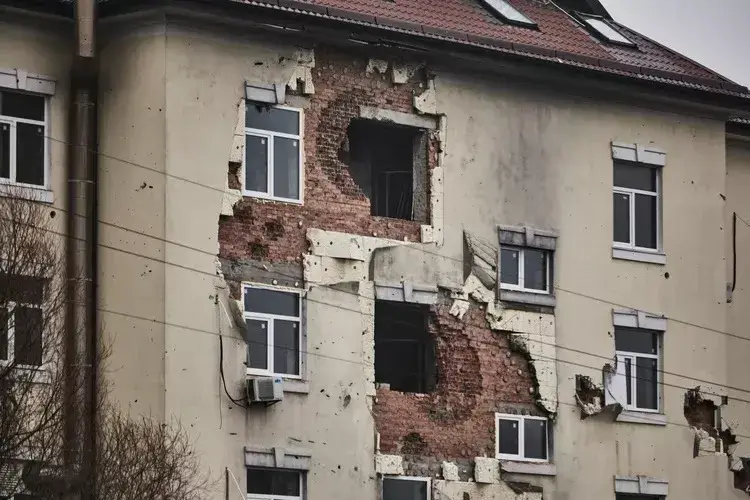
Makariv’s total reconstruction ask per resident sits well below that of comparable communities in the same district — not because it needs less, but because less of what it needs has been written down in a form the system can read. And where this can’t be read, it will not be funded.
My place of power is my house, published this month in English and Ukrainian, is an attempt to supply that missing half of the evidence. It came out of participatory workshops held in Makariv in July 2025 — thirty people over three days, ten at a time, gathered around a single A0 town plan printed at 1:7000 — and is built from residents’ own testimony, field audio and photographs. What they drew was not damage in the registry’s sense, but the shape the damage has given the town. The impact on daily lives, livelihoods and attempts to memorialise a conflict that it still taking many lives.
Writing on this site in April 2022, I argued that the way maps are drawn shapes how we understand a war. Four years on, that argument has migrated from territory to money. Cartographic absence was once a tactical asset. In a reconstruction economy, it is a liability.
Not if, but when
The residents of Makariv already know what they need. They know which road has to come back first, which shelter should be registered, and why the parks matter more than they look: Panskyi and Molodizhnyi, with the museum, the library lawns and a planned amphitheatre, have quietly become the town‘s memorials to those killed in a conflict that still rages. Holding the memories of 238 civilian dead without turning the settlement into one vast cemetery.
None of that knowledge is missing. It is simply unseen by the systems now deciding who and what gets rebuilt. Reconstruction is run as an accounting exercise, and given the sums it must be, but a town is not a portfolio of assets awaiting valuation. Makariv is a place built on ideas and the future, not on its worst month.
And the war goes on, another conflict is being fought over who is legible enough to rebuild. With such devastation that second conflict will be perhaps even more complex and long lasting, but in the words of one workshop participant: ‘I think that everything will be fine — not if, but when.’