From warming temperatures to reversing ocean acidification, discover what would happen if oceans stopped absorbing carbon
By
Thirty per cent. That’s the percentage of emitted carbon dioxide that our world’s oceans store. As such, this makes the oceans our largest carbon sink – bigger than the Amazon rainforest.
Storing so much carbon has invaluable positive impacts on the planet, from regulating the climate to helping to keep temperatures down. At the same time, there are drawbacks to the ocean’s ability to hold carbon dioxide. Such a process makes the ocean more acidic, lowering its pH and threatening marine life such as corals and shell-builders.
Enjoying this article? Check out our related reads…
But what would happen in a scenario where oceans stopped absorbing carbon completely? Although it may seem far-fetched, such a scenario is plausible for several reasons. Firstly, the ocean could be fully saturated due to high atmospheric carbon dioxide levels. Surface waters may also have warmed substantially, meaning less carbon dioxide can dissolve.
Temperatures would increase at a faster rate
Each year, humans emit roughly 35 billion tonnes of carbon dioxide. Not all of that remains in the air – at present, around a quarter to a third of these emissions are absorbed by the oceans. However, if the oceans stopped absorbing carbon dioxide, around 25 to 30 per cent more of the greenhouse gas would remain in the atmosphere.
Carbon dioxide is currently confirmed as the primary long-lived greenhouse gas responsible for warming, so increasing the quantity of it in the atmosphere would turn temperatures up.
Climate tipping points would become more likely
Climate tipping points will become more likely if the ocean carbon sink weakens, because tipping risks are strongly linked to the rate and magnitude of global temperature rise.
Essentially, climate tipping points are critical thresholds in Earth systems that, once crossed, trigger large and often irreversible changes. Examples include the collapse of the Greenland Ice Sheet, the Amazon rainforest dieback and the thawing of permafrost. Such global systems are sensitive to mean temperatures.

According to the IPCC, the probability of large-scale, abrupt or irreversible changes increases with higher levels of warming. In other words, 1°C of warming carries a lower tipping point risk than 2°C, and 2°C carries a lower risk than 3°C.
And as previously outlined, if the oceans stopped absorbing carbon dioxide, temperatures would increase. This would be the catalyst for climate tipping points to be reached at a faster rate.
Ocean chemistry would alter
In a scenario in which the world’s ocean stopped absorbing carbon, the balance of dissolved carbon compounds in the water would shift, affecting pH and marine life.
Currently, the ocean has a low pH thanks to absorbed carbon dioxide, reducing the concentration of ions known as carbonates. These ions are essential for marine organisms such as corals, molluscs and some plankton species which use ions to build shells and skeletons.
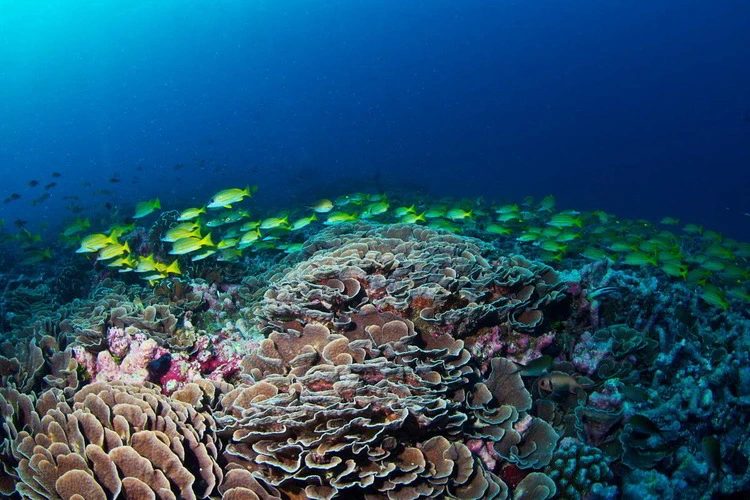
When carbonate ion availability drops, calcification becomes harder which means shells can weaken or dissolve in extreme cases.
By contrast, an ocean not absorbing carbon dioxide would have a higher pH, since there would be less of the greenhouse gas within the water. Consequently, there would be a greater concentration of carbonate ions – making it easier for marine organisms to build their shells and skeletons.
However, it’s important to note that the benefits of a reduction in ocean acidification wouldn’t necessarily outweigh the plethora of issues from planetary warming, if the oceans stopped absorbing carbon dioxide.