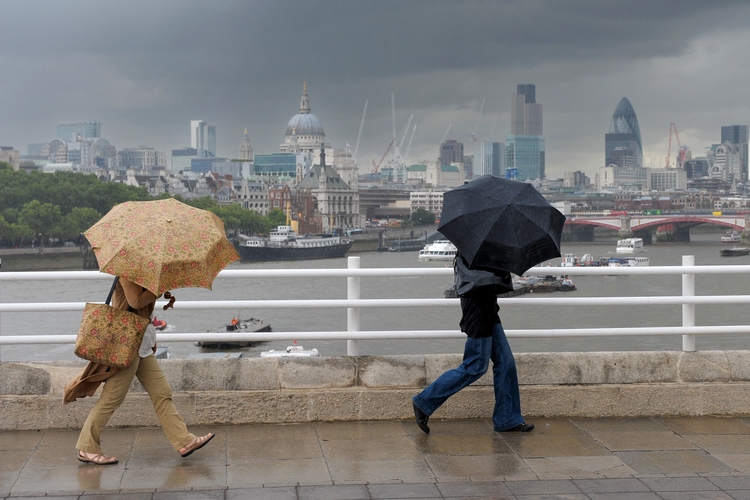
The UK has experienced a deluge of rain in January and February – but why exactly is such weather persisting?
By
For those in the UK, 2026 has been off to a particularly wet start. In some parts of the nation – like Devon, Cornwall and Worcestershire – rain has fallen every single day, from January 1 until the beginning of February: almost forty days straight. Rainfall in the south-west was 56 per cent above long‑term averages, increasing to 88 per cent above average across the south-east and central southern England.
In addition, Met Office statistics show that Northern Ireland experienced its wettest January in 149 years, and second wettest on record. Co Down endured its wettest January on record, with the region experiencing the most rainfall being the Mountains of Mourne, where 790mm of rain was recorded so far this year.
Enjoying this article? Check out our related reads…
Across many parts of the UK, rainfall has been so severe that it has damaged buildings and roads. Heavy rain in Yorkshire led to the closure of the M62 for emergency repairs at the weekend, after reports it was damaged by the weather.
But what exactly is behind such vast swathes of rainfall? Here we unpack exactly the reason why the UK is experiencing a deluge across its many cities, villages and towns – and whether climate change is having an impact…
A blocked jet stream
The main culprit for such rainy weather is a blocked jet stream. Essentially, the jet stream is a powerful ribbon of air, flowing several miles above the Earth’s surface. It affects changes in wind and pressure, which in turn impact weather systems on the ground. Sometimes, the jet stream’s movement is straight and smooth. However, its movement can buckle and loop, causing a slowing effect.
At the moment, it is positioned further south than typically expected at this time of year. When the jet stream moves to this position, it tends to funnel low-pressure systems directly toward the UK, increasing the frequency and intensity of rainy weather fronts.
Wintry cold plunges in temperature across North America have also helped to strengthen the jet stream. As such, a stronger jet stream acts like a conveyor belt, rapidly developing and then propelling areas of low pressure toward north-west Europe.
At the same time, high pressure has also established across parts of northern Europe, creating a blocked pattern in which it becomes difficult for the jet stream to change position. This limits the chances of more settled, drier weather occurring. In this way, blocking also prevents weather fronts from pushing through and clearing the UK. Instead, they are stalling over the nation, giving rise to the persistent and slow-moving bands of rain that have characterised much of 2026.
As well as the blocked jet stream, several storms have battered the UK in recent months – Storms Goretti, Ingrid and Chandra – with back-to-back deluges making soil in certain regions completely saturated.
Such a situation has had knock-on effects for farmers, whose crops – like barley, wheat and oilseed rape – have been underwater for a month. These types of crops can typically only survive for ten days underwater before perishing. In addition, rain is making lambing particularly difficult, forcing farmers to take sheep and cattle onto higher ground if they have access to it.
Does climate change make rainfall worse?
In short, yes. Current climate models have indicated that rising temperatures will intensify the Earth’s water cycle, increasing evaporation. Increased evaporation will result in more frequent and intense storms in certain areas. As a result, storm-affected areas are likely to experience increases in precipitation.
In addition, warmer air can hold about seven per cent more moisture for every 1ºC rise in temperature, making rainfall more likely.
A study conducted by the Met Office found that climate change means there is a ‘a high chance of exceeding the observed record monthly rainfall totals in many regions of the UK’. Another study, from the Met Office again, shows that on average, for the decade 2010 to 2019, UK summers were 13 per cent wetter, and winters 12 per cent wetter, than in the period 1961 to 1990.
Such intense rainfall brings about a clear risk of flooding. According to the UK Climate Change Committee, 1.4 million people in England currently face a 1 in 75 risk or greater of flooding of any kind. The number at this level of risk could increase to 1.7 million if global warming reaches 2ºC above pre-industrial temperatures.
Managing these risks is pivotal, and includes natural flood management, such as restoring bends in rivers, changing the way land is managed so soil can absorb more water and planting trees in river catchments to intercept rainwater.
Ultimately, scientists predict that climate change will lead to wetter winters and drier summers in the UK.