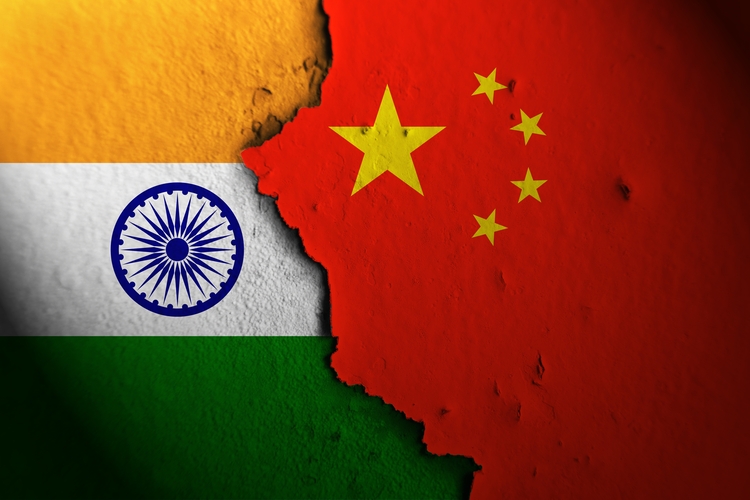

The idea that rising powers challenge established ones has shaped thinking about China and the USA. But in Asia, the more consequential contest may be between a slowing China and an ascendant India, James Rose argues
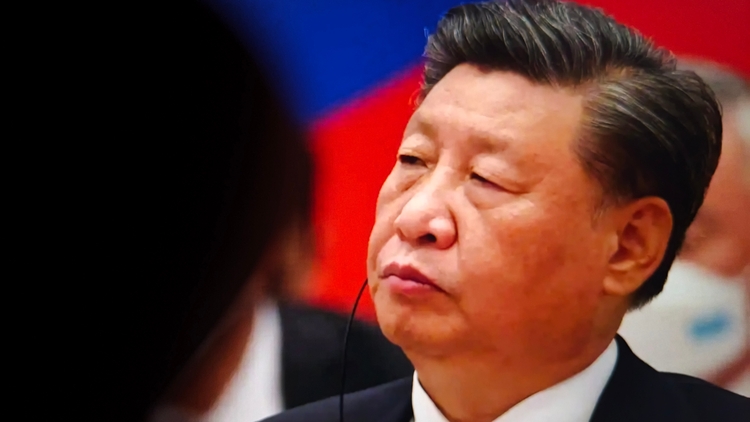
At a meeting in 2013, Chinese leader Xi Jinping warned his assembled Western guests that we must all work together to avoid Thucydides’s trap. In saying this, Xi wasn’t just demonstrating his knowledge of obscure classical history. He was also warning of something more serious – that Beijing believed it was caught in one of history’s most perilous patterns: the tendency for conflict between a rising power and an established one.
The phrase Xi used had been coined only a year earlier by Graham T Allison, a prominent Harvard professor. Professor Allison drew on the ancient Greek historian Thucydides, who wrote that the Peloponnesian War had been caused by the rise of Athens and the fear this inspired in the dominant power, Sparta. Professor Allison expanded this insight into a broader theory of international politics: when a new power begins to rival an established one, fear, uncertainty and miscalculation increase the risk of war.
To develop this idea further, Professor Allison outlined 16 historical cases in which such a dynamic had occurred. In 12 of the 16, he concluded, the rivalry ended in war. The implication for the 21st century was obvious. As China’s economic and military strength grew, the USA would become increasingly anxious about preserving its global primacy, and conflict between the two would become ever more likely.
Enjoying this article? Check out our related reads…
Unsurprisingly, the argument quickly spread beyond academia. The Thucydides Trap became a staple of policy debates and media commentary, shaping how officials and analysts described the growing rivalry between Washington and Beijing. By 2018, the Financial Times had named it one of the defining phrases of the year.
Yet not everyone agrees with Professor Allison’s theory, or its gloomy outlook for Sino-American relations. Many have questioned his reading of history and the examples he chose, arguing that the pattern was less consistent – and less inevitable – than he suggested. Others believe that the modern world is simply too different for these historical examples to remain relevant. Nuclear weapons and the threat of mutual assured destruction are said to have made great-power war unthinkable. At the same time, the deep web of economic interdependence – more than US$500billion in annual trade between the USA and China – is often cited as an additional restraint.
But what if Professor Allison is right about the underlying dynamic, but wrong about the countries involved? What if it’s India that is the emerging challenger, and China the dominant state increasingly focused on preserving its position as Asia’s leading geopolitical power?
India remains oddly marginal in much Western geopolitical analysis. Modern discussions of international relations still revolve mainly around China, Russia and the USA, while India is treated as something of a bit-part player. The USA’s most recent National Security Strategy, published in November 2022, mentions China 21 times and Russia ten times. India appears only five times, fewer even than Iran. Donald Trump himself once referred to the 27 meetings when India does feature, it’s normally in the context of its relationship with Pakistan, and the periodic crises that occur between these two long-standing and bitter rivals.
Yet this no longer reflects reality. In recent years, India has begun to assert itself as a major power in its own right – economically, technologically and strategically. In August 2023, the Indian Space Research Organisation’s Chandrayaan-3 mission achieved a successful soft landing on the Moon, making India only the fourth country to do so, and the first to land near the Moon’s south pole. Celebrating the achievement, Prime Minister Narendra Modi proudly declared that it was ‘the triumph of the new India… the call of India’s ascending destiny’.
Modi’s choice of language was revealing, signalling not only national pride but a growing conviction that India’s moment on the world stage may finally have arrived. What’s more, given that it was China that had been the previous country to join the lunar club, the parallels with the Cold War-era space race were hard to miss.
That same year carried another symbolic milestone: India overtook China to become the world’s most populous country, with a population of 1.43 billion.
Economically, India is becoming a major power player. In recent years, its economy has expanded rapidly, enjoyed by what some economists describe as a ‘Goldilocks phase’ of high growth and low inflation. In late 2025, it was reported that India had overtaken Japan to become the world’s fourth-largest economy, and is projected to surpass Germany by 2028 to become the third. The government in New Delhi is also looking to convert this economic clout into military might. According to data from the Stockholm International Peace Research Institute, India’s defence expenditure has more than doubled in real terms over the past 20 years.
Across the border in China, the picture is less positive. Officially, China continues to record economic growth rates that most Western leaders could only dream of. Unofficially, many question how accurate this data is, and point out that decades of breakneck growth have left it grappling with an enormous debt burden and a vast real-estate bubble.
China also faces a major demographic crisis. Its decades-long programme of limiting fertility through the one-child policy has warped the country’s population structure. The UN projects that over the next 50 years, China’s population will shrink from 1.41 billion today to 934 million by 2075. This would represent depopulation on a scale unprecedented in history. At the same time, the population is ageing rapidly, with the proportion aged 65 and over expected to double over the coming quarter of a century. The long-term consequences are difficult to predict. Nonetheless, for a country that built its economy on its vast supply of cheap labour, its difficult to see how this can be positive. As Yi Fuxian, a demographer at the University of Wisconsin–Madison, has warned, China’s economic momentum will be sapped by an ageing, shrinking labour force.
India, by contrast, is expected not only to keep growing, but to remain relatively young. By 2050, its median population age will be just 38, more than 13 years younger than China’s.
This is, of course, a simplistic overview. Even as India continues its rapid economic growth, it faces many serious problems, including a sluggish bureaucracy, high unemployment and persistent poverty. China, for its part, is acutely aware of its impending demographic crunch and is attempting to boost birth rates. Recent efforts include paying cash benefits to new parents and introducing a tax on contraceptives. Even so, it isn’t hard to see why Beijing might look at its younger, faster-growing neighbour and worry that it could begin to challenge China’s dominance in Asia.

One potential future flashpoint is the Indian Ocean. This is a key strategic region, with the naval strategist Alfred Mahan once declaring that ‘whoever controls the Indian Ocean controls Asia’. Over the past three decades, China has used its diplomatic leverage and financial clout to expand its influence in the region. Much of this has occurred as part of its Belt and Road Initiative, including major infrastructure investments in ports and facilities in Myanmar, Sri Lanka and Bangladesh, as well as the Maldives, the Seychelles and parts of Africa. At the centre of this effort lies the China–Pakistan Economic Corridor, through which Beijing has poured investment into a major deep-water port at Gwadar, alongside road and rail infrastructure connecting it to western China.
For China, these projects portray as legitimate attempts to secure vital trade routes. In New Delhi, however, they are often seen as part of a deliberate ‘string of pearls’ strategy designed to encircle India. Of particular concern is the prospect that ostensibly commercial ports could have a dual purpose and one day morph into military bases.
India has begun to push back against what it sees as encroachment in its maritime backyard. Expanding the metaphor, senior Indian officials have spoken of developing a countervailing ‘necklace of diamonds’ strategy, strengthening military and diplomatic ties with key partners across the region. How this competition will unfold remains uncertain.
Tensions aren’t confined to the sea. India and China share a vast, poorly demarcated border stretching some 3,400 kilometres. In 1962, a brief but bloody war erupted along this frontier, in which more than 1,000 soldiers lost their lives. The border has been a source of friction ever since, with further clashes taking place in 1967. More recently, tensions flared again when a violent standoff in the Galwan Valley in 2020 left 20 Indian and four Chinese soldiers dead.
A further fault line, closely linked to the others, is China’s support for Pakistan. Beijing has long been a key strategic ally of Islamabad, supplying military aid and equipment, and previously helping Pakistan develop its nuclear arsenal. The JF-17 fighter jets used by Pakistan against Indian air defences during the two countries’ brief military confrontation in May 2025 were jointly developed by Pakistan and China. Describing the relationship, Xi said the two countries ‘have long been iron friends’ and ‘all-weather partners of strategic cooperation’. How long Delhi will tolerate such support for its principal adversary remains an open question.
None of this means that China and India are destined to end up at war. In recent years, both countries’ leaders have taken steps to reduce tensions and manage long-standing disputes. The return of President Trump, and the renewed focus on using tariffs to rebalance global trade in America’s favour, has also (at least temporarily) pushed the two Asian giants closer together. Speaking at an international meeting in August last year, Modi declared that the two countries should be ‘partners not rivals’.
Still, it’s difficult to avoid the conclusion that the rise of a younger, faster-growing India will alter Asia’s balance of power. Whether that shift can be managed peacefully may determine whether Thucydides was simply a chronicler of a bygone age – or a prophet for ours.