
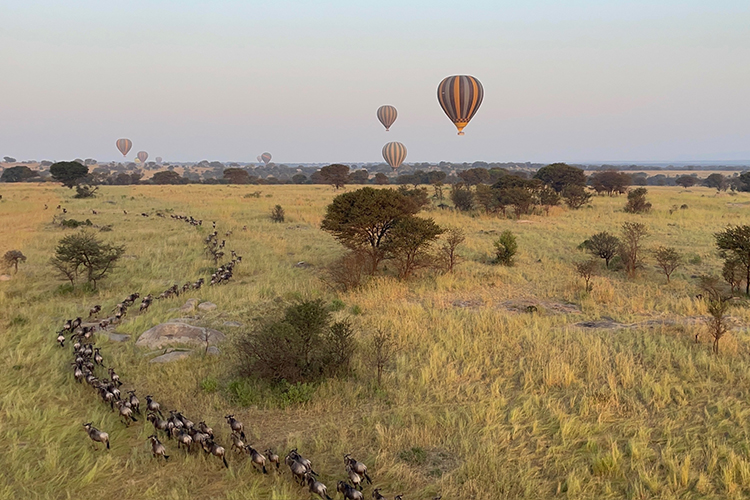
From the giant tuskers of Tarangire to the thunder of the Great Migration, safari expert Vihann Van Wyk explores the raw, untamed heart of Tanzania
Sponsored post
Deciding on where to go on safari in Tanzania can seem like trying to map the stars – with no knowledge of astronomy. There are endless possibilities, and each of Tanzania’s safari experiences comes with its own unique flavour of adventure.
Discover Africa safari expert Vihann Van Wyk recently returned from a journey through some of Tanzania’s most iconic safari destinations, a route that took him from the giant baobabs of Tarangire through to the steep rim of Ngorongoro Crater and, finally, to the heart of the Serengeti, a place of massive herds and raw adrenaline courtesy of the Great Migration.
Tarangire: The Land of Tuskers
Vihann’s journey began in Tarangire National Park, a destination famous for its excellent wildlife-to-human ratio. It’s a good choice for travellers wanting to encounter more animals than people. Something that stood out was the massive herds of male elephants – something not usually encountered in the southern Africa safari circuit.
‘That’s very not unusual, but you don’t see that many big bulls. There were over 20 bulls together at the waterhole as we went to Forest Chem Chem. And we were very
close to them… and they are these big elephants, what you call “tuskers“,’ Vihann explains.
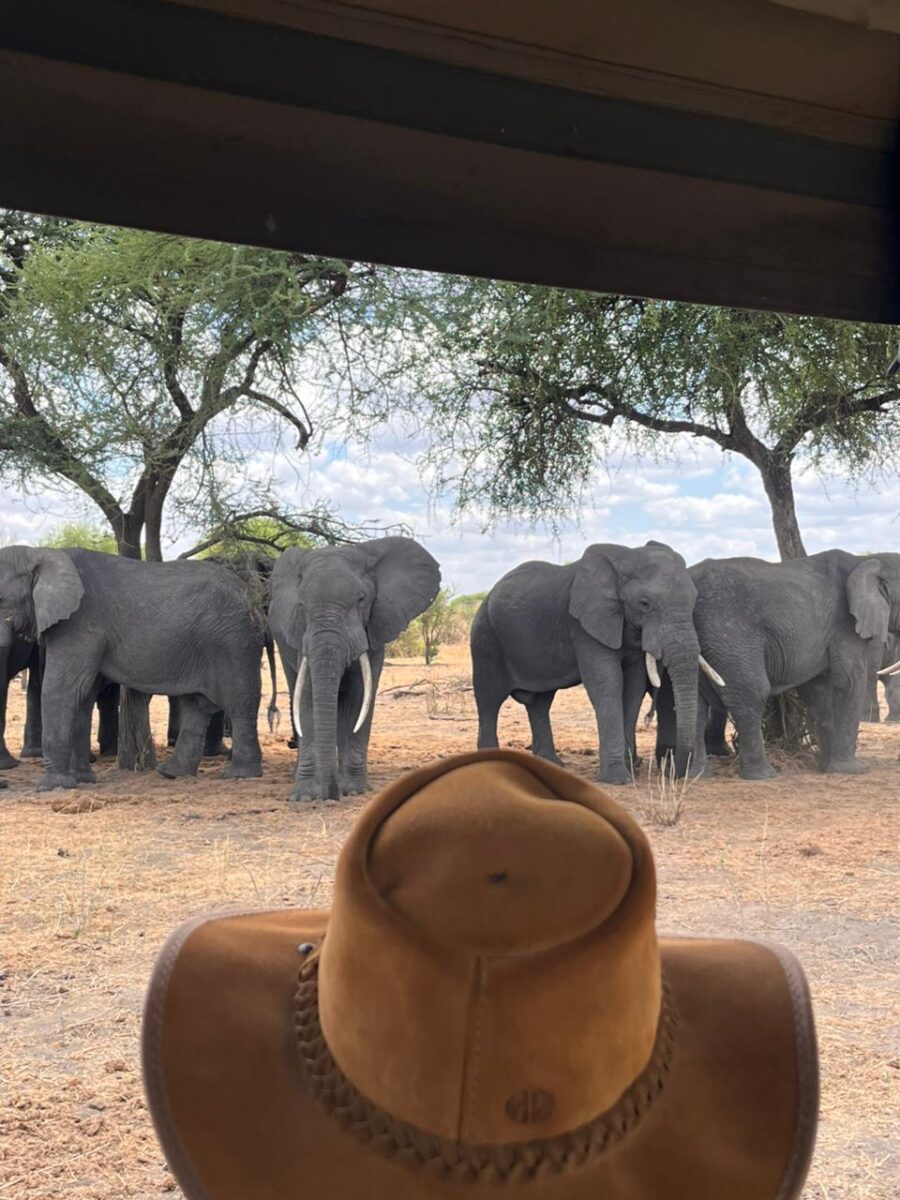
Tusker elephants, particularly super tuskers, are rare bull elephants with tusks weighing over 45 kilograms. Tarangire is particularly famous for these massive bulls gathering along the river during the dry season. This is all possible because of the conservation work done by the Chem Chem Association, which has transformed the area into a haven for these giants. Since 2008, this non-profit organisation has worked tirelessly to conserve and restore the Kwakuchinja Wildlife Corridor and, by extension, the Tarangire-Manyara ecosystem, allowing these tuskers and other animals to thrive in once-barren lands.
Ngorongoro Crater: A Garden of Eden
Next stop on Vihann’s safari list: Ngorongoro Crater, the world’s largest inactive, unbroken volcanic area, and a UNESCO World Heritage Site. It is known as a Garden
of Eden in the safari world and features a 600 metre basin teeming with over 30,000 animals.
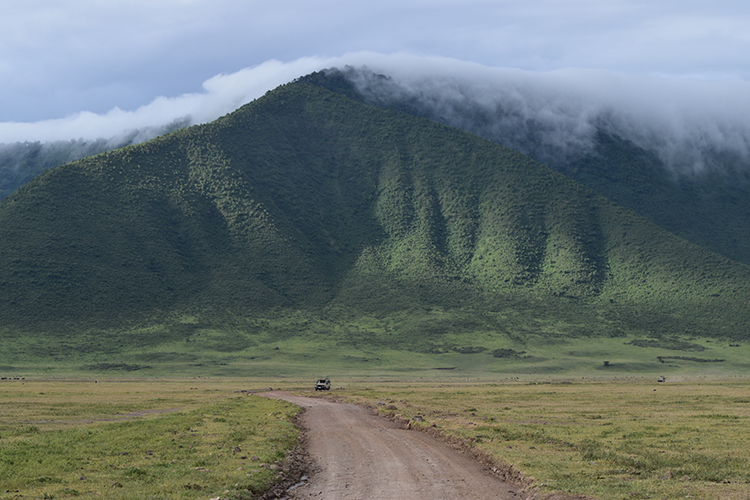
According to Vihann, staying on the crater’s rim at lodges like Lemala Osonjoi and – the aptly named – Crater’s Edge offers a front-row seat to one of the world’s most stunning views.
‘The rooms are spacious. Everything that you need is there. A bar, a fridge, your own private deck area overlooking the crater,’ he says about Craters Edge.
For those seeking a more remote adventure, the secret to having the Ngorongoro Crater to yourself is timing. Using the less commercialised access paths from the rim
lodges allows for a quieter descent into the crater before the day-trip crowds arrive. Although, Vihann warns that it can get quite busy during the peak months of July,
August, and September.
The Serengeti: A River Crossing Surprise
The Serengeti is one of Africa’s most iconic landscapes, immortalised in poetry, songs, and photography inspired by its rolling grassy plains. For many, it is the climax of any Tanzania safari adventure and is where the ‘wild’ factor hits its peak.
If you time it just right, or even if you’re lucky, you might witness a Great Migration river crossing in action. Vihann was fortunate enough to witness this, partially due to some mishaps in travel planning and a delayed flight.
For those not familiar with the Great Migration, it is a raw, massive spectacle, often called ‘The Greatest Show on Earth’, whereby over a million blue wildebeests and
zebras move in enormous herds between the Serengeti and Masai Mara ecosystems. It is driven by the seasonal shifts in rain and the search for fresh grazing, culminating in the ultimate spectacle of the Mara River crossing.
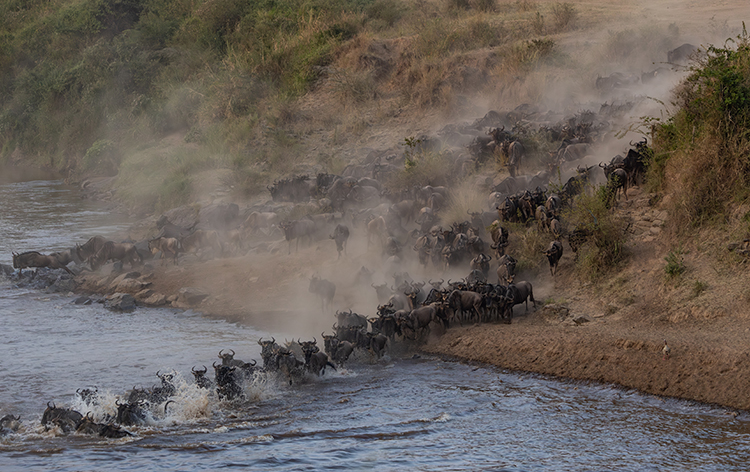
This usually occurs between July and October, when thousands of blue wildebeest brave the croc-infested waters to get into the Masai Mara, where greener pastures
await. Vihann got to spend a whole extra day in the Serengeti, time that allowed him to witness an unusual late-season river crossing in mid-November.
‘At that time of the year, it’s very unusual to see them. But the guide explained to us that there are still wandering herds, straggling at the back, that are still waiting to cross the river,’ he says.
Setting off on a full-day game drive, just a couple of hours away from Serengeti Bushtops Camp, they headed towards the river, where a large herd of wildebeest had
gathered.
‘When we got there, we quickly checked out the situation, and our guide was actually so knowledgeable. He looked at how the zebras moved. And he said, “No, if the zebra moves, usually what happens is the blue wildebeest will move with them.” So you’ll see them coming to the river, going again, coming to the river, going again,’ Vihann explains.
He adds that it might take a few hours for them to cross the river, with many of them going back and forth until a few of them commit to crossing. So, his party settled in on the banks for lunch and waited for the first few brave wildebeest to finally take the leap forward.
‘We probably sat for an hour and a half, two hours – we were constantly watching the herds coming down closer to the water… If it’s only one that goes into the water, they’re not going to commit. Because, usually, the little ones and the females are first, and then when a couple of them cross, everyone follows. And once a few of them go down the ditch, then all of a sudden four, then five – go, go, go, go, go… You just hear the vehicles; everyone starts their vehicles and rushes to the viewpoint.’
The experience was chaotic, raw, and unpredictable.
The Quiet After
Following the chaos of a long game drive, going from sighting to sighting, the thunder of hundreds of hooves moving down the riverbanks, Vihann reflected on the stillness afterward.
After witnessing the unexpected river crossing, Vihann and his group sat with their guide by the fire, reflecting on what they saw. The sights, the sounds, the smell of the
crackling fire. It all starts to hit home once the day ends.
‘We just sat around the fire, had a nightcap before going to bed and just listened to the night sounds. Just hearing the hyenas and the lions going off. That calmness at
nighttime, sitting around the fire, sharing the stories of the day and just what you saw, just soaking everything in, not hearing anything besides the cracking of the fire.’
It’s moments like these where one can truly reflect on the magic of the bush. The stillness after a game drive – it all starts to come together, and it’s a type of peace not
found anywhere else.
‘That’s where everything just sinks in because you’re so focused; like on the river crossing, you don’t have time to actually let everything sink in. And when you get to the
lodge, everything just seems like, “oh my word”. This was such a once-in-a-lifetime thing that we experienced,’ he says.
A Thrill for Hot Air Ballooning
To end off your trip, and to truly capture the spirit of adventure, Vihann says that you must get out of the vehicle.
A hot air balloon trip starts with a 3am wake-up call and ends with a champagne breakfast in the middle of the bush. Although you might be slightly groggy at first, the view is absolutely worth it.
‘When you are up there, it is the most peaceful, quiet thing ever, like you can hear a pin drop,’ says Vihann.
If the pilot spots some wildlife, they can lower the basket, providing a stunning aerial view of the herds moving across the plains.
‘And you are in the air for one hour. Then you drop down. Before you arrive at your breakfast spot, the pilot shares a story about the first-ever people that did the hot air
balloon and then why you have to pop a bottle of champagne,’ Vihann explains.
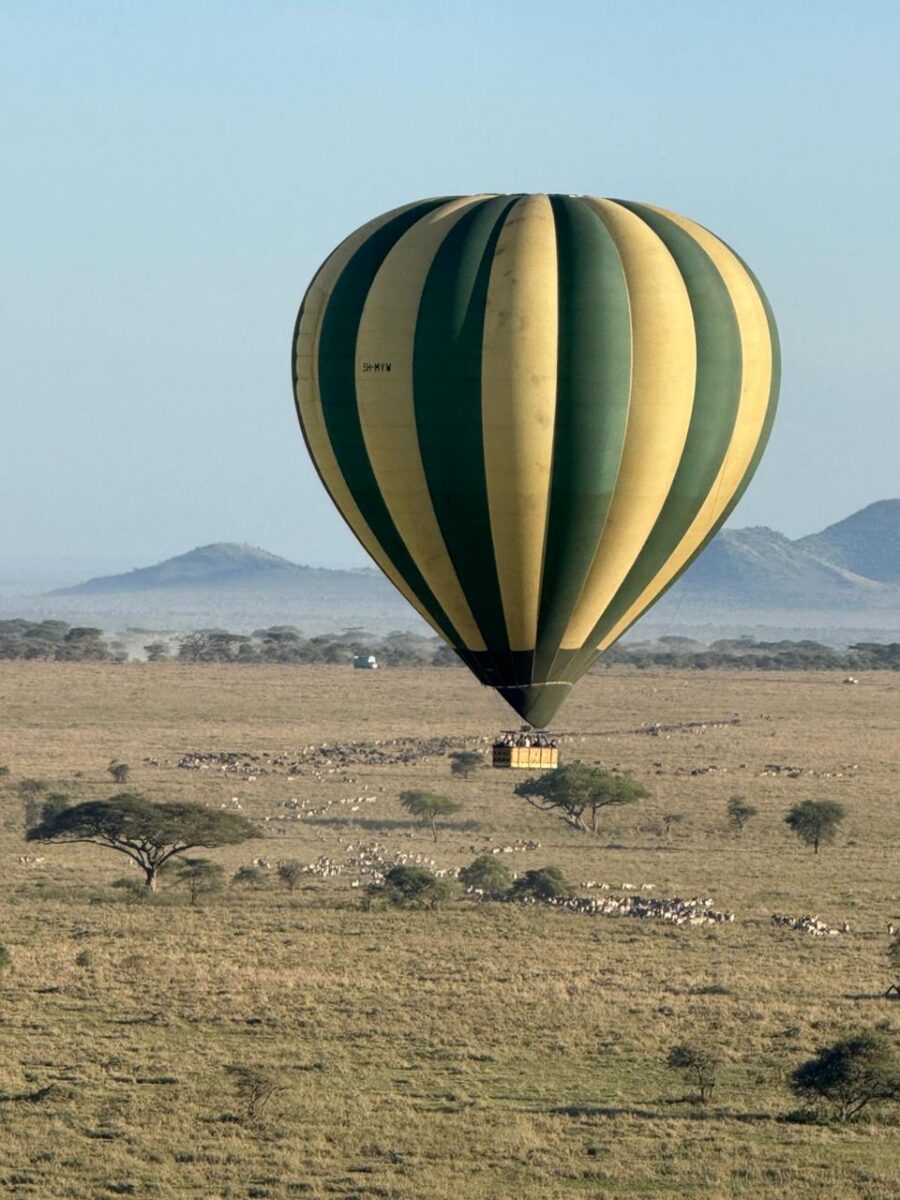
The tradition of champagne and hot air balloons started in 18th-century France, when early balloonists, such as the Montgolfier brothers, used bottles of bubbly as peace offerings to appease startled farmers, calming fears that their dragon-like balloons were demonic and ensuring safe landings in fields, thus creating a celebratory ritual that continues today as a toast to successful flights.
And as the last drop of champagne is raised in a toast to a successful flight and an unforgettable journey, you realise this bird’s-eye view – of the plains stretching out to the horizon, dotted with tiny herds – is the perfect final perspective on Tanzania.
It is a moment of pure, peaceful reflection, a celebratory punctuation mark on an adventure that has taken you from the massive tuskers of Tarangire to the chaos and wonder of the Great Migration. It is the memory you’ll carry home, a final, thrilling reminder of the raw, untamed spirit of Tanzania.

For over 20 years, Discover Africa has arranged safaris like this one in Tanzania, as well as in other East African countries and southern Africa, assisting people from
around the world in exploring the beautiful continent of Africa.


