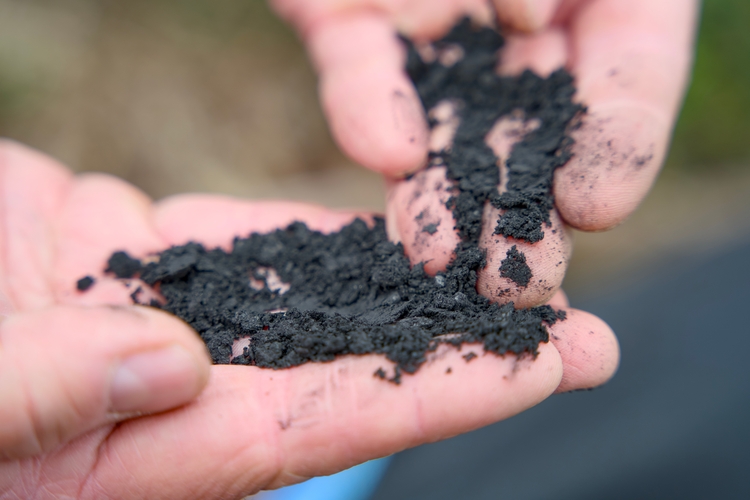
Common agricultural byproduct – biochar – could offer a practical solution to tackling high emissions of greenhouse gas 300 times more powerful than CO2
By
Agricultural soils are one of the world’s largest sources of nitrous oxide, a greenhouse gas nearly 300 times more powerful than carbon dioxide across a century. Now, new research has revealed that a common agricultural byproduct may offer a powerful solution.
A study published in Biochar shows that straw-derived biochar – a charcoal-like substance made by heating up organic material – could reduce nitrous oxide emissions from China’s croplands by as much as 50 per cent.
Enjoying this article? Check out our related reads…
Nitrous oxide is primarily released from soils treated with nitrogen fertilisers. While biochar, a carbon-rich material, has long been recognised for its ability to store carbon in soils, its potential to reduce nitrous oxide emissions has been difficult to quantify at large scales until now.
Previous estimates often relied on a single average value, overlooking how climate, soil properties, farming practices and specific characteristics of biochar interact across different regions.
To address such a gap, researchers compiled data from more than a decade of field studies across China, combining meta-analysis with machine learning techniques. Then, they conducted a nationwide, high-resolution analysis to identify where and how biochar could most effectively reduce nitrous oxide emissions.
‘Our results show that biochar’s climate benefits depend strongly on how it is made and where it is used,’ said corresponding author Qing Yang.
Under ideal conditions, where sufficient crop straw is available to produce biochar, the study found that optimised biochar application could avoid about half of China’s cropland nitrous oxide emissions. Even under realistic conditions that account for limited straw resources, emissions could still be reduced by roughly one-third across time.

The analysis also revealed how nitrogen fertiliser use is the single most important factor determining biochar’s effectiveness. The substance performed best in regions with moderate to high fertiliser inputs, where nitrous oxide emissions are the highest.
‘There is no one-size-fits-all solution,’ said Yang. ‘In wetter regions, biochar produced at higher temperatures performs better, while in drier areas or where wheat and maize residues dominate, lower production temperatures can be more effective.’
In particular, regions in China such as Jiangsu and Henan are promising to researchers for large-scale deployment. These areas have high baseline emissions, with strong responses to biochar application –meaning that future projects coul have substantial climate benefits.
Beyond reducing greenhouse gas emissions, biochar may also help to support sustainable agriculture. Researchers estimate that biochar use could significantly increase crop yields by improving soil structure and nutrient efficiency.
‘Biochar offers a rare opportunity to address climate change and food security at the same time,’ said Yang. ‘With proper planning, farmers could cut emissions, improve soils, and make better use of agricultural waste.’
For the authors, future research should consider biochar’s effects on other greenhouse gases, such as methane and carbon dioxide, as well as long-term changes as biochar ages in soil. Still, the findings provide one of the most comprehensive assessments to date of biochar’s potential role in climate-friendly agriculture.