
Performance artist Tom Bailey talks to Victoria Heath about changing the narrative of travel
Bailey’s travel insights
– Walk through landscapes rather than passing over them
– Slower journeys reveal deeper connections
– Don’t reduce travel to distance or summits
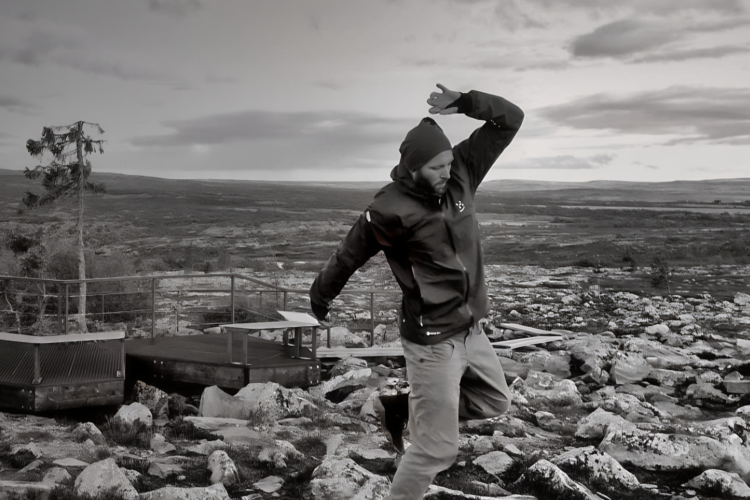
For artist Tom Bailey, there’s an art – quite literally – in travelling through places rather than simply passing over them. Based in Bristol and trained in theatre, Bailey has spent more than a decade creating performance art that explores our relationship with the natural world, often by walking through landscapes for weeks at a time.
His work sets out to subvert how people have traditionally responded to the climate crisis. ‘A lot of the narrative has been apocalyptic,’ he says. ‘Doom and gloom.’ But amid such turbulent times, Bailey’s work offers a glimmer of hope.
Enjoying this article? Check out our related reads…
Instead of framing the climate crisis purely in terms of loss, Bailey began asking how art might honour nature in a more positive light. His answer, in 2024, took the form of a months-long, 1,600km journey on foot through Scotland, Norway and Denmark. Tracing boreal treelines, he carried a 16-metre fabric list of 44,000 endangered species. Along the way, he visited submerged forests in the Outer Hebrides and old-growth pine valleys in Norway, searching for ecological connections across borders.
Certain moments from the journey still resonate: a waterfall valley along the Kinso River in Norway; and old-growth forest near Lillehammer. ‘You don’t always know why a place moves you,’ he reflects. ‘There’s this old Romantic idea of the sublime. But I don’t know what happens when a place really hits you and changes you.’
Bailey doesn’t claim to be a pioneer in his art – he readily offers examples of those who have inspired him. His influences are wide-ranging and include the rich history of walking as an art form across the 20th century, as well as British artist Richard Long, who incorporates walking into his sculpture-making practice.
Bailey’s next artistic journey will see him trek through Arctic Norway in spring, beginning on skis and finishing in high summer in the Lofoten Islands. At points along the route, he will pause to collaborate with local communities. A theatre designer from his company will meet him at intervals, bringing materials and helping to translate landscape encounters into masks, costumes and performance ideas.
Yet the journey wasn’t born solely from artistic motivations. Political context is never far away. Growing geopolitical tensions in the Arctic prompted Bailey to look more closely at the lived realities of those who call the region home. Rather than simply reading headlines, he wanted to experience the place physically.
Underlying all Bailey’s work is a desire to refute the traditional ‘helicopter model’ of international art touring: fly into a location, perform, then fly straight back out. Such an approach can leave artists feeling disconnected from the places where they perform. Bailey prefers to keep things grounded and hopes doing so will inspire others to incorporate slow journeying into their way of touring.
It’s the same subversive thinking that shapes how he travels. Rather than offering gear lists or mileage targets, he resists reducing journeys to numbers – and questions our obsession with them. ‘Outdoor culture can be quite stats-driven,’ he says. ‘But I found myself increasingly not caring how much I’m carrying, or how far I’m going. For me, the slower I can go, the better.’
For Bailey, the most meaningful journeys begin when those metrics fall away. ‘Give yourself permission to be unconventional. Don’t necessarily follow the path.’ In doing so, you might meet a place on its own terms rather than trying to conquer it.
In a world where travel is increasingly defined by speed – from high-speed rail to long-haul jets – Bailey’s work suggests something else entirely: slowing down allows a place to unfold in ways we might otherwise miss.


