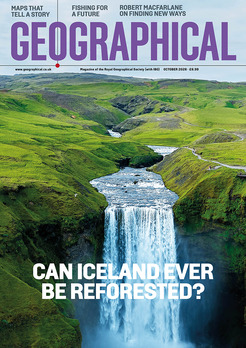
Shafik Meghji explores Cal Flyn’s The Savage Landscape, a wide-ranging examination of wilderness that questions our romanticised notions of the natural world and the human costs of protecting it
A place of yearning and fear, conflict and discovery, the wilderness is a slippery idea – hard to define, hotly contested, often out of reach, perhaps even a mirage. Author Cal Flyn, an award-winning writer whose previous book, Islands of Abandonment, was a Sunday Times bestseller, describes it as a ‘powerful, ancient concept, which lies at the intersection of landscape, philosophy and ecology. It is a place where the human is brought into confrontation with all that is non-human, and is challenged and changed as a result.’
Filled with evocative descriptions and thought-provoking passages, Flyn’s new book, The Savage Landscape, is an original and illuminating examination of humanity’s relationship with the natural world at its most extreme. It encompasses a series of journeys to some of the ‘wildest and most invigorating landscapes’ on the planet, including rainforests and deserts, steppe and tundra, the open ocean and Antarctica. These travels provide the backdrop for wide-ranging discussions about issues such as the nature of the world’s wilderness areas and what we can – and/or should – do to protect them.
Enjoying this article? Check out our related reads…
At the peak of Mount Sinai in the Egyptian desert, for example, Flyn explores the spiritual significance of wilderness, taking in Sumerian epics, Norse legends and the origins of Islam, Judaism and Christianity, as well as Buddhism and Hinduism. In the depths of the vast forests of Transylvania, she looks at wilderness as a place of fearsome beasts, both real and imagined, internalisations and projections; a volcanic eruption in Iceland offers an opportunity to examine the concept as an aesthetic experience; and a vast game reserve carpeted with thick brush in northern Mozambique provides her with an encounter with a trophy hunter – in this case an ‘American neurosurgeon is his early seventies’ eager to bag a Cape buffalo.
The Savage Landscape looks at the threats posed to wilderness areas and the Indigenous peoples who live in them, as capitalism, prejudice and notions of development swirl together. A memorable chapter takes the author into the Amazonian territory of the Yanomami people, where the long discredited ‘spectre of the savage still haunts the contemporary wilderness debate’. It provides a timely reminder that places deemed ‘wild’ by outsiders and held out as realms of exploration and opportunity are, for many others, simply a home. ‘True savages don’t come dressed in skin or bearing spears,’ Flyn notes. ‘They wear fatigues, dress uniforms, blazers, dinner jackets.’
The Savage Landscape also explores the frequent tensions between competing notions of environmental action and social justice. There’s a particularly powerful chapter about the concept of ‘fortress conservation’ in Uganda’s Impenetrable Forest. In the early 1990s, the authorities forcibly evicted thousands of Batwa people – who are thought to have occupied the region for more than 30,000 years – and reclassified their land as national parks as part of efforts to preserve endangered mountain gorillas. ‘Conservation refugees are, in some senses, human sacrifices to nature,’ Flyn writes. ‘And like most sacrifices, they have been offered without consultation or agreement, at least partly symbolically, and with a sense of moral rectitude on the part of those presenting them.’
Seamlessly blending archival research with first-hand experiences and philosophical and ecological contemplations, Flyn has produced a memorable book that both shifts and expands perspectives. As she writes: ‘The wilderness, a concept anchored in the physical world, nevertheless seems to express some deeper instinct: a drive to escape the bounds of “normality” and connect with something larger… An urge that may be, it seems, universal.’