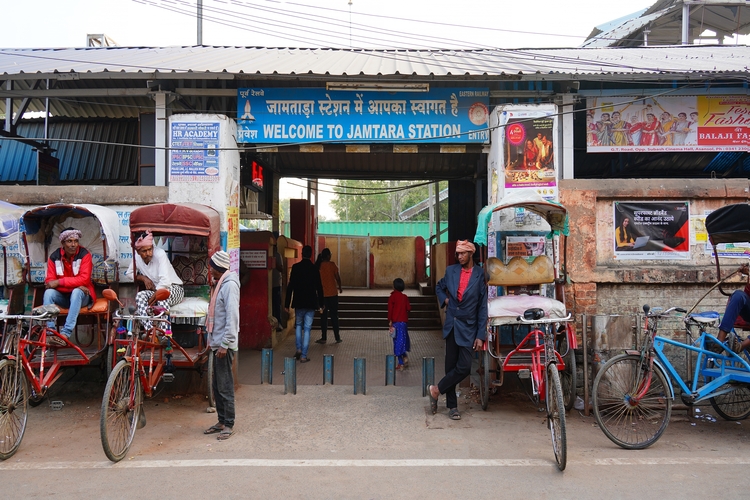
A rural backwater has become India’s byword for cybercrime
By
For many Indians, ‘Jamtara’ is no longer just a dot on the map in the country’s northeast – it has become a commonly used shorthand for being scammed.
This neglected, rural district has acquired a notoriety that far exceeds its size, driven by young men who, armed with little more than mobile phones, learned to siphon money from strangers’ bank accounts. Jamtara rapidly grew into a centre for gangs of scammers, with money flowing into the region and ‘working the phones’ becoming far more profitable than tilling the fields.
Check out our related reads about scam centres…
- Is it possible to crack down on scam centres?
- China’s influence in the world of scam farms
- Inside southeast Asia’s scam farms
The boom was closely tied to India’s rapid digital expansion. As mobile-phone towers spread through rural areas and ever more citizens shifted to app-based banking, digital wallets and online commerce, scammers found a vast pool of newly connected targets.
Each innovation in India’s digital marketplace widened the net of potential victims. The earliest playbook relied less on technical ‘hacking’ than on traditional con tricks: impersonating a bank, manufacturing urgency around account access and coaxing victims into sharing the one-time password that authorises a transfer.
Police investigations show how this can scale. In one Delhi Police case reported by The Indian Express, six men linked to Jamtara allegedly duped more than 2,500 people of more than ten million rupees (about £80,000) by posing as customer-care staff for banks and shopping sites – placing misleading phone numbers where victims might search for help. The same report describes the recovery of 12,500 pre-activated SIM cards, underscoring the fact that volume scamming depends on logistics as much as persuasion.
The loose organisation of such gangs makes enforcement feel like whack-a-mole – groups can splinter, regroup and shift location quickly. Raids and arrests linked to ‘Jamtara gangs’ regularly surface across state borders, reflecting networks that recruit, travel and operate interstate.
In February 2025, West Bengal Police announced 46 arrests allegedly linked to Jamtara gangs involved in online fraud, along with seizures of 84 mobile phones and 84 SIM cards (as well as more than 100 bank cards). Other cases point to the continual evolution of tactics. In late 2025, Surat Police said they dismantled an interstate gang accused of sending ‘traffic fine’ messages that tricked people into installing a bogus Android ‘payment’ app, enabling theft from victims’ bank accounts.

Alongside these dispersed networks targeting the home market, cybercriminals have also flourished in larger cities and industrial areas, often operating from call centres and pursuing Western targets. Last July, India’s Central Bureau of Investigation (CBI) raided a bogus call centre operating from the Noida Special Economic Zone, describing a syndicate that impersonated technical support staff – including for Microsoft – to cheat foreign nationals by falsely claiming their devices were compromised and then extracting payments for ‘fixing’ non-existent problems.
The UK’s National Crime Agency said the disruption followed 18 months of collaboration between the CBI, NCA, FBI and Microsoft, and that UK victims alone were believed to have lost more than £390,000.