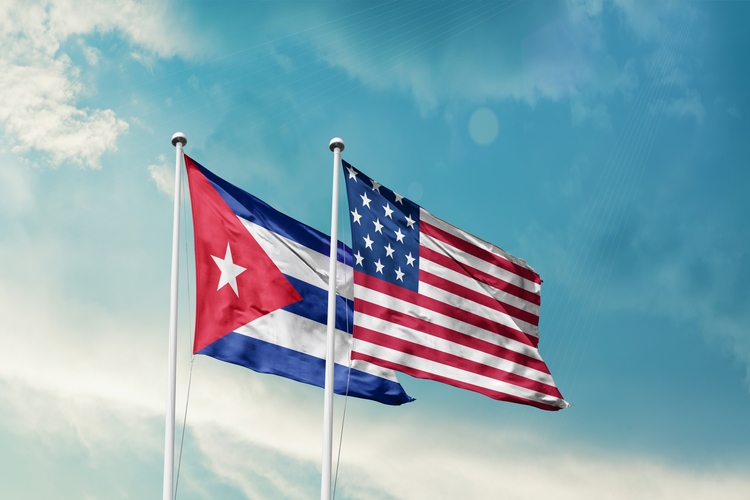

If Havana wobbles, Washington will move fast to protect trade – and its strategic background, argues Tim Marshall
The sea routes into the key American ports in the Gulf of Mexico go past Cuba. It follows that the USA will always seek a friendly government in Havana. This year, the route to achieving that goal, after 60 years of failure, lies in Venezuela.
The shortest distance between Cuba and Florida is just 145 kilometres. On the other side, across the Yucatán Channel, it’s 210 kilometres to Mexico. Through these narrow gaps flow more than 50 per cent of US imports and exports to and from ports in Texas and Louisiana. If a hostile power were to mine the waters on each side of Cuba, or use ships and submarines to block them, the entire US economy would be jeopardised. If it were to position long-range missiles on the island, the security of the USA would be threatened. That no power currently intends to do so isn’t the point.
Enjoying this article? Check out our related reads…
This is why the Americans fought the 1898 Spanish–American War, launched the disastrous Bay of Pigs invasion of 1961, and almost went to war with the Soviet Union the following year during the Cuban Missile Crisis. Washington lost control of Cuba after Fidel Castro’s forces replaced a US-backed dictatorship with a Soviet-backed version in 1959. The Americans have been trying to reverse the situation ever since, and 2026 is the year it may happen.
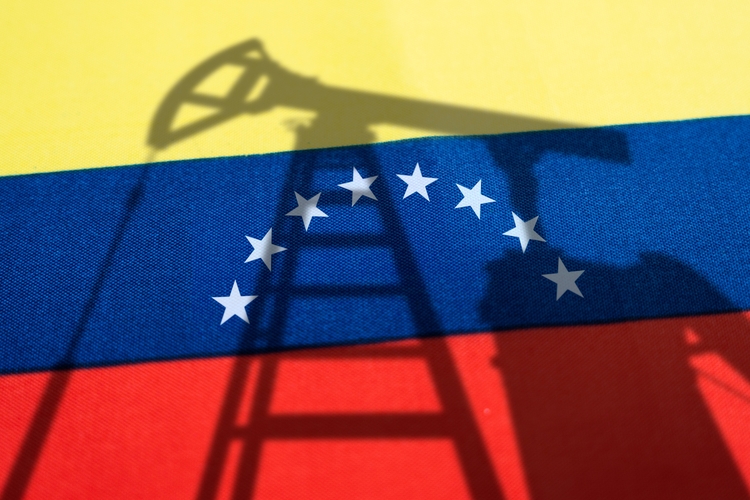
For decades, Cuba’s largest oil supplier was Venezuela – providing at least a third of the island’s daily requirement. In 2000, Castro negotiated a deal whereby Cuba received oil at reduced prices and, in return, sent doctors, intelligence officials and bodyguards to Venezuela. However, since the capture of former Venezuelan president Nicolás Maduro, pressure from Washington has seen supplies run dry. The new interim president, Delcy Rodríguez, is less enamoured of Cuba.
Cuba has a domestic oil industry that produces another third of its needs, but it’s in desperate need of investment. Mexico was its second-largest overseas supplier, but shipments have been cut since the White House threatened to impose additional tariffs on countries supplying oil. Cuba is left with few friends prepared to support it – even China and Russia are becoming lukewarm in their interest in a country on the brink.
An economy already on life support now faces collapse. The lack of fuel means blackouts lasting hours are common across the country. There are long queues at petrol stations, traffic lights go dark, some TV stations have suspended broadcasts and agricultural production has dwindled, leading to food shortages.
Much of this was already happening, but the situation is becoming critical. President Miguel Díaz-Canel has declared a national emergency and said of Trump’s threats: ‘This new measure demonstrates the fascist, criminal and genocidal nature of a cabal that has hijacked the interests of the American people.’
Some of the crisis is due to American sanctions, but mismanagement by the regime is also a factor. The government is unwilling to break from its disastrous central planning model and refuses to change the one-party police-state system. In the last five years alone, more than a million people have fled the country – one in ten of the population. Protests have been crushed, but it’s inevitable they will break out again.
The government and military are unlikely to give up without a fight. Top Communist Party officials and generals are among the richest people in Cuba, and the military controls large companies, especially in the tourism industry. Despite overseeing severe repression, including torture, the regime has not resorted to gunning down protesters in the street. However, given the potential for mass unrest as the economy collapses, its level of tolerance for dissent will be tested.
Is the USA pushing for regime change? Secretary of state Marco Rubio, the son of Cuban immigrants, is thought to favour it, but other senior officials would prefer a change in the regime’s behaviour. The administration has accused Havana of aligning itself with ‘hostile countries and malign actors [and] hosting their military and intelligence capabilities’ – by which it meant the Russians, who have a large signals-intelligence base on the island, and Hezbollah.
President Trump has said he is now negotiating with Cuban officials at the highest levels. The USA has also increased humanitarian aid supplies in a bid to avoid alienating ordinary Cubans, and is wary of creating conditions that could lead to another wave of people crossing the Florida Straits seeking refuge.
In late January, Trump said: ‘Cuba will be failing pretty soon! If it does, the USA intends to secure the sea lanes into the Gulf of Mexico for generations to come by installing ‘Our Man in Havana’.’