
• Skip to main content
  • Skip to secondary menu
  • Skip to primary sidebar
  • Skip to footer
Geographical

Geographical

Official magazine of the Royal Geographical Society (with IBG)

  • Geographical Home
  • News
  • Features
  • Opinion
    • Climatewatch
    • Front Lines
  • Podcast
  • Travel
    • Discovering Britain
    • Passport
  • Culture
    • Book reviews
  • Quizzes
    • Crosswords
  • Choose Geography
    • University directory
    • Masters courses
    • Course guides
      • Climate change
      • Environmental science
      • Human geography
      • Physical geography
    • University pages
      • Aberystwyth University
      • Brunel University
      • Cardiff University
      • University of Chester
      • Edge Hill University
      • The University of Edinburgh
      • Newcastle University
      • Nottingham Trent University
      • Oxford Brookes University
      • The University of Plymouth
      • Queen Mary University of London
    • Geography careers
      • Charity/non-profit
      • Education & research
      • Environment
      • Finance & consulting
      • Government and Local Government
    • Applications and advice
  • Magazine
    • Issue previews
    • Subscribe
    • Manage My Subscription
    • Special Editions
    • Geographical Archive
    • Advertise with us
  • Subscribe
    • Direct Debit Changes

The newly-discovered Canadian island that appeared to vanish

3 September 2026
2 minutes

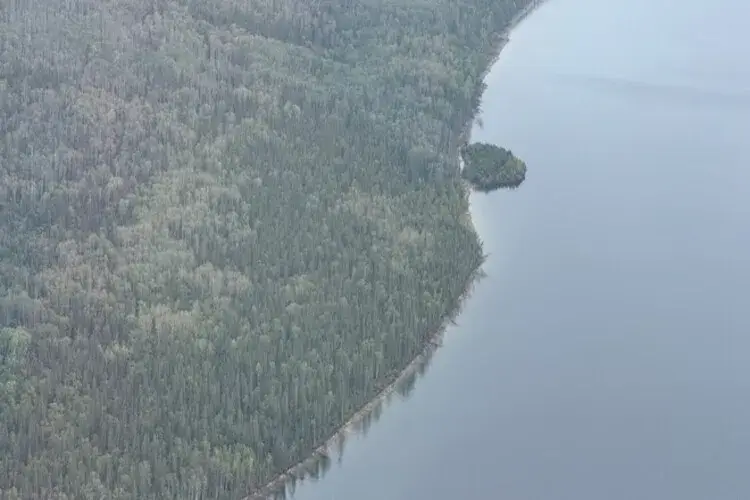
Floating island in Canada
The island was eventually found 30 kilometres from where it was originally spotted. Image: BC Hydro

A floating island of trees in British Columbia’s largest reservoir was spotted in August, disappeared entirely from satellite imagery, then reappeared


By Victoria Heath

Out in the Williston Reservoir in British Columbia, Canada, a newly discovered island has been garnering worldwide attention for appearing, and then seemingly vanishing, before reappearing again some 30 kilometres from where it was first spotted.

The landmass, covered in forest, was originally seen by a boater in August in the province’s largest reservoir. Images and videos of it went viral online, with some raising concerns that the videos were AI-generated.


Enjoying this article? Check out our related reads…

  • Five islands that no longer exist
  • Britain’s mascot debate reignites over Exeter Chiefs’ branding
  • Millions of satellites poised to enter space pose ‘grave threat’ to night skies
  • Into the urban jungle: how Zealandia became Wellington’s wild heart
  • Has summer disappeared? And what seasons are replacing it?

But satellite imagery confirmed the island was entirely real, estimated to be around 70 metres wide and 140 metres long – roughly the size of one-and-a-half American football pitches and covered in trees.

‘It’s not like they’re just a bunch of little shrubs. This is an island with larger trees, and it’s something you really have to wrap your mind around,’ said a spokesperson for BC Hydro, Bob Gammer. ‘It’s not an everyday thing. This is really, really unusual.’

The island has also been confirmed to be home to birds and small animals.

However, by 5 August, this new island no longer appeared in the same location in satellite data. For ten days, experts were baffled as to where it had gone. Eventually, officials in BC said they were able to locate the island again after it had drifted about 30 kilometres (18.6 miles) from its original location.

The mysterious island in Williston Reservoir. Video: CBC News

‘Floating vegetated islands of this size are rare, but they can occur in large reservoirs like Williston, particularly when water levels are higher than they have been for some time,’ said Gammer. ‘Higher reservoir levels can lift material that may have been lodged along the shoreline or in a sheltered bay, allowing it to float free.’

Speculation has arisen about how the island formed, with some theorising that it formed over many years from the accumulation of driftwood, where plants and trees took root.

Similar islands have been spotted around the world, including the Forty Acre Bog in Wisconsin’s Lake Chippewa, thought to have formed when peat bogs detached from the lake bottom and surfaced. The Forty Acre Bog is protected by state laws and is home to a plethora of wildlife, from frogs to salamanders.
Themes News Forests

Protected by Copyscape

Primary Sidebar

SUMMER SALE

GEOGRAPHICAL WEEKLY LOGO FREE - Sign up to get context, clarity and perspective in a noisy world, every Friday

Popular Now

What If We Get It Right?

Review: What If We Get It Right? by Ayana Elizabeth Johnson

Aid workers in Brazil

Why aid work is becoming more dangerous than ever

QUIZ: Capital Cities – Hard

QUIZ: Capital Cities – Hard

Two dice displaying 1.5 and 2C concept

World is set to cross 1.5°C global warming threshold

Aerial wildfire

How wildfires could push the climate crisis beyond repair

Footer

  • Facebook
  • Instagram
  • LinkedIn
  • Reddit
  • TikTok
  • Twitter
  • YouTube

Geographical print magazine cover

Published in the UK since 1935, Geographical is the official magazine of the Royal Geographical Society (with IBG).

Informative, authoritative and educational, this site’s content covers a wide range of subject areas, including geography, culture, wildlife and exploration, illustrated with superb photography.

Click Here for SUBSCRIPTION details

Want to access Geographical on your tablet or smartphone? Press the Apple, Android or PC/Mac image below to download the app for your device

Footer Apple Footer Android Footer Mac-PC

More from Geographical

  • Subscriptions
  • Get our Newsletter
  • About Us
  • Contact Us
  • Advertise with us
  • Privacy policy
  • Terms & Conditions

Copyright © 2026 · Site by Syon Media