The warning lights are flashing, but the building blocks of a different civilisation already exist – and they work
By Jeremy Lent
Something has shifted in the cultural atmosphere. Not so long ago, it was possible to dismiss fears of democratic collapse and ecological breakdown as the anxieties of doom sayers. Today, the evidence is harder to wave away. Authoritarianism is consolidating across four continents. Inequality has reached levels not seen since the Gilded Age. And the natural systems that underpin all human civilisation – the climate, the ocean currents, insect populations and the soil – are fraying in ways that no amount of optimism can obscure.
Enjoying this article? Check out our related reads…
Into this moment has stepped a new agenda that calls itself ‘abundance’. Its premise is seductive: technology, deregulation and accelerated growth will solve these crises faster than any structural reform. Build more. Move faster. Trust the market. The warnings about limits and redistribution are, in this view, a counsel of unnecessary despair.
I want to suggest something different.
The real counsel of despair is to double down on the system that produced these crises in the first place and call it hope. The question worth asking is not whether to grow faster or slower. It’s what our civilisation is for. What if the organising principle of society were human and ecological flourishing, rather than the endless extraction of profit? What would change? The answer, I want to argue, is a great deal – and more significantly than most people realise.
The operating system beneath
Every society runs on a largely invisible operating system: the assumptions embedded in its laws, its institutions and its measures of success. Our current operating system treats the natural world as a resource to be exploited, measures success almost exclusively through GDP, concentrates power in the hands of those who already hold capital, and encodes in law the primacy of shareholder returns over every other consideration. These are not natural laws, but design choices. And, as such, they can be redesigned.
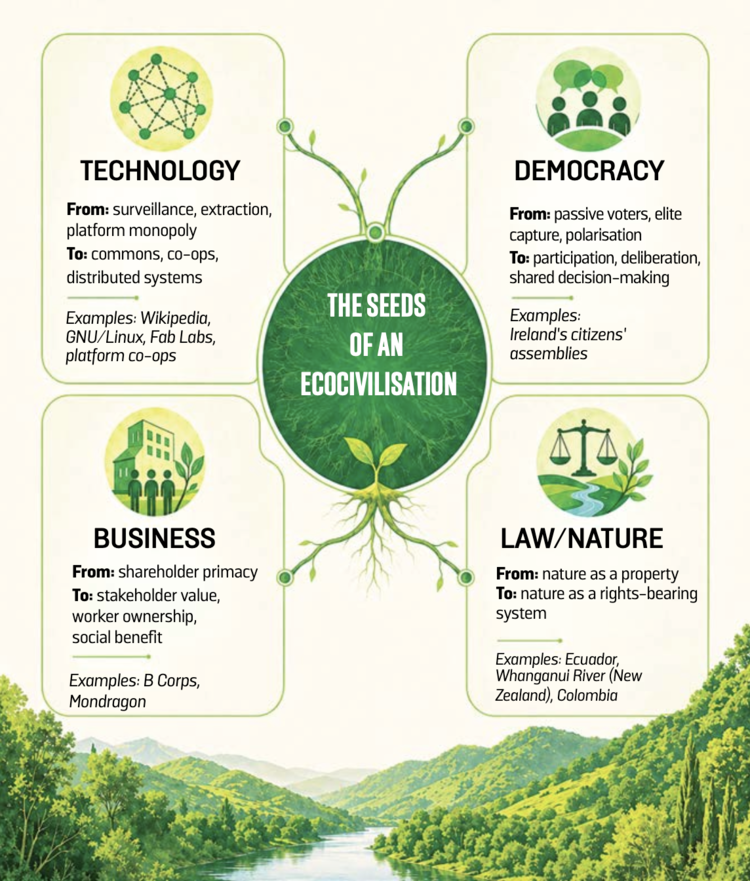
This matters because, in the current moment, we’re at risk of accepting a false binary: either the dysfunctional status quo or the authoritarian nationalism that has positioned itself as its only alternative. There is a third path. Its stepping stones are not merely theoretical. In many cases, they already exist in prototype form – in functioning democracies, life-inspired technologies and legal systems that have begun to encode a different relationship with the living world. What they lack is not proof of concept, but scale.
Technology that empowers
The precious resource of the digital economy is data – information about what we say, where we go, what we like and how we’re feeling. Because of network effects, the largest platforms keep growing, making their data ever more valuable to advertisers in a self-reinforcing cycle. The result is that the Big Five tech companies now account for roughly 25 per cent of the S&P 500’s entire market capitalisation.
For those whose livelihoods depend on these platforms, the consequences are what Shoshana Zuboff calls ‘surveillance capitalism’: algorithms tracking every movement, determining pay and employment through efficiency rankings, and reducing workers to a precarity that some analysts compare to medieval serfdom. Meanwhile, Big Tech’s ‘race to the bottom of the brainstem’ – engineering addiction to maximise engagement – has driven a measurable rise in adolescent mental health crises. AI will intensify every one of these dynamics.
The alternative takes its inspiration from nature’s own technology of self-organisation. The largest structure on Earth is not human-made but a termite complex in Brazil the size of Great Britain, constructed without any centralised blueprint through stigmergy, where each individual leaves traces that guide others, generating collective intelligence that is decentralised, adaptable and scalable.
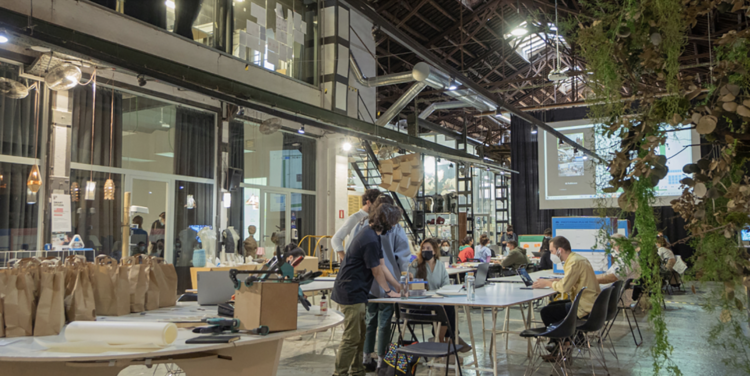
A new generation of technologists is applying precisely this principle. Commons-based peer production – the model behind Wikipedia and GNU/Linux – creates shared resources without hierarchical control. Cosmo-local Fab Labs, now spanning 2,500 centres across 125 countries, share designs freely while enabling local manufacturing tailored to community needs. Platform cooperatives return the roughly 25 per cent commissions extracted by Uber and Airbnb to the workers themselves.
These pioneering models hint at the potential of technology to benefit society by inverting dominant power structures, with data distributed rather than centrally controlled.
Democracy for everyone
One of the most important social experiments of the past two decades has received almost none of the attention it deserves: citizens’ assemblies.
In Ireland, a randomly selected citizens’ assembly, representative of the population by age, gender, class and region, deliberated for months on the question of abortion – a topic so politically toxic that politicians had avoided it for decades. Its recommendation, which went to a referendum and passed by a wide margin, resolved what had seemed an intractable conflict. The same model has produced breakthroughs on climate, health policy, electoral reform and gender equality.
Ireland is not alone. France, Belgium, Australia, Taiwan and dozens of municipalities have deployed deliberative democracy in various forms. The result is the same: when citizens are given time, information and structured space to reason together, they reach conclusions that are more nuanced, more forward-looking and more broadly supported than those produced by conventional electoral politics. This matters enormously at a moment when democratic institutions are losing legitimacy.
The crisis of democracy is often portrayed as a crisis of values – as though people have simply stopped caring about the common good. But what the evidence from citizens’ assemblies suggests is that the problem is structural: people have been excluded from meaningful participation. Give them a participatory role, and they engage with a seriousness that surpasses that of most elected politicians.
Corporations redesigned
At the heart of our current operating system sits the corporation – legally structured to maximise returns to shareholders, subordinating all other considerations to the doctrine of fiduciary duty. This isn’t the only way to organise large-scale economic activity. It’s a choice made in the 19th century, embedded in law and never seriously revisited.
What would it mean to redesign the corporate charter? In practical terms, it would mean requiring companies to demonstrate benefit to workers, communities and the natural world as a condition of their legal existence, not merely as an optional add-on. The B Corporation movement, which now encompasses tens of thousands of firms globally, has demonstrated that profitable enterprises can be run on this basis. Jurisdictions in the USA and Europe have created legal frameworks for benefit corporations, but as long as these frameworks are voluntary, they have virtually no measurable impact on our civilisational trajectory. If, however, they were mandatory, our entire world system would change.
Beyond corporate structure lies the question of ownership. Worker-owned cooperatives consistently outperform investor-owned firms on measures of employee wellbeing and community investment, and can match them on productivity. The Mondragon cooperative in the Basque Country, which has operated successfully for nearly seven decades and employs nearly 80,000 people, remains one of the most important economic experiments of the modern era – and one of the most systematically ignored in mainstream economic debate.
Rights that extend to the living world
Perhaps the most radical reorientation of all – and the one that most directly challenges the assumptions of our current operating system – is the emergence of ‘rights of nature’ law.
Ecuador enshrined the rights of Mother Earth, Pachamama, in its constitution in 2008. New Zealand granted the Whanganui River legal personhood in 2017. Since then, the movement has spread to Colombia, Canada and Bangladesh, among a growing number of jurisdictions worldwide. The legal logic is straightforward: corporations can hold legal rights; there is no principled reason ecosystems can’t. The practical implication is transformative.
Rather than a mystical notion, this represents a legal technology for encoding what ecological science has long established: that human wellbeing is inseparable from the health of the systems we inhabit. A civilisation that treats the Amazon as a resource to be liquidated is not just ethically bankrupt – it’s also strategically incompetent, destroying the very foundations of its own existence.
A different story
What connects all of these alternatives – from democratic innovation to corporate law to rights of nature – is a different understanding of what civilisation is for. Not the maximisation of extraction, the concentration of power or endless growth on a finite planet, but the setting of conditions under which all life, human and non-human, can genuinely flourish.
Far from being utopian ideals, these institutional designs exist and have been tested. They can be studied, refined and scaled. What is required for them to have a meaningful impact on the direction of our civilisation is a shift in what we think is possible – and a willingness to name the current system for what it is: not an inevitable condition of human nature, but a set of choices that can be deconstructed and replaced.
Yes, the warning lights are flashing. But the alternative is already being built, piece by piece, community by community, law by law, across the world. Our collective task is to recognise it, connect it and accelerate it. That is the civilisation worth fighting for.
Jeremy Lent is co-founder of the Ecocivilization Coalition and founder of the Deep Transformation Network. His previous books are The Web of Meaning and The Patterning Instinct.