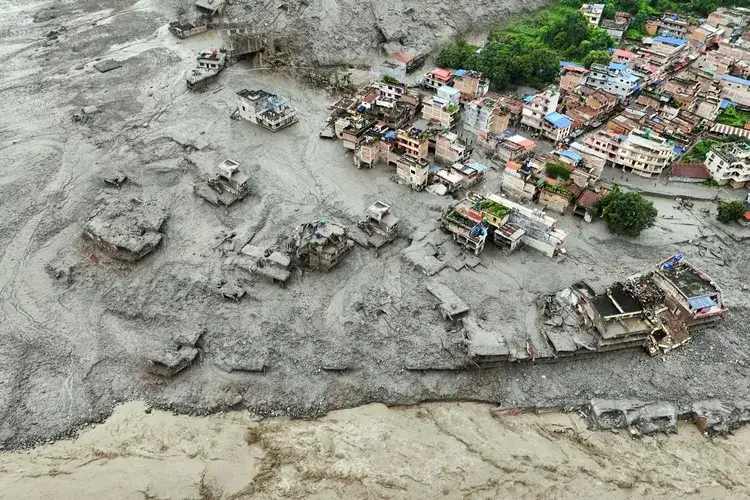
Scientists believe the climate crisis played a role in deadly floods last month in a country responsible for less than 0.1 per cent of global greenhouse gas emissions
By
Nepal is seeking $20million in compensation following the devastating floods in the country last month, arguing that major emitters should be held responsible for climate-related impacts faced by countries that contribute little to global warming.
The flash floods in the Bhotekoshi River basin have killed more than 1,380 people and left at least 5,500 missing after floodwaters mixed with debris, mud, stones and rocks destroyed homes, bridges and hydropower infrastructure.
Related reads…
Nepal’s foreign minister Shisir Khanal said Nepal has sought relief from the UN’s Fund for Responding to Loss and Damage – created in 2022 to help vulnerable countries recover in the wake of climate-related disasters – and requested $20million in climate-related damages.
‘We have contributed so little to climate change,’ Khanal said. ‘It is imperative for those in the global community who benefit from larger, much more polluting economies, and whose historical contribution to greenhouse gases is much bigger than ours, to accept a shared responsibility. This affects all of humanity.’
Khanal said that the compensation requested was ‘obviously not nearly enough to cover the damage that we have sustained’, with some estimates projecting that damages in Nepal could exceed $5billion. Around 20,000 homes, as well as Nepal’s main highway, will need to be rebuilt. Villages washed away by floodwaters may also need to be relocated to higher locations.
‘The global community should not see this as a one-off disaster; it should be viewed in the context of the changing climate in the Himalayas,’ he said. ‘We know it is going to be a recurring scenario that more and more communities, not just in Nepal but around the world, will have to face.’
The UN has already admitted that its loss and damage fund is facing a ‘significant financing gap’ after receiving requests totalling $2.8billion from 119 countries. So far, $ 400 million has been provided by the international community.
‘There is a risk of the fund exhausting its capital by the end of 2027, which could result in a loss of operational momentum and expose [it] to reputational risk,’ said the fund back in April.
What caused the floods?
Satellite analysis showed that the flash floods in Nepal were caused by the collapse of bedrock beneath a glacier.
Scientists have not conclusively linked the Nepal disaster to the climate crisis, but have acknowledged that rising temperatures can melt frozen mountain slopes, destabilising them. Back in 2023, the UN said Nepalese mountains had lost almost one-third of their ice in more than 30 years due to global warming.
In an interview with The Guardian, Khanal said the recent disaster was far more extreme than flooding usually seen during monsoon season, and that the damage in Nepal was similar to that of its 2015 earthquake, which caused nearly 9,000 deaths, left 22,000 injured and resulted in an estimated $10billion in economic damages.