A little-known legal mechanism has awarded fossil fuel companies billions in damages from countries trying to go green
By
With control over many of the world’s most important energy resources – and profits to match – fossil fuel companies are among the world’s most powerful corporate actors. But behind the drilling rigs, pipelines and balance sheets lies a less visible source of influence: a legal mechanism that can allow companies to challenge government climate policy.
Investor–state dispute settlement (ISDS) is embedded in many international investment agreements. It allows foreign investors to seek compensation from states when government action allegedly harms their investments. Fossil fuel companies have used it repeatedly – securing at least US$82.8 billion in damages and settlements – and critics say the threat of further claims is slowing the transition away from coal, oil and gas.
Enjoying this article? Check out our related reads:
Most fossil fuel investors claiming against states are based in high-income countries. Businesses based in the US, the UK, the Netherlands, Spain, and Canada account for 51 per cent of fossil fuel claims. Meanwhile, almost 80 per cent of contract-based ISDS claims are put forward against low-income countries.
‘We would not say an asbestos company is entitled to compensation for a ban on asbestos when it’s evidently bad for human health. And I do not see a difference between that type of regulation and climate regulation,’ said senior researcher at Columbia Law School in New York, Martin Dietrich Brauch.
A concrete example of the ISDS having an impact on reducing climate action ambition can be taken from New Zealand. New Zealand refrained from cancelling existing offshore oil exploration contracts, which meant it could not join the Beyond Oil & Gas Alliance (BOGA) as a core member. ‘It would have run foul of investor-state settlements,’ said former New Zealand minister for climate change, James Shaw.
With 54 per cent of fossil fuel ISDS cases kept confidential, it is difficult to accurately gauge the resulting shortfall in ambition. Essentially, it contributes to a general enabling environment for fossil fuel companies, in which their interests come at the expense of the communities the state has a duty to protect. Ultimately, across the world, communities are already living in the wake of a warming planet, facing impacts that only intensify when governments are discouraged from taking action.
These impacts can be seen in a variety of places, from the polluted Niger Delta in southern Nigeria to the island nation of Vanuatu.
How fossil fuel extraction reshaped life in the Niger Delta
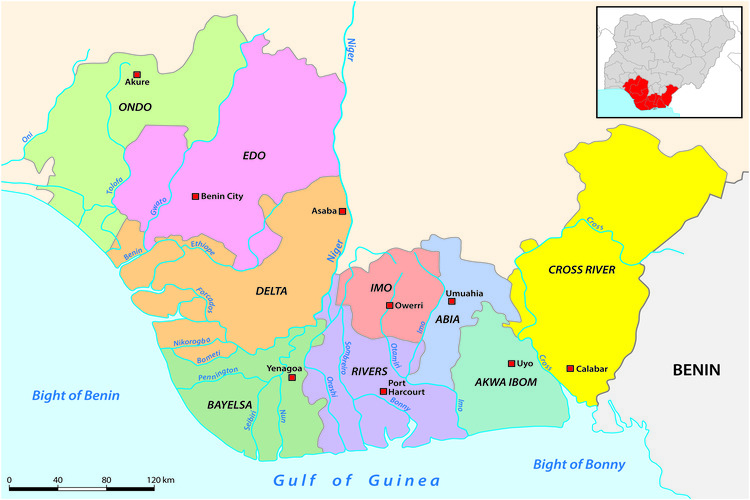
In addition to contributing to climate change, localised fossil fuel extraction can have detrimental impacts on livelihoods.
The Niger Delta lies at the heart of the country’s oil-driven economy, which produces 2 million barrels of oil every day. Around 31 million people live in the region which receives little benefit from oil production despite suffering from appalling environmental and health outcomes.
Leaks from oil pipelines and facilities are widespread, with one estimate suggesting that over 30 million barrels of oil were spilt by the Shell Petroleum Development Company of Nigeria (SPDC) between 1976 and 2001. The gradual and sustained seeping of oil into groundwater sources contaminates drinking water and explains why in the wells in Ogoniland, quantities of the harmful carcinogen, benzene, are 2,600 times higher than WHO guidelines.
The pollution also extends into aquatic life. Fish are poisoned when coated with oil and habitats can take decades to recover. And into agriculture – crops are destroyed, land is rendered unusable and food is contaminated. Local people are at risk simply from eating, drinking and breathing in the air in an environment facing a cancer ‘epidemic’.
Vanuatu – a country on the front line of climate change

Just last week, the General Assembly at the UN adopted a resolution backing an International Court of Justice advisory opinion stating that countries are legally obliged to address climate change. The UN resolution was led by Vanuatu, an island nation in the Pacific Ocean.
Vanuatu is a country that is particularly vulnerable to the impacts of climate change. Many of its 82 volcanic islands lie just 0.9 metres above sea level. With much of the population living in coastal areas, rising sea levels pose serious risks to communities and infrastructure. Six villages on four of its islands have been relocated as water sources have become increasingly salty.
Vanuatu is also experiencing more incidences of severe tropical cyclones. In 2015, Cyclone Pam damaged an estimated 90 per cent of all buildings and impacted half the population. This makes clear just how vulnerable Vanuatu is to the unrelenting impacts of climate change.
Fishing and tourism are key industries in Vanuatu. Cyclones and warmer ocean temperatures have destroyed coral reefs through coral bleaching. Additionally, a downward pressure on tourism inflows is expected. A harsher and more unpredictable climate and strained infrastructure simultaneously reduce the attractiveness of the country for foreign visitors and the ability of its services to cope.