
• Skip to main content
  • Skip to secondary menu
  • Skip to primary sidebar
  • Skip to footer
Geographical

Geographical

Official magazine of the Royal Geographical Society (with IBG)

  • Home
  • Briefing
  • Science & Environment
  • Climate
    • Climatewatch
  • Wildlife
  • Culture
  • Geopolitics
    • Geopolitical hotspots
  • Study Geography
    • University directory
    • Masters courses
    • Course guides
      • Climate change
      • Environmental science
      • Human geography
      • Physical geography
    • University pages
      • Aberystwyth University
      • Brunel University
      • Cardiff University
      • University of Chester
      • Edge Hill University
      • The University of Edinburgh
      • Newcastle University
      • Nottingham Trent University
      • Oxford Brookes University
      • The University of Plymouth
      • Queen Mary University of London
    • Geography careers
      • Charity/non-profit
      • Education & research
      • Environment
      • Finance & consulting
      • Government and Local Government
    • Applications and advice
  • Quizzes
  • Magazine
    • Issue previews
    • Subscribe
    • Manage My Subscription
    • Special Editions
    • Podcasts
    • Geographical Archive
    • Book reviews
    • Crosswords
    • Advertise with us
  • Subscribe
    • Direct Debit Changes

How deep-sea vents can help warn of future eruptions

24 November 2025
2 minutes

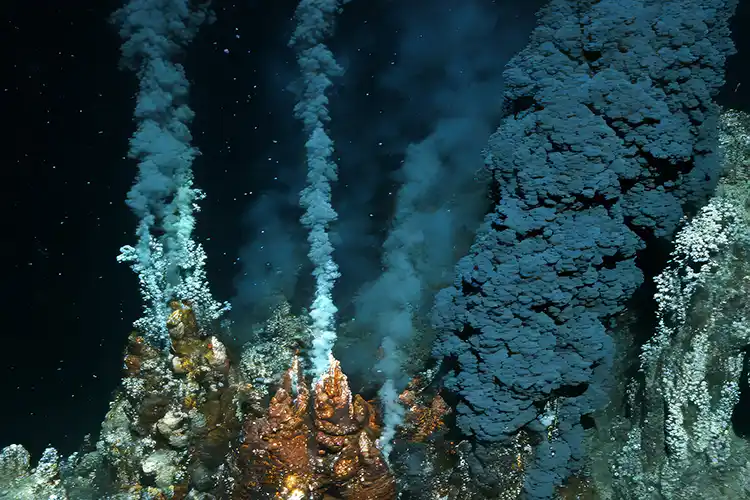
A ‘black smoker’ – a deep-sea hydrothermal vent. Image: Shutterstock

A 35-year study of deep-sea vents has uncovered temperature clues that may warn of future eruptions


By Bryony Cottam

The East Pacific Rise (EPR) is a massive mid-ocean ridge that runs more than 16,000 kilometres from near the Gulf of California into the southeastern Pacific Ocean.

It’s the fastest-spreading ridge system on Earth, pulling apart at rates reaching 150 millimetres per year and lifting the seafloor 1,800 metres above the abyssal plains in the process.


Enjoying this article? Check out our related reads:

  • Bacteria near Mariana Trench ‘sense’ Earth’s magnetic field
  • Should we mine the deep-sea floor?
  • New Arctic Ocean map marks key milestone in global seafloor mapping project ‘Seabed 2030’
  • Sharks, rays & chimaeras face threats from deep-sea mining
  • Expedition searching for new species in Arctic Ocean

All this rapid tectonic activity makes the EPR a very volcanically active place, and it’s home to some of the world’s best- studied hydrothermal vents – or ‘black smokers’, as they’re often called – which release a continuous stream of chemical- rich water that can reach temperatures above 350°C.

‘Mid-ocean ridges are where much of Earth’s internal thermal energy is transferred to the ocean,’ says Dan Fornari, a marine geologist at the Woods Hole Oceanographic Institution in the USA. ‘Until now, we lacked a direct way to link what we can measure at the seafloor to what’s happening deep below, where magma accumulates and drives eruptions.’ A new study shows that the two are closely connected.

Discover more about hydrothermal vents. Video: Woods Hole Oceanographic Institute

The research team, led by Thibaut Barreyre, a marine geophysicist at the French National Centre for Scientific

Research, set to work assembling data collected from the vents over the last 35 years to see what it might reveal about the magmatic and tectonic processes that occur miles beneath the seafloor.

They found that vent temperatures at the EPR rose steadily from around 350°C to nearly 390°C in the years preceding two known eruptions – one that lasted from 1991 to 1992 and another from 2005 to 2006. Following the second event, temperatures dropped back to about 350°C but have been climbing ever since – likely driven by rising pressure in the oceanic crust, itself caused by the gradual increase of magma located roughly 1.5 kilometres beneath the seafloor. It’s a clear signal, the researchers say, that could help
us anticipate eruptions before they occur – which could prove beneficial for mitigating hazards to underwater infrastructure such as fibre-optic cables.

The team confirmed an eruption took place this year, one they had previously forecast based on hydrothermal data collected from the vents. ‘This is an extraordinary step forward in submarine geophysics,’ says Fornari. ‘Hydrothermal vents are not just biological oases – they are windows into the dynamic processes that shape our planet.’

Themes Briefing Oceans

Protected by Copyscape

Primary Sidebar

OUR UK DIRECT DEBITS ARE CHANGING
WINTER SALE

Geographical subscriptions

GEOGRAPHICAL WEEKLY LOGOFREE - Sign up to get global stories, told well, straight to your inbox every Friday

Popular Now

ALLENTOWN, PENNSYLVANIA - OCTOBER 29: Republican presidential nominee, former President Donald Trump speaks during a campaign rally at The PPL Center on October 29, 2024 in Allentown, Pennsylvania.

What is it that Trump wants from Greenland?

Why the US seizure of Maduro echoes a century of gunboat diplomacy

Why the US seizure of Maduro echoes a century of gunboat diplomacy

Children in Seoul, South Korea

The top five OECD countries experiencing fertility rate declines

Dandelions

Winter blooming of hundreds of plants in UK is a ‘visible sign’…

Venezuela oil

Why is Venezuela a failed petrostate?

Footer

  • Facebook
  • Instagram
  • LinkedIn
  • Reddit
  • TikTok
  • Twitter
  • YouTube

Published in the UK since 1935, Geographical is the official magazine of the Royal Geographical Society (with IBG).

Informative, authoritative and educational, this site’s content covers a wide range of subject areas, including geography, culture, wildlife and exploration, illustrated with superb photography.

Click Here for SUBSCRIPTION details

Want to access Geographical on your tablet or smartphone? Press the Apple, Android or PC/Mac image below to download the app for your device

Footer Apple Footer Android Footer Mac-PC

More from Geographical

  • Subscriptions
  • Get our Newsletter
  • About Us
  • Contact Us
  • Advertise with us
  • Privacy policy
  • Terms & Conditions

Copyright © 2026 · Site by Syon Media