Rory Walsh explores the origins of a Dartmoor literary landmark

View • Rural • South West England • Web Guide
When the weather is good, Dartmoor is magical. It is a seemingly untouched landscape, where wild ponies wander among rolling hills and trickling streams. When the weather is bad, Dartmoor is terrifying. Shrouded in mist and lashed by horizontal rain, it becomes a bleak place where sinister, strange rocks loom over one of Britain’s remotest prisons. It is no surprise that Dartmoor has inspired centuries of myths and legends.
Some relate to the tors. These gnarled stacks of granite, found on almost every hilltop, are one of Dartmoor’s defining features. From below, Hound Tor resembles a huddled group of animals. Local lore claims that a giant called Bowerman went hunting with his hounds and stumbled upon a coven of witches. The witches turned them into stone. While the dogs became Hound Tor, the nearby rock Bowerman’s Nose is said to be the petrified hunter.
Enjoying this article? Check out our related reads…
Hound Tor also attracted a famous fictional detective. Sherlock Holmes author Sir Arthur Conan Doyle visited Dartmoor in 1901. Doyle heard the Bowerman legend alongside other tales of demonic dogs. His novel The Hound of the Baskervilles is set on Dartmoor, with Holmes and a mysterious ‘hell hound’ roaming the hills at night. Fans from around the world have visited Hound Tor ever since.
The true story of Hound Tor appears up close. Piles of rock have been worn smooth, with deep fissures between them. The tors originated 280 million years ago, when huge tectonic movements created a mountain chain. At the same time, molten magma deep in the Earth’s crust was forced upwards into the base of the mountains. There, several kilometres below the surface, the magma solidified into granite.
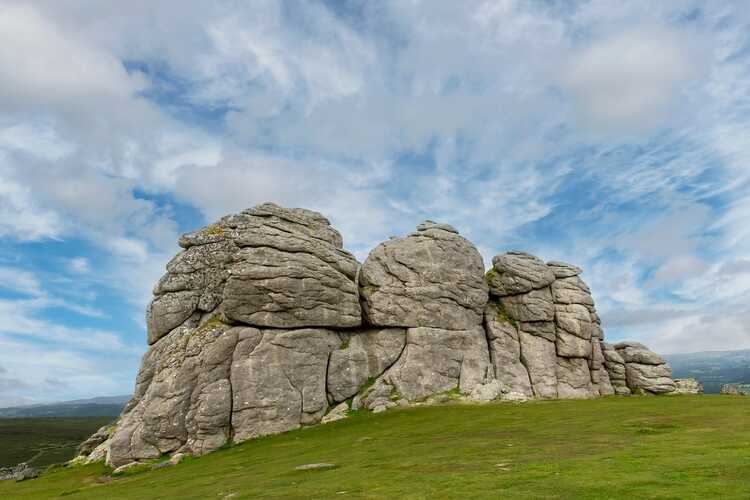
Millennia of erosion – by wind, rain and ice – wore the mountains away. The tors are all that remain of the granite core. Their blocky shapes come from freeze–thaw action. Rainwater that seeped into cracks in the granite repeatedly froze and thawed. This put great pressure on the rock, enlarging the cracks and causing sections to crumble away. The dramatic tors were left behind, like giant pimples on Dartmoor’s surface.
Today, the tors are popular with climbers. At Hound Tor, there is evidence of an earlier human settlement. Below the outcrop are the hummocky remains of an abandoned village. Hundatora was recorded in the Domesday Book, but harsh daily life on the moor meant it was deserted by the fifteenth century. Meanwhile, on the hill above, Hound Tor’s craggy dog story endures.