
Across the border from New York, Quebec has forged a national identity and global city of its own
By
New York is known as the ‘Empire State’. The Empire State Building in Manhattan embodies the modernity and ambition of 20th-century North America. Jay-Z and Alicia Keys sang Empire State of Mind as a heartfelt, flag-waving tribute to New York City.
The origins of the sobriquet are unclear, but empire encapsulates the state’s resources and wealth. New York City serves as an Atlantic gateway and economic capital for the USA’s continental empire. With its high-rise skyline, entertainment industries and financial might, NYC is the ultimate North American metropole.
Could anywhere else have rivalled New York?
Bordering New York state to the north is Quebec. I recently visited this francophone Canadian province and was first impressed by its natural landscape and ecology. I toured the Great Lakes–St Lawrence Lowlands.
On the border with Ontario, I saw bears, moose and wolves. At Tadoussac, the Saguenay Fjord meets the maritime estuary of the St Lawrence River. A confluence of nutrient-rich fresh and salt water produces a marine-mammal-watching hotspot, with porpoises, belugas and humpback whales. Against that wondrous backdrop, the abundance of exploitable natural resources was visible from the highways: huge cereal farms, trucks carrying ore and vast forests.
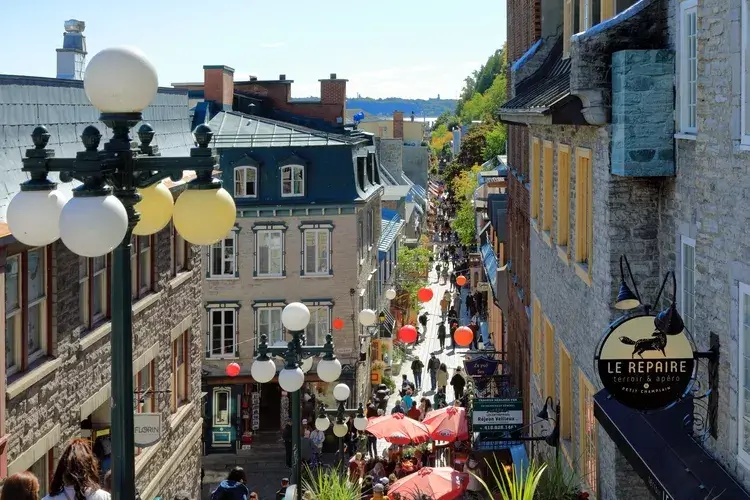
I was anticipating that the epic physical geography of Canada’s largest province would be spectacular, but I wasn’t prepared for the vibrancy of the human geography of Quebec’s two major cities. First, I visited Quebec City, which dates from 1608.
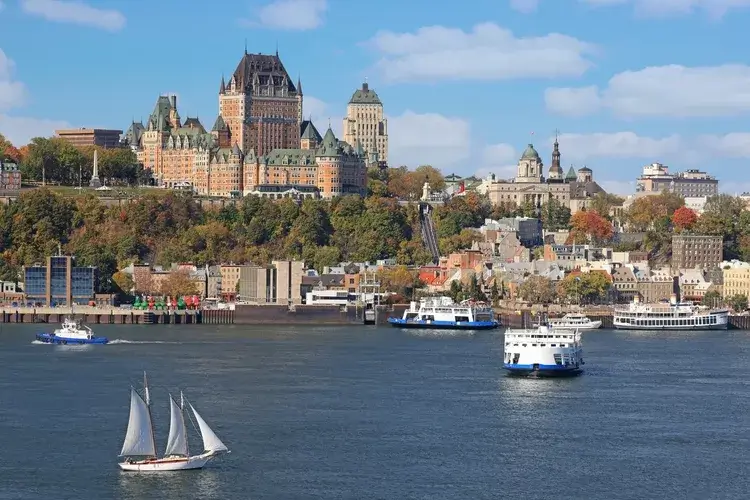
Set on a promontory above the St Lawrence, the city is dominated by the Fairmont Le Château Frontenac, which lays claim to being the most photographed hotel in the world. Before the hotel, this strategic site housed the Saint-Louis forts and châteaux, a seat of French and later British colonial power.
Eastern Canada was the locale for a monumental struggle for territorial control between the French and British, and their respective Indigenous allies. The war finished with a treaty in 1763 that ceded France’s claims in the northeast of the continent.
Quebec City is now the provincial capital and the political heart of Québécois national identity. In 2006, following decades of debate and two unsuccessful referendums on independence, the Canadian House of Commons passed a motion recognising that ‘the Québécois form a nation within a united Canada’. The motion was symbolic rather than a grant of new constitutional powers, but formally acknowledged Quebec’s distinct cultural and national identity.
In Canada, the word ‘nation’ also appears in ‘First Nations’, a collective term for many distinct Indigenous peoples, including the Cree and Mohawk, who inhabited the land before European colonialism. Montreal was larger and much more cosmopolitan than Quebec City and instantly reminded me of New York. Its urban landscape carried some of those same cultural currents of 20th-century modernity and confidence.
A sense of monument and scale was embodied in the towering skyscrapers, world-class arts scene and the Stade Olympique, which staged the biggest sporting event in the world in 1976. The 1970s also marked the period when Montreal was overtaken by Toronto as Canada’s largest metropolitan area. For the previous century and a half, it had been Canada’s industrial and financial centre – a wealthy port that grew as the entrepôt for a vast resource economy. Today, it’s the ninth-largest city in the whole of North America.
Across rural communities and major cities, the cultural importance of Québécois identity is ever present. I caught a TV programme in which the presenter spent many minutes preparing a fleurdelisé – the Quebec flag. The halyard, cords and folds were intricately set in a precise pattern.
The handsome royal-blue banner takes pride of place on public and private buildings and, in the order of precedence, always comes before the maple leaf.
Quebec is three times the size of France and, with a population of just over nine million, has roughly as many people as Switzerland or New York City, so has a healthy claim to nationhood. Nation is a word that belongs to the present as much as the past.
Québécois national identity continues to be made and imagined, evolving independently of its French heritage. What emerges isn’t an unrealised remnant of a French empire, but a Québécois global city set within a province epic in scale – unique, proud and worth celebrating for its own culture and natural history.