
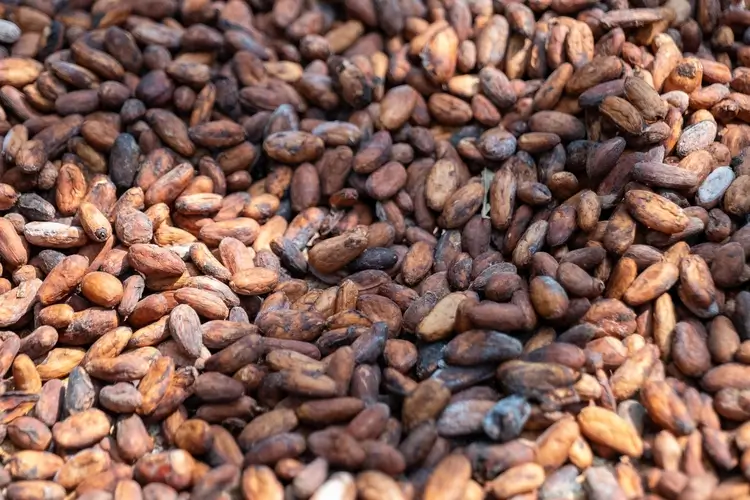
Heavy rainfall is an ‘underappreciated risk’ threatening cocoa production – but better warnings before extreme rains could help farmers protect their harvests
By
A study has found that heavy rainfall – rather than temperature or water availability – is the main reason for cocoa production shortfalls across the tropics, according to scientists at Harvard and the University of Ghana.
Nearly six million smallholder farmers depend on cocoa for their primary income, yet until now the causes of production shortfalls have been poorly understood.
Lead researcher of the study Anna Lea Albright said that while drought is a ‘real threat’ to cocoa, the opposite extreme of too much rain has not been ‘as well articulated’ – particularly heavy rain while trees are flowering.
Climate change is impacting both the intensity and timing of rainfall across the world, with every one degree Celsius of global warming making the atmosphere hold around seven per cent more moisture.
‘You can think of it like a bucket that’s getting bigger: holding more water, so that when it does rain, more comes down at once,’ Albright said.
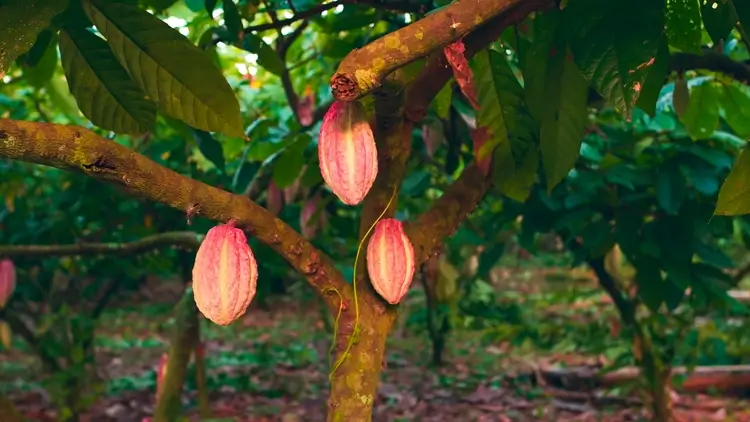
Heavy rainfall is causing vast, unpredictable swings in cocoa harvests, surging raw cocoa prices and leading to smaller bars or entirely reformulated products. In 2024, cocoa reached a record-high value of around $12,200 per tonne, almost 19 times more expensive than oil, weight-for-weight, on the same day. This was due to extreme rainfall in West Africa in 2023, more than double the 30-year average for that period.
In Ghana – one of the world’s largest cocoa-growing countries – the most impactful rains occur during the April to June wet season, when cocoa trees are flowering, and young pods begin to form. During the November to February dry period, insufficient rainfall can damage crops as young pods continue to develop.
Even looking at two other major producers on other continents – Ecuador and Indonesia – a similar pattern was found in the new study: years with heavier wet-season rains tended to be worse for cocoa.
To support farmers, researchers emphasise the importance of forecasting. Rains that damage cocoa plants are linked to larger climate patterns such as El Niño or shifts in sea-surface temperatures in the Atlantic – weather patterns that can be predicted early enough to give farmers warning. Currently, a strong El Niño is developing, suggesting heavy rainfall in coastal Ecuador and drier weather across both Indonesia and West Africa.
Enjoying this article? Check out our related reads…
‘If extreme rainfall becomes more frequent or more intense, can farmers adapt quickly enough?’ said Albright. ‘That is particularly difficult for cocoa because these are perennial trees. You cannot just change what you plant next year. Decisions about cocoa production are decisions that can last for decades.’
However, rain is not the only problem that Ghanaian cocoa farmers face: they must contend with ageing trees, gold mining, smuggling, and rising fertiliser costs, all of which lead to lower cocoa production. In particular, diseases and pests plague cocoa, with estimates placing losses from these as high as 30 to 40 per cent of global production (equivalent to $1-2billion).
‘We hope the findings will help reduce future crop damage, possibly by encouraging more canopy cover to shield cocoa flowers from large raindrops or by retaining more leaf litter to prevent splashes that transmit infection from soil to cocoa pods,’ said senior author Peter Huybers, chair of Harvard’s Department of Earth and Planetary Sciences.
Cocoa production has increased steadily over the last 40 years, with Côte d’Ivoire and Ghana remaining the two largest cocoa-growing countries in the world – representing 49 per cent of global cocoa production. One-third of the annual harvest is ground in Europe alone.



