After years away, Anthony Ham returns to the Algerian Sahara, where ancient rock art, Tuareg hospitality and vast, wind-carved landscapes revive an old love affair with the desert
My relationship with the Sahara began nearly three decades ago, in Agadez in northern Niger, on a brief foray into the Aïr Mountains. The love affair was instant. In the years that followed, I sought out the desert’s silences. In Mauritania, in ancient caravan towns such as Chinguetti, I sat surrounded by historic manuscripts and listened to the stories of their librarians, and explored oases such as Terjit. Across Libya, I ran out of petrol near the Cave of Swimmers, studied the rock art of Jebel Acacus, and spent weeks exploring the sand seas of Ubari and Murzuq. And in Mali, I used Timbuktu not as the end goal of my travels but as a starting point for going further.
Enjoying this article? Check out our related reads…
The Sahara and its soulful landscapes were my playground, and I forged deep connections and lifelong friendships among the Tuareg, who were my constant companions. I fell in love with their stories. I felt at home in Saharan landscapes. I adored how far it was from the rest of the world and its noise. I craved its silence.

And then, in 2009 in Mali, on an expedition to Araouane, a remote, sand-drowned town a day’s drive north of Timbuktu, al-Qaeda militants passed through the settlement the day before I arrived. I had been incredibly lucky. That same weekend, four European tourists attending a music festival further west in the Malian Sahara were kidnapped. One of the tourists was later executed. It set off a wave of kidnappings across the Sahara.
The door to travel in the Sahara had begun to close. Libya remained safe for a time. On my last visit there, early in 2010, the authorities closed the country’s Saharan south the day after I returned to Tripoli from Waw al-Namus, a nightmarish black-sand volcano in the desert’s heart. Two months later, Libya descended into civil war.
It was difficult not to read in these near misses a warning. I loved the Sahara as deeply as ever, but it was no longer safe to return.
For 15 years, I watched the Sahara from afar. I kept in touch with friends. I relived my past journeys through photos of sand dunes, through the music of Tartit and Tinariwen, and through trying to find echoes of the Sahara in other deserts – the Namib and the Kalahari in Africa, the Gibson and the Great Sandy in Australia.
But it wasn’t the same.
And then, early in 2025, the opportunity arose to return to southern Algeria. Much of the Sahara and Sahel remained too dangerous to visit – violent insurgencies and the threat of kidnappings kept Niger, Mali and Burkina Faso off-limits, while Libya had long ago divided into fiefdoms controlled by warlords. Yes, it was possible to ride a camel into the sand dunes of Tunisia and Morocco, but I had done both before and they were more excursion than immersion. And so I booked my flight to Djanet.
Arriving in Algiers, and later Djanet, was reassuringly familiar, a time warp that told me how little had changed – hours spent in cavernous airports where nothing was open, bored, chain-smoking airline or immigration officials. The airport bureaucracy in Algiers was masterful in its insistence on arcane procedures – despite my paperwork being in order, I visited five different desks and waited for nearly two hours for my visa-on-arrival to be issued, by which time I had missed my connecting flight. There were no ATMs, wi-fi was non-existent, although later it would elsewhere be widespread, and the décor was grey and provincial Soviet circa 1974.
It was like I had never been away.
Djanet, too, was as I remembered it, a classic caravan town of the Sahara that filled a wide valley carpeted with palm groves. The mud-brick old town clung to hillsides, rising above the oasis, crumbling yet somehow monumental. Local men passed the time in tea houses, while tourists lingered uncertainly, unsure whether it was okay to join them; it was. The fresh food market roused the city into life in the early morning, and at the Marché Traditionnel, sun filtered down through gaps in the roof as the call to prayer filled laneways; stalls sold homewares, cheap clothes, Tuareg swords and warm djellabas. Wherever I went, I was reminded, too, of the quiet yet enduring warmth of the Sahara’s people.

Soon we left behind the city for the drive north into the UNESCO World Heritage-listed Tassili n’Ajjer, a long range of dark desert mountains that runs close to the border with Libya. I was travelling with a guide, Abdessalem, and driver, Ahmad, two wise old Tuareg men.
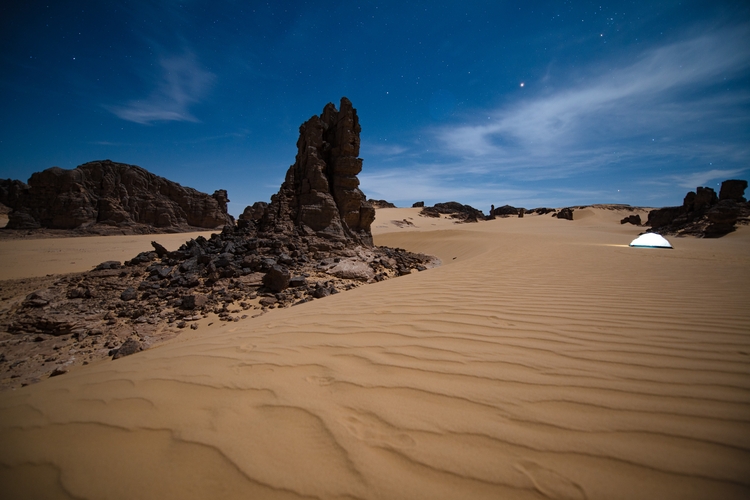
Over the days that followed, the trip took on a reassuring rhythm. Having slept on the sand beneath the stars, we would rise with the sun and set out early, when the Saharan sun bathed a landscape of brooding desert massifs and sand dunes in the golden light of morning.
We would drive for a while, then stop to look at rock art dating back thousands of years, or to explore a village. While Abdessalem and I explored, Ahmad would build a fire.
WHEN TO VISIT
• Dry and relatively mild conditions, with cool nights, prevail from November until March or April. Avoid travelling in the furnace-like summer, from May to September, other than for the Sebiba festival in Djanet in May–June.
TOUR OPERATORS
• Duneya Tours (duneyatours.com)
• Expert Algeria (expertalgeria.com)
• Fancy Yellow (fancyalgeria.com)
• Mouflon Voyages (mouflon-tourisme.com)
VISAS
• Getting a tourist visa (mfa.gov.dz/services-for-foreigners/entry-visa-to-algeria) from an Algerian embassy can take some weeks, but it’s cheaper than getting your visa on arrival and you pass through immigration more quickly.
• Visas on arrival are for those travelling with an Algerian tour company; make sure you have Euros or US dollars in cash for the fees on arrival, as well as a printed authorisation and itinerary from the company.
MONEY
• Bring more cash (Euros or USD) than you think you’ll need – internationally enabled ATMs are so scarce as to seem non-existent, and few places accept credit cards.
Ahmad is a Tuareg elder of the Kel Ahaggar, the most powerful of all the Tuareg confederations that dominate cultural life across the Sahara. Swathed in indigo, he was warm yet reserved, quick with a smile yet still and silent, a man of gravitas. The only time I ever saw him uncertain was at the airport when he was surrounded by men in uniform, men from the city.
Over the course of an unhurried hour, two or three times a day, he would brew and boil the tea, a rite of such patience that it almost had the quality of a sacrament. Despite the wonder of what I saw, the sharing of tea – always three glasses – was my favourite moment in the day.
The villages of the Tassili were alive with people in the morning and late afternoon, but deserted in the white light of midday. Ifni baked on hot stones, but also lay alongside a reed-lined waterhole, not far from a deep canyon that caught the shade from mid-afternoon. Ihrir, the largest village in the area, was a cacophony of people and noise. From high on a side valley, we looked down on Old Ihrir, ruined and magical, from a lookout shared with Algerian university students on excursion from Illizi, who gossiped and giggled and uploaded photos to Instagram.

We scanned remote rock walls for old, old stories, for rock art that told of a time when the Sahara was green and wildlife roamed these same valleys. There were paintings – in ochre and wrought in exquisite detail – of wedding ceremonies and battles, hunting scenes and episodes from everyday life. Other paintings and petroglyphs depicted elephants and giraffes, lions and wild dogs, before newer works shifted to chariots and horses and domestic cows, in the process telling the story of a changing Sahara. It was difficult not to read these history books of the Sahara as a lesson: where once the climate changed and savannahs became deserts over millennia, it now happens over a human lifetime.
More than anything else, it was the landscapes that had me in their thrall. Valleys such as Oued Essendilene, which narrowed into canyons filled with water. Or Tikobaouen, whose rocks took on the form of archways and elephants in a world of red sand. On the way back to Djanet, Adaeg resembled a petrified forest or a city cast into stone, so perspective-altering were its rock formations.
We detoured to Tissout Tiskalal, site of one of the most famous rock engravings anywhere in the Sahara – the Crying Cows. On a west-facing wall of a lone monolith rising from the sands, an ancient artist had carved near-life-size cows, with tears appearing to fall from their eyes. The engravings are perhaps 8,000 years old.
According to local legend, the artist was a herder who came with his herd from the drought-stricken south, drawn by promises of pasture and grazing for his cows. But, Abdessalem told me, ‘when the herder arrived here in the north, he found it was a desert, just like the land he left behind. The tears he carved into the rock were his own, because he knew that his cows would die.’

After so much time away, I found it difficult to slow down. Past experience had taught me that the door to the Sahara could close again at any time, and it could again be years before I would be able to return. The Algerian Sahara covers an estimated 1.9 million square kilometres, which is roughly eight times the size of the UK. Three weeks was never going to be enough. Still, I intended to cover as much ground as I could while I was here.
We drove back to Djanet, flew to Tamanrasset and set out into the desert again. For days we explored the blistered landscapes of the Atakor Plateau, listening for echoes of ancient battles and rumours of near-mythical creatures like the Saharan cheetah. We explored Tuareg villages such as Terhenanet on our way to Ilmane, an ancient volcanic plug and among the most striking of the Atakor’s misshapen summits. Where the sands ended and the track climbed towards narrow mountain passes, a timeworn desert mosque – facing Mecca and the mountain – was little more than a pile of stones, and yet carried great power for its endurance in such a place.
And then, on the final days of our trip, we took rocky mountain trails to Assekrem, whose name means ‘the End of the World’. The road ended at the Refuge, a saddle between tall mountains where basic stone huts sheltered a handful of travellers. From here, a steep path climbed to the Ermitage de l’Assekrem du Père de Foucauld, built by the French ascetic Charles de Foucauld in 1911.
Born into French high society, later a party-loving soldier in North Africa, de Foucauld learned deep respect for the Muslim faith and later became a Trappist monk who lived a life of utmost simplicity among the Tuareg. Some of his scholarly works about the Tuareg, and a replica of his English–Tamasheq dictionary, adorned the tiny museum. The chapel itself was a study in profound simplicity. And everywhere you looked from high on this mountaintop, at an altitude of nearly 3,000 metres above sea level, was sheer magnificence.
It was February and a cold winter wind blew ceaselessly across the high plateau. The hermitage was attended by Father Ventura, a Spanish Catholic priest who had lived here in isolation for 23 years. For most of the year, he had two other priests, both from Poland, for company, although they had been away for a month when I visited.
‘How do you cope with the solitude?’ I asked.

‘There is no solitude. There are three of us,’ he replied. I scanned his face for irony, but there was none.
‘People think that de Foucauld came here to find solitude. He came here because there were lots of Tuareg camps. He came here to escape the solitude.’
I climbed back down to the refuge. We drank three rounds of tea. We ate a simple meal in silence. When it came time to sleep, Abdessalem and Ahmad took their bedrolls outside and I did the same. I lay awake for a long time, counting the stars, mourning how long it had been since I was last in places like this.
For tonight at least, I was back and that was something. The only sound was the wind. When I awoke a few hours later, all was still and the landscape was bathed in the purest silence.
‘When I awoke a few hours later, all was still and the landscape was bathed in the purest silence.’