rather different. This chimpanzee was photographed in Bugoma Forest. Image: Stuart Butler
Shrinking forests are fuelling fear, anger and hard choices in Uganda as human-wildlife conflict rages on
By
It was the morning of 29 October 2025. I was at work in town when I got a phone call from my uncle. Roger Ahimbebue pauses to compose himself before continuing. ‘He didn’t tell me what had happened.
Just that I needed to come straight home, but in my heart, I knew that something dreadful had happened. I drove home on my motorbike as fast as I could. When I got to the village, I saw a big crowd of people around our house. I can’t remember who it was who first told me that my baby daughter was dead. She had been killed by chimpanzees.’
Check out our related reads…
Roger and I are sitting in the shade cast by a tree on the edge of the small market town of Muhorro in western Uganda. At first glance, Muhorro seems like an uneventful kind of place. There are a couple of bars and hair salons, a school and a church or two, as well as a few shops selling washing powder, maize, schoolbooks and the other essentials of Ugandan rural life.
But in the villages around Muhorro, humans and chimpanzees are embroiled in a battle for survival that has seen dozens of children killed and injured, and the forests that the chimpanzees live in reduced to fractured patches of trees surrounded by fields.
‘My wife was at home working in the garden. The baby was asleep on the ground in front of her and my four-year-old was just off to her side,’ Roger says as he continues to recount the horrifying events of that October morning. ‘About seven chimpanzees came up from the forest. Some of them stopped below the house and kept watch for any other people coming.’

sight of chimps crossing the road would inspire fear. Image: Stuart Butler
‘The rest of the chimps moved up through a field of sweet potatoes and surrounded the house. My wife knew then that she was going to have to choose which child to save. One of the chimps raced towards my four-year-old daughter and, as my wife grabbed her, another chimp came in from the side and took Milak, my five-month-old daughter. They came so fast that there was nothing my wife could do. The chimps ran back down the hill and into the forest with my daughter. My wife chased after them, but they were too fast. They dropped the baby in the forest. But by the time my wife got there, my daughter was already dead.’
Three forests
This is a tale of three Ugandan forests – Bugoma, Kibale and a small island of forest just outside Muhorro – and the chimpanzees and people who live in and around them. Before the arrival of chainsaws, these forests were part of a much larger tropical forest that covered much of western Uganda. Today, only fragments of that forest are left, but even so, with almost 2,000 chimpanzees (390 in Bugoma, 1,500 in Kibale and an estimated 30 around Muhorro), it’s one of the most important chimp habitats in Africa.
Each of these forests has a very different story to tell. Kibale is a world-class example of how people and chimps can live together in harmony; Bugoma is fighting for its survival; and the islands of forest around Muhorro are a horrifying example of what can happen when it all goes wrong. Uniting all of these forest stories is tourism – the lack of it, the desire for it and the good it can bring.
Conflict hotspot
Our report begins in the worst possible way: the death of a child in the patchwork of forests around Muhorro.
‘I was boiling with anger. I wanted to go into that forest and kill every single chimpanzee.’ Roger still shakes with rage as he recalls how he felt when he discovered what had happened to his daughter. ‘I’m still recovering from it all. My wife is not okay. She’s been in hospital and she’s changed [since the attack]. We’re not on good terms right now.’
‘She thinks it’s my fault that our daughter is gone because I was in town working and not there to help. Life is so hard right now. My wife is frightened to return to the village with our two other daughters, so now we are stuck here in town, where life is expensive. My four-year-old daughter often asks where her sister is. I don’t tell her that she’s dead. Just that she’s gone away.’
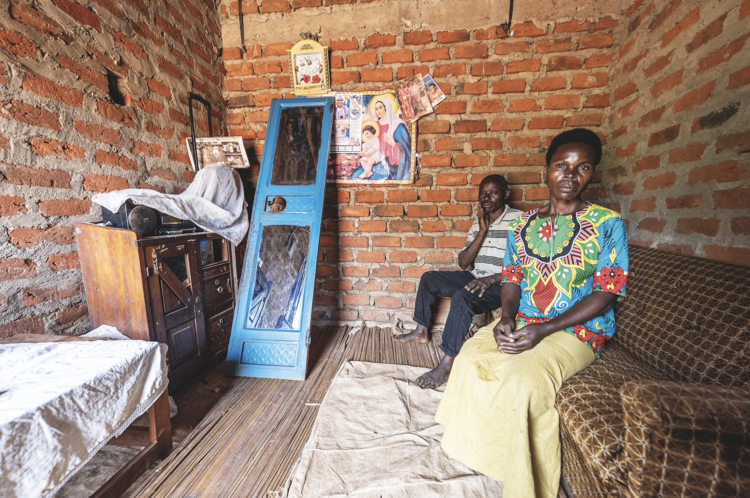
What makes the attack on Roger’s family even more shocking is that it was not a one-off. In the villages around Muhorro, chimpanzees have been actively hunting children for years. Nyamiti, where Roger’s daughter was killed, is perhaps the most notorious of the villages for chimpanzee–human conflict. My arrival there quickly drew a curious crowd who gathered around to listen as Kaahwa Iburahimu, a local farmer, tells me that ‘many kids have been killed by chimps around here. It’s been happening for years. Six years ago,’ even my own 15-month-old son, Ali, was killed by a chimpanzee. It ran up to our garden, grabbed him and took him to the forest. When we found him he was still alive, but he died in hospital a few hours later.’
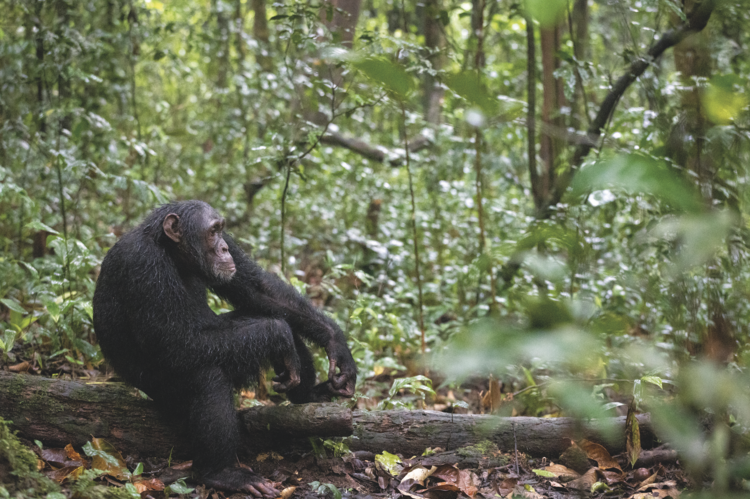
Bagoma Ssebowa, the chairman of the village, tells me that the people of Nyamiti are so frightened of the chimpanzees that parents rarely let their children out of sight. ‘Every day,’ he says, ‘groups of chimps come looking for food in our fields or even in the village itself. Every family here has had an incident with the chimps – either a direct attack or the chimps raiding their crops.
Young children are not safe here anymore. Even older children are attacked on the way to school. Everyone keeps their children safely inside nowadays.’ When I ask the gathered crowd if anyone likes the chimpanzees, not one person raises their hand, and the chairman says simply, ‘We just pray that the government will take the chimps away, but they won’t. They say that we should leave, not the chimpanzees. The government thinks that the chimpanzees are worth more than our children.’
Forest cover
Over past decades, people have chopped down vast swathes of Uganda’s forests. A 2025 report by the Ugandan Ministry of Water and Environment revealed that Uganda is losing an average of 122,000 hectares of forest cover a year.
The same report says that in 1990, 24 per cent of Uganda was forested, but that by 2025 forest cover had been reduced to 12.7 per cent, much of this reduction due to the expansion of agricultural land and illegal charcoal production. This reduction in tree cover is creating small, isolated islands of forest that can’t provide enough food for the chimps trapped within them. The result is that the chimps start to raid nearby fields, gardens and villages in search of food – sometimes with deadly results.
To find out more about the pressures being put on Uganda’s forests, I travelled a couple of hours north to the Bugoma Forest. For the moment, the forest here is still large and healthy enough to provide a home to nearly 400 chimpanzees. But with big agricultural companies wanting to exploit the forest, Bugoma’s future hangs in the balance.
‘It’s hard to say exactly how much forest we have lost and how much danger the rest is in,’ says Asiimwe Nuzario as the two of us creep quietly along a narrow forest trail in the gloom of the early evening. ‘By some estimates, we have already lost 30 per cent of the forest in a decade due to illegal charcoal burning and sugarcane production. The pessimistic outlook would be to say that in less than ten years, the entire forest will be gone.’
Asiimwe, from the Association for the Conservation of Bugoma Forest (ACBF), which works to safeguard the forest, protect the chimpanzees living within it and encourage sustainable chimpanzee tourism, wanted to show me the destruction first-hand. As we walked deeper into the forest, the rhythmic thwack of an axe on wood grew louder and the smell of wood smoke stronger. The plainclothes policeman who was with us swung the Kalashnikov off his shoulder and flicked the safety catch off. ‘We might need it,’ he said. ‘They have machetes and sometimes fight back.’
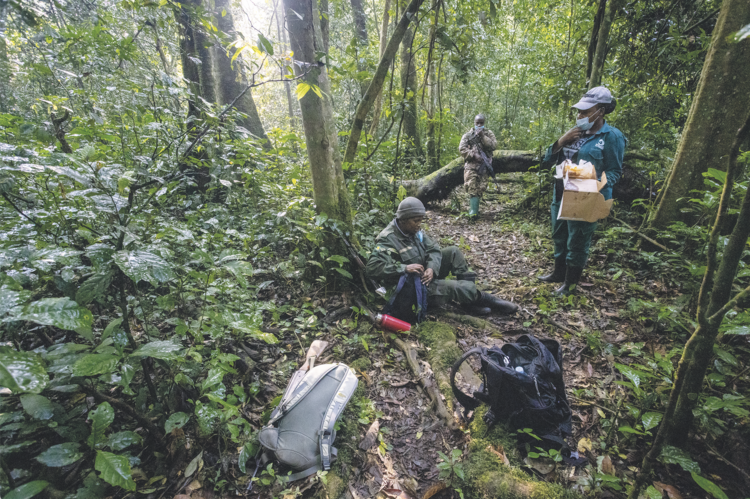
Rounding a corner, we stepped into a clearing where a group of illegal charcoal burners were busy at work. Fortunately, the gun wasn’t needed, as the instant they saw us, the charcoal burners dropped their tools and scattered through the forest in all directions. Walking around the area where the men had been working, I was stunned by the devastation. Among the chaos of broken trees and hacked-up branches were huge pyres of slow-burning wood, and I realised that the industrial-level destruction brought by charcoal burning ensured that nothing could live in what was left of the forest afterwards.
As we walked back to our waiting car, I was given a little background into what I had witnessed. ‘It’s all to do with corruption,’ Asiimwe said. ‘The boundaries of the forest reserve aren’t always very clear and a big agricultural company has been using the charcoal burners to help them encroach into the forest. They encourage people from other parts of Uganda to come here and chop the forest. They tell them that they have the ownership papers, but it’s not true. Then, once the forest has been cleared, the company can just say there’s no forest on the land, so is allowed to plant more sugar on it. Everyone here knows it’s going on, but people high up are paid off. The National Forest Authority has a ranger post – with armed rangers – very close to the edge of the forest. They can hear the charcoal burners at work at night and smell the smoke. They know what’s happening, but they turn a blind eye.’
When I ask him what happened to the chimpanzees living in cleared areas, Asiimwe said, ‘We don’t know what happened to what happened to them. Maybe some were able to move, but the rest are probably dead.’ And when pushed on whether there had been an increase in human–chimp conflict as the forest has shrunk, he replied: ‘In the past, chimps occasionally came to our gardens in search of food – maybe just two or three times a month. Now, because the forest is smaller, they come all the time. Maybe three times a week. So far this hasn’t led to any attacks on people, but I’m sure it will do one day. Already children are scared to walk to school alone in case they see chimps.’
Living together
After all I had seen in Uganda, it was easy to lose faith. But there are other forests in Uganda where the story is very different.
It was early morning on the edge of Kibale Forest. A local dance troupe was gyrating and spinning to the heavy beat of an African drum while a group of tourists, watching from the sidelines, drank coffee and waited to be assigned a guide to lead them into the forest in search of chimpanzees.
Kibale is the mirror opposite of Bugoma and Muhorro. Most of these tourists were likely to be paying hundreds of dollars a day to be here, and it seemed that almost every family in the area was, in some way or another, financially reliant on chimpanzee safari tourism. The upshot of all this was that illegal activities within the forest are rare and the chimps have almost hero status among the local population. Cafés are named after chimps. Buses have chimps painted on their sides. Hotels are decorated with chimpanzee-focused art.
One afternoon, after having gone to see the chimps myself, I went to meet Nick, Robert and Innocent, three members of In the Shadow of Chimpanzees, a local conservation group that surveys and monitors the birds and smaller creatures of the forest.
‘Sometimes chimps come and raid our crops,’ Nick tells me as we walk along the forest fringe surveying butterfly species. ‘But generally nobody minds. Everyone here loves the chimpanzees and the other animals. It’s no longer just because we make money from them. It’s also because people are proud of having the chimps here and we know how important a healthy forest is. If someone cut down trees in the forest or put out poaching snares, then the community would act.’
Thanks to tourism, the trees and chimpanzees of Kibale are unlikely to ever face the kind of threats being directed towards Bugoma, nor is there likely to be the kind of all-out warfare between humans and chimps as there is around Muhorro.
So could tourism be the key to saving chimpanzees and forests elsewhere in Uganda? When I pose this question to the villagers of Nyamiti, I’m answered with sarcastic laughter. ‘No. It’s gone too far. No amount of money would bring our children back,’ says village headman Bagoma Ssebowa. ‘We don’t want the chimpanzees here at all, even if tourists did pay money to come and look at them.’
But in Bugoma, the answer was more hopeful.
One afternoon, Asiimwe led the way down a muddy red road to a small farm where Kisembo Amos, a farmhand and former charcoal burner, works.
‘I used to go into the forest about three times a week to cut wood for charcoal. I did it for a year and I think that in that time I cut down about 100 big trees. Some of the wood was used locally, but mostly trucks would come and take the charcoal to Kampala. Almost the entire community here was involved. I knew it was illegal, but I didn’t have any alternative. I needed to make money for food and to pay school fees.’
So what was it that made him change?
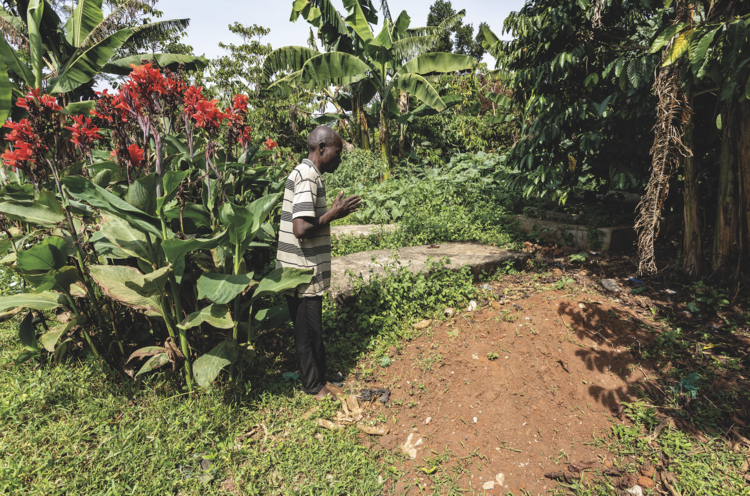
‘The Association for the Conservation of Bugoma Forest gathered people from the community and discussed the advantages of protecting the forest,’ he says. ‘They explained that the chimpanzees were very important and could be a way of bringing tourists and money to the area. And they showed us how we could start new ways of making a living that didn’t involve destroying the forest. They trained me in beekeeping and helped me get my first bees and hives. And they help me market my honey and sell it to tourist lodges and in Kampala. I earn more money from honey than I ever did through charcoal burning. And the work is easier!’
Smiling at the thought of this, he goes on to tell me, ‘Before, I was always afraid of being arrested. My life today is better and without the chimpanzees and the forest none of this would have happened. I regret what I did in the past and now I feel touched and upset when I see the forest being damaged.’
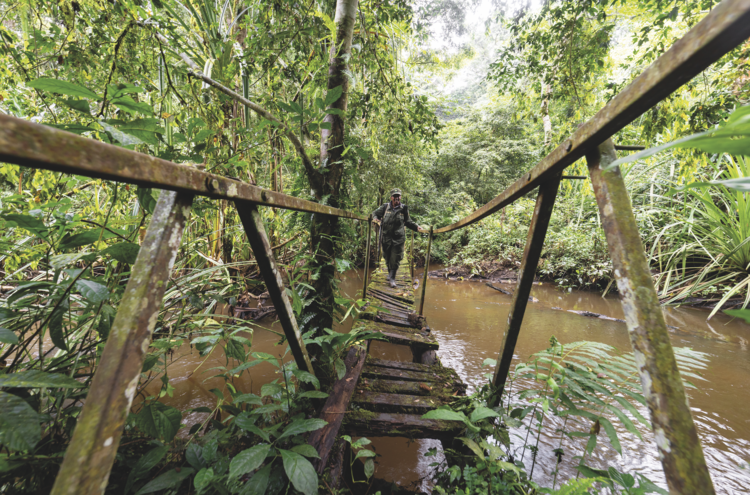
Asiimwe tells me that, thanks to the ACBF’s work in this village and several others, the number of people engaged in charcoal burning has declined, and that people are more involved in sustainable activities. But even so, there is still much more work to be done if they want Bugoma to mirror Kibale. Asiimwe and the other members of the ACBF are up against big agricultural businesses, organised crime and corrupt officials and, with few resources on their side, they know this is going to be a tough fight.
So what, I wondered, would it take to really turn things around and save Bugoma?
Without hesitation, Kisembo speaks up. ‘Tourism. Our chimpanzees have already been habituated to people and a few tourists are already coming here to see them. But if more tourists came, then communities and the government would see that there’s more money to be made preserving this forest than destroying it. That’s how we can save the forest and our chimpanzees.’
Go on a Ugandan chimpanzee safari
Groups of chimpanzees habituated to people can be seen in several parks and reserves in Uganda, including both Kibale Forest and Bugoma Forest.
Seeing the chimpanzees in any of these places will ensure you are contributing to their long-term survival. Bugoma Jungle Lodge (ugandajunglelodges.com) supports the ACBF. It offers chimpanzee and mangabey monkey treks within the forest.
Mahlatini Luxury Travel (mahlatini.com) is a reliable UK-based tour operator that runs tailor-made safaris to Uganda, including chimpanzee tours.
Samgai Journeys (samgaijourneys.com) runs chimpanzee-dedicated safaris that take in several Ugandan forests, including Bugoma Forest. Local Ugandan tour company Engabi Tours (gorillasafaridiscovery.com) can also organise chimpanzee safaris.