Zoologist Lindsay Nikole talks to Victoria Heath about evolution, empathy and exploration
Lindsay’s travel insights
• If you’re taking part in an excursion allowing close interaction with animals that would typically harm you in the wild, it’s almost definitely unethical
• Leave places the way you found them – or better
• Use mineral sunscreen when going to tropical beaches to protect marine life
It’s safe to assume that something must have eyes in order to see, right? But, as zoologist and YouTuber Lindsay Nikole explains, what may seem like a definitive fact is proven wrong by the remarkable brittlestar. Using a collection of photoreceptors along with a particular pigment – and possessing no eyes – brittlestars can produce an image that they see with cells all over their body, completely flying in the face of previous scientific understanding.
It’s this constant revision and re- learning about the world that inspires Nikole, particularly in her creation of short-form video content about the environment and wildlife. Her YouTube and TikTok channels attract a global audience of more than 4.6 million followers combined – and as her follower count grew, what started as a hobby quickly evolved into a full- time career. Eventually, she was able to quit her teaching job and instead focus on content creation full-time.
Enjoying this article? Check out our related reads:
‘I love researching,’ Nikole says. ‘I find such interest in finding a topic I don’t know a lot about, then taking a deep dive into it for a YouTube video or a TikTok.
‘I think that’s what makes being human so special – the ability to continue learning about the world.’
Nikole focuses on the topics of prehistory and evolution in her videos, something she describes as ‘grounding’ to learn about and helps to place humanity in a broader planetary context. While her content may be rooted in the prehistoric, Nikole has a personal penchant for all things wildlife.
Having worked with big cats throughout her university education, she recently spent time in Namibia working with the Cheetah Conservation Fund, an organisation focused on rescuing cheetahs from the illegal pet trade and releasing them back into the wild.
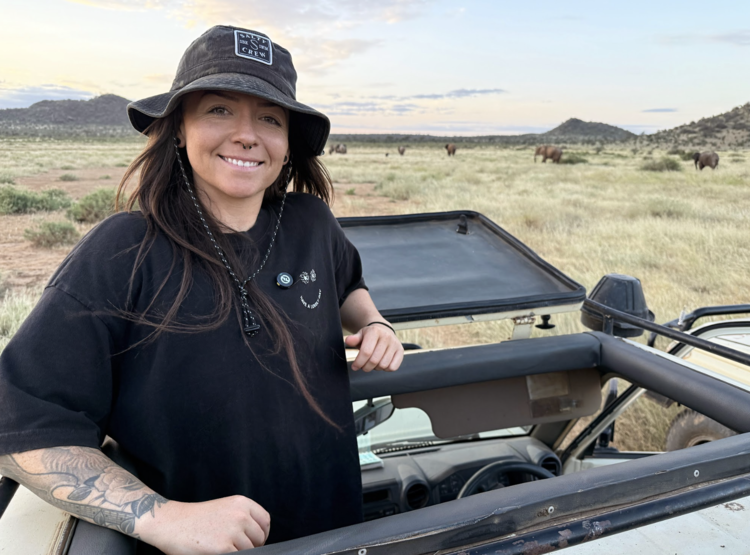
Nikole’s adventures have also taken her to the plains of Kenya, where she worked alongside a Save the Elephants pilot to conduct aerial surveys to track the movements of the large mammals. It’s an experience Nikole describes as ‘terrifying’ – as the plane had no doors – and she was forced to confront her fear of heights head on.
Despite her trepidation, the experience proved to be pivotal. ‘I felt so at peace, as I was able to look out at the entire landscape,’ she says. Through her content creation, Nikole is eager to showcase the efforts of these organisations. As she explains, publicity of their positive actions is scarcely seen on social media.
‘Most of the content you seeabout people working with animals is hands-on and invading their space, because that’s what gets the most clicks,’ she explains. Yet the organisations Nikole works with do the exact opposite – for example, Save the Elephant’s aerial surveys of elephants from a distance. In the case of the Cheetah Conservation Fund, workers give the animals ample space, refraining from coming close and touching them. Such examples are still vital to be showcased, though – as real, vivid testimonies to the power of conservation.
But it’s not just animals that such organisations can help. During her flight with pilot PK, Nikole found out the reason why he chose his career path. One day, PK saw the founder of Save the Elephants flying a plane overhead, a moment that inspired him to do the same in the future.
‘It’s so cool to see this group not only changing the lives of elephants, but also the local community,’ says Nikole.
When reflecting upon her travels, Nikole advocates for leaving places as you found them – or better – as well as choosing mineral-based sunscreens when visiting tropical beaches.
For Nikole, then, travelling to landscapes requires one major point: respect. Ensuring that you remain at ample distance from wildlife and treat their surroundings with care is pivotal. In doing so, travellers can help protect the places they visit and the creatures that call them home.