
• Skip to main content
  • Skip to secondary menu
  • Skip to primary sidebar
  • Skip to footer
Geographical

Geographical

Official magazine of the Royal Geographical Society (with IBG)

  • Geographical Home
  • News
  • Features
  • Opinion
    • Climatewatch
    • Front Lines
  • Podcast
  • Travel
    • Discovering Britain
    • Passport
  • Culture
    • Book reviews
  • Quizzes
    • Crosswords
  • Choose Geography
    • University directory
    • Masters courses
    • Course guides
      • Climate change
      • Environmental science
      • Human geography
      • Physical geography
    • University pages
      • Aberystwyth University
      • Brunel University
      • Cardiff University
      • University of Chester
      • Edge Hill University
      • The University of Edinburgh
      • Newcastle University
      • Nottingham Trent University
      • Oxford Brookes University
      • The University of Plymouth
      • Queen Mary University of London
    • Geography careers
      • Charity/non-profit
      • Education & research
      • Environment
      • Finance & consulting
      • Government and Local Government
    • Applications and advice
  • Magazine
    • Issue previews
    • Subscribe
    • Manage My Subscription
    • Special Editions
    • Geographical Archive
    • Advertise with us
  • Subscribe
    • Direct Debit Changes

The life and legacy of Gertrude Bell

21 August 2026
4 minutes

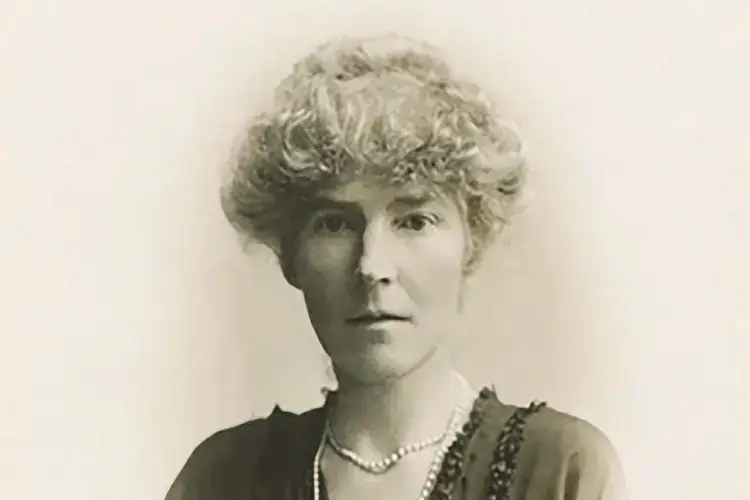
Gertrude Bell
Gertrude Bell, 1900. Image: RGS-IGB

Gertrude Bell’s remarkable life as an explorer, archaeologist and influential figure who helped shape the modern Middle East after WWI


By Geographical Contributor

By 1914, Gertrude Bell had spent around 15 years travelling in the Middle East and Europe. Following the outbreak of the First World War, she was called upon by the British government to assist in its war efforts. Based first in Cairo and then in Baghdad, she used her extensive knowledge to help shape Britain’s wartime policy in the Middle East. An archaeologist, explorer, writer and Fellow of the Society, Bell is also the only woman to have had her name inscribed in gold on the Society’s Ondaatje lecture theatre halls when it was built nearly 100 years ago, in 1930.


Enjoying this article? Check out our related reads…

  • Five very different New Year’s traditions
  • Discover Fasching, the bizarre and often hilarious carnival of the Black Forest – Geographical Archive March 1938 issue
  • McCurry: The Pursuit of Color is an intimate portrait of a life lived behind the lens
  • A proper geography conference
  • Following in the footsteps of explorers: The Royal Geographical Society Collection

Now, a new exhibition, Routes, Ruins and Reconnaissance, opening this August, will consider Bell’s relationship with the Society, highlighting their contributions to the war effort and showcasing unique photographic and documentary material in one venue for the first time.

Courtyard scene in Hail, northern Saudi
Arabia, February–March 1914
Courtyard scene in Hail, northern Saudi Arabia, February–March 1914. Image: RGS-IBG

The exhibition marks the completion of a 17-month collaborative project between Newcastle University and the Society, generously supported by the Harry and Alice Stillman Foundation. It will feature some of the 530 newly digitised images created from original negatives held in the Society’s Collections, as well as treasures from the Gertrude Bell Archive, held in Newcastle. To mark the moment, we’re sharing a timeline of Bell’s iconic life and work.

Gertrude Bell, 1868–1926

1868: Bell is born in Washington, North East England.

1886–88: Bell studies Modern History at Oxford.

Gertrude Bell riding a camel at Hallabat,
Jordan, 1913–14. Image: RGS-IBG

1889–1914: As a result of family wealth and connections, Bell is able to travel widely to Europe and the Middle East. This included journeys to Lebanon, Syria, Turkey, and Mesopotamia (a historical region of West Asia that roughly corresponds to modern-day Iraq). Travelling through the Ottoman Empire, Bell developed an interest in photography and in medieval, early Islamic, and Byzantine architecture.

1913: RGS membership is opened permanently to women, with 163 joining in that first year alone, including Bell. At the RGS, Bell receives the Gill Memorial Prize and undertakes training in using a theodolite and in observing maps and photographs.
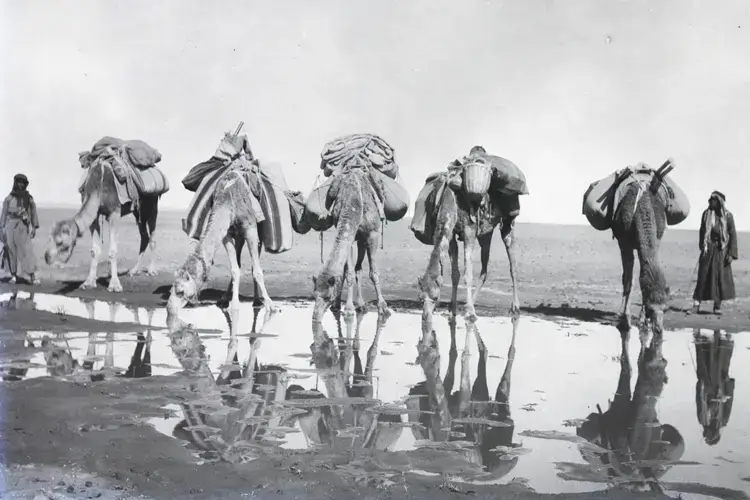
Gertrude Bell’s caravan at a watering place in north-west Saudi Arabia, 25 January 1914
Gertrude Bell’s caravan at a watering place in north-west Saudi Arabia, 25 January 1914. Image: RGS-IBG

November 1913: After receiving the prize, Bell travels to Hail, Saudi Arabia, to record archaeological sites. Bell keeps diaries and detailed architectural studies of everything she sees – notebooks that are stored in the RGS. In her diaries, Bell contemplates what purpose keeping these records served: ‘I am not sure what profit I shall get out of it all.’

1914: Bell works for the Red Cross.

1915: Bell is invited to Cairo to help David Hogarth with intelligence files.

1916: Now considered a specialist on the Middle East, Bell is called upon to assist the British government in Mesopotamia during the First World War. She moves to Baghdad to work for Sir Percy Cox in the British administration. She is based there for the rest of her life.

1918: Bell is awarded the Society’s Royal Gold Medal. After the war ends, Bell has a huge influence on post-WWI Mesopotamia, shaping the country’s spatial and architectural legacies.

Men drawing water from a well at Ba’ir Fort,
Jordan, 1913–14
Men drawing water from a well at Ba’ir Fort Jordan, 1913–14. Image: RGS-IBG

1926: Bell dies in Baghdad, aged 57

Routes, ruins and reconnaissance is open until 24 August: bit.ly/4elOrIB

Bell’s story is just one of many. As Dr Sarah Evans, Research and Higher Education Manager at the Society noted: ‘I’m really delighted about this collaboration and what it’s going to unlock … encountering Bell as a complex and fascinating figure worthy of further study. But I keep coming back to those other 162 women who were elected to the Society in 1913 and what stories we might uncover about them and their work and lives. But that will have to wait for another day.’
Themes Culture

Protected by Copyscape

Primary Sidebar

SUMMER SALE

GEOGRAPHICAL WEEKLY LOGO FREE - Sign up to get context, clarity and perspective in a noisy world, every Friday

Popular Now

The subterranean secrets of the Pyrenees

The subterranean secrets of the Pyrenees

On The Ground: Diary of Whistleblower

On The Ground: Diary of Whistleblower

QUIZ: Physical Geography Trivia

QUIZ: Physical Geography Trivia

September issue covers

Out now: September 2026’s Geographical Magazine

Raincloud over a landscape

Could cloud seeding make it rain and help fight wildfires?

Footer

  • Facebook
  • Instagram
  • LinkedIn
  • Reddit
  • TikTok
  • Twitter
  • YouTube

Geographical print magazine cover

Published in the UK since 1935, Geographical is the official magazine of the Royal Geographical Society (with IBG).

Informative, authoritative and educational, this site’s content covers a wide range of subject areas, including geography, culture, wildlife and exploration, illustrated with superb photography.

Click Here for SUBSCRIPTION details

Want to access Geographical on your tablet or smartphone? Press the Apple, Android or PC/Mac image below to download the app for your device

Footer Apple Footer Android Footer Mac-PC

More from Geographical

  • Subscriptions
  • Get our Newsletter
  • About Us
  • Contact Us
  • Advertise with us
  • Privacy policy
  • Terms & Conditions

Copyright © 2026 · Site by Syon Media