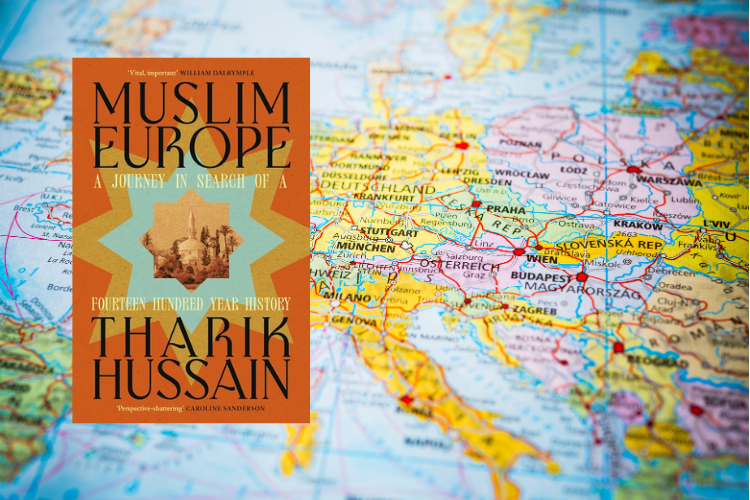
Shafik Meghji reviews Muslim Europe, a fascinating book delving into the 1,400-year story of Europe’s Islamic history
By Tharik Hussain
Award-winning journalist and author Tharik Hussain has spent two decades researching Europe’s Islamic history – a 1,400-year story that has often been overlooked, disregarded or suppressed. His first book, Minarets in the Mountains, focused on the western Balkans. Muslim Europe, which similarly blends history, memoir and travel writing, explores the Islamic connections across the Mediterranean and the Iberian peninsula.
Hussain visits ancient tombs in Cyprus that show how Islam arrived in Europe a mere 16 years after the death of its founder, ‘more than twice as fast as Christianity, which is believed to have arrived – at the earliest – within forty years of Jesus’s death’.
Enjoying this article? Check out our related reads…
Over in Sicily – whose Muslim links date back to 667 – the author meets the espresso-drinking imam of the Moschea di Tunisia in Palermo, which was originally opened by the Tunisian authorities in 1990 to spy on the activities of its expatriate citizens. And in Malta, Hussain finds that while physical remnants of its rich Muslim heritage are largely long gone, ‘the greatest legacy of the island’s Islamic era remains its language, with the Maltese the last of the “Arabic”-speaking Europeans’.
Particularly illuminating are the chapters on Portugal and Spain, much of which was once part of al-Andalus, the Islamic-ruled region of Iberia between 711 and 1492, which profoundly influenced modern science, the arts, law, economics, architecture, philosophy, medicine, mathematics, cuisine, music and fashion. In the
former, Hussain visits Sintra’s fairytale castles, palaces and fortresses, one of which features a ‘bright-yellow Mughal-style dome atop a faux minaret on the edge of a roof terrace with the green treetops of the park behind’.
Over in Spain, he explores the remains of the tenth-century Madinah az-Zahra, capital of Umayyad Caliph Abdu’r Rahman III: ‘Stretching for seven miles when London and Paris were less than one square mile in size, Madinah az-Zahra… was printing its own money within a decade of completion and featured stunning landscaped gardens, artificial lakes, grand fountains, streets illuminated with lighting, a spectacular mosque, baths in every quarter, libraries, schools and palaces built in such magnificence that when foreign delegates entered, they were spellbound.’

Hussain has conducted extensive research and regularly draws on neglected Muslim and Jewish sources. As a result, the book is packed with intriguing details and revealing insights – from a gold coin minted by the Anglo-Saxon King Offa in 774 that featured the Muslim declaration of faith to the Islamic origins
of the three-course meal.
Crucially, he also includes perspectives from the people he meets along the way – imams, historians, archaeologists, museum curators, guides, tourists and worshippers; people such as Mohammed, a Moroccan living in Spain whose ‘family were part of the mass migration of Iberian Muslims that begun following the fall of Granada in 1492, but gathered pace after 1567, when the practise of Islam and use of Arabic was made illegal across Iberia’.
Muslim Europe arrives at a time of surging Islamophobia across the Continent. In the UK, we’ve seen rising anti-Muslim violence on the streets, mosques fire bombed, conspiracy theories spiralling online and intensifying racist rhetoric from prominent politicians and media figures. Hussain provides a vital corrective that shows how Muslims have been central to Europe’s story for almost a millennium and a half.
He includes a pertinent quote from King Charles III, given in a lecture when he was still the Prince of Wales: ‘Islam is part of our past and our present, in all fields of human endeavour. It has helped to create modern Europe. It is part of our own inheritance, not a thing apart.’