
• Skip to main content
  • Skip to secondary menu
  • Skip to primary sidebar
  • Skip to footer
Geographical

Geographical

Official magazine of the Royal Geographical Society (with IBG)

  • Geographical Home
  • News
  • Features
  • Opinion
    • Climatewatch
    • Front Lines
  • Podcast
  • Travel
    • Discovering Britain
    • Passport
  • Culture
    • Book reviews
  • Quizzes
    • Crosswords
  • Choose Geography
    • University directory
    • Masters courses
    • Course guides
      • Climate change
      • Environmental science
      • Human geography
      • Physical geography
    • University pages
      • Aberystwyth University
      • Brunel University
      • Cardiff University
      • University of Chester
      • Edge Hill University
      • The University of Edinburgh
      • Newcastle University
      • Nottingham Trent University
      • Oxford Brookes University
      • The University of Plymouth
      • Queen Mary University of London
    • Geography careers
      • Charity/non-profit
      • Education & research
      • Environment
      • Finance & consulting
      • Government and Local Government
    • Applications and advice
  • Magazine
    • Issue previews
    • Subscribe
    • Manage My Subscription
    • Special Editions
    • Geographical Archive
    • Advertise with us
  • Subscribe
    • Direct Debit Changes

Elephants shape their environment long after dying, study finds

14 October 2026
3 minutes

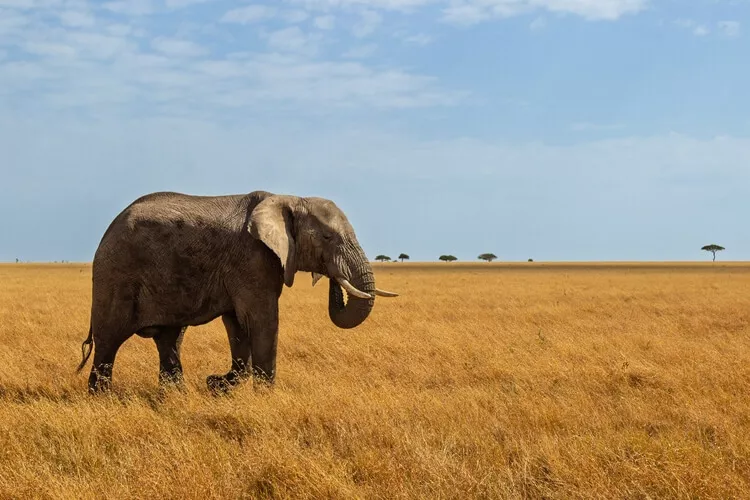
An elephant walks through the Serengeti National Park in Tanzania, searching for food and water.

Nutrients leach from elephant carcasses for at least eight years after their death, creating nutritious plant growth for herbivores


By Victoria Heath

A study found that elephant remains create nutrient hotspots that can persist on savanna landscapes for years, possibly even decades.

These nutrients help to fuel microbial activity and plant vigour, attracting herbivores to the site long after the visual signs of the elephant have disappeared, researchers found after analysing elephant carcasses in South Africa’s Kruger National Park.

The researchers compare elephant carcasses to whale falls, when giant whales sink to the seabed and trigger a plethora of activity and productivity. However, they acknowledge that decay happens much faster in sunny African savannahs than in icy ocean depths. Elephant carcasses disappear within several weeks as scavengers pick apart the meat and bones.

‘We know that these really charismatic megafauna have strong impacts on ecosystems while they’re alive, but until now we haven’t really understood how those impacts continue after they die,’ said lead author of the paper published in the Proceedings of the National Academy of Sciences Courtney Reed.


Check out our related reads…

  • Excess fine sediment in rivers starves fish habitats of oxygen, study finds
  • Better World Video Awards 2024: Elephant Orphanage
  • Curbing elephant human conflict in Sumatra
  • Arctic Ocean food chain disrupted as key tipping point passed
  • World Elephant Day 2025: Teacher captures surprise lunchtime visit from group of elephants

Immediately after dying, an elephant carcass will flatten out any vegetation underneath, while activity from scavengers renders the surrounding ground bare.

‘It essentially resets the plant communities to zero,’ explained senior author Deron Burkepile, a professor of ecology, evolution and marine biology.
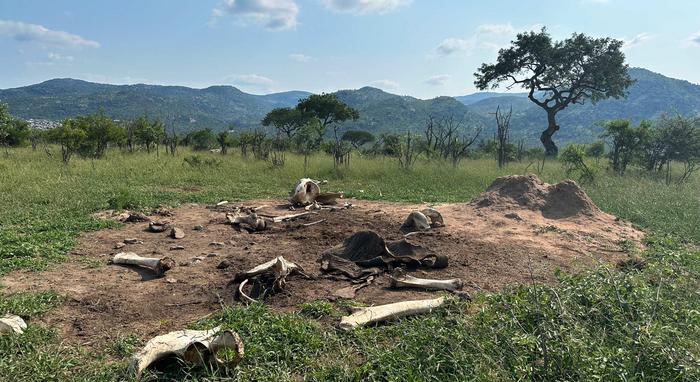
An elephant transforms the spot where it dies, with a legacy that lasts long after the body is gone and the bones are scattered.
An elephant transforms the spot where it dies, with a legacy that lasts long after the body is gone and the bones are scattered. Image: Courtney Reed

However, nutrients soon percolate into the ground from elephant remains. At fresh carcass sites, soil nitrogen concentrations can be up to 3,000 times higher.

This spike in nutrients doesn’t immediately promote regrowth; instead, it causes nutrient toxicity that initially prevents plants from growing back. After that, just a few fast-growing species become dominant in what is known as a biodiversity ‘coldspot’, a trend that persists for at least eight years after an elephant’s death.

The plants able to colonise the site are especially nutritious for herbivores, with grazers continuing to revisit carcass sites for years. Grazing animals’ manure further enriches these areas, boosting nutrient levels in the soil and keeping them consistently high.

Researchers say that in more dynamic ecosystems like forests or wetlands, the effect of elephant carcasses may be short-lived as nutrients leach out of the soil via rainfall. In deserts, water constraints may prevent microbes and plants from using moisture to take advantage of nutrients from the carcass.

‘When we got started, we didn’t know how the carcass of a four-tonne elephant would impact its environment,’ said senior author Dave Thompson. ‘Nothing of that magnitude had been studied in a terrestrial system.’
Themes Wildlife Africa

Protected by Copyscape

Primary Sidebar

SUBSCRIBE

GEOGRAPHICAL WEEKLY LOGO FREE - Sign up to get context, clarity and perspective in a noisy world, every Friday

Popular Now

A Manggala Agni firefighter works to extinguish a land fire in Ogan Ilir Regency, South Sumatra, Indonesia, on August 15, 2026. The onset of a drier dry season amplified by El Nino, combined with illegal land-clearing activities, has driven a significant spike in forest and land fire hotspots across parts of Sumatra and Kalimantan

Indonesia experiencing world’s highest wildfire emissions

Championing the Earth: Anjana Khatwa on The Whispers of Rock

Championing the Earth: Anjana Khatwa on The Whispers of Rock

Illegal mining activities disrupted in Guatemala

233 people arrested in environmental crime crackdown across Latin America and Caribbean

Chinstrap penguins

The world’s largest penguin colony is collapsing

Sewage wastewater draining into water

England’s water companies in the first half of 2026 have failed to…

Footer

  • Facebook
  • Instagram
  • LinkedIn
  • Reddit
  • TikTok
  • Twitter
  • YouTube

Geographical print magazine cover

Published in the UK since 1935, Geographical is the official magazine of the Royal Geographical Society (with IBG).

Informative, authoritative and educational, this site’s content covers a wide range of subject areas, including geography, culture, wildlife and exploration, illustrated with superb photography.

Click Here for SUBSCRIPTION details

Want to access Geographical on your tablet or smartphone? Press the Apple, Android or PC/Mac image below to download the app for your device

Footer Apple Footer Android Footer Mac-PC

More from Geographical

  • Subscriptions
  • Get our Newsletter
  • About Us
  • Contact Us
  • Advertise with us
  • Privacy policy
  • Terms & Conditions

Copyright © 2026 · Site by Syon Media