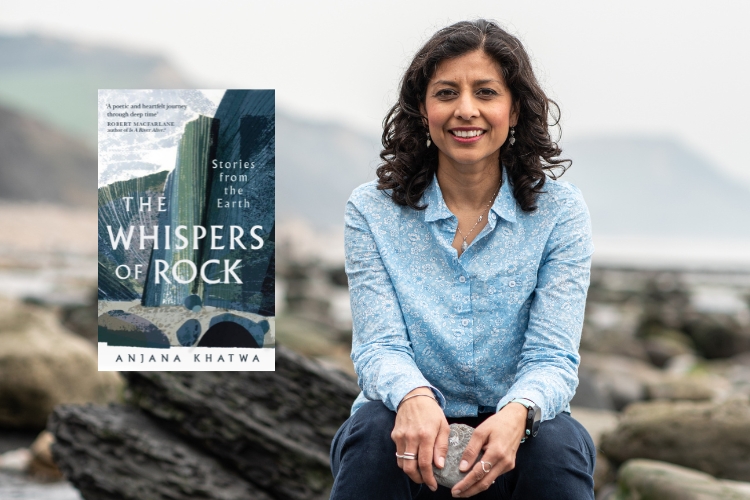
Geoscientist Anjana Khatwa’s new book weaves hard science with spirituality, exploring the many ways that humans understand and connect with nature
By
Anjana Khatwa holds up a palm-sized piece of black, pock-marked rock. ‘This,’ she says, turning it over in her hands, ‘is essentially the beginning of my journey to The Whispers of Rock.’
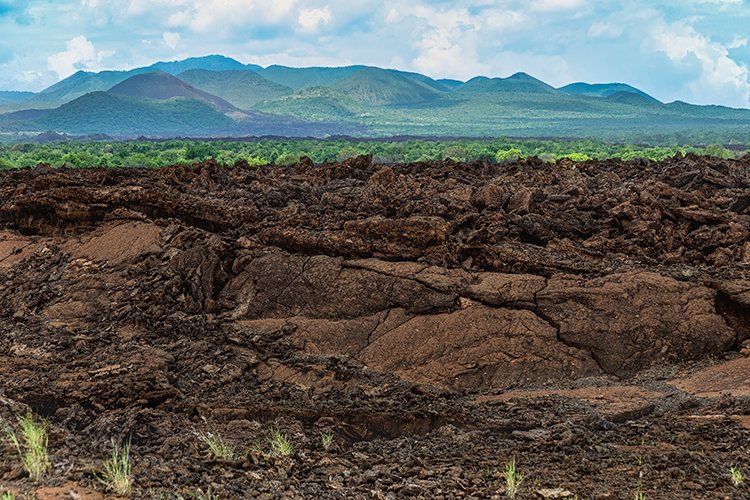
Formed some 200 years ago, this chunk of basalt was first picked up by 13-year-old Khatwa as she stood in the midst of the Shetani Lava Flow in southern Kenya. Spanning several kilometers, this vast field formed when a series of volcanic vents in the nearby Chyulu Hills burst open. To Khatwa, who remembered her geography lessons from school, lava was something that erupted from volcanoes as a steaming hot liquid, and flowed across the landscape. Yet here she was, walking across sharp, jagged rocks. It was an eye-opening moment – one, she says, that ‘completely transformed my whole life’s path.’
Enjoying this article? Check out our related reads…
- Scientists publish an extended seabed geology map of the Bristol Channel
- The planet’s earliest fossilised forest is discovered in Somerset
- Do 250-million-year-old rocks contain secrets to net zero?
- An ancient supervolcano has been found in England
Khatwa had discovered the lava flow while on holiday in Kenya with her parents. Both were originally from Nairobi, but the family now lived in Slough. It was not, she points out with a smile, a place that could easily spark a love of nature. Nonetheless, she developed an early interest in science, particularly space, and dreamed of one day becoming an astronaut.
It was a difficult dream to reconcile with her reality: growing up in a traditional Indian family, where she was expected to finish school, marry, and become a homemaker. ‘I didn’t see that future for myself.’ It was somewhat ironic, then, that a family visit to ‘the homeland’ would be the very thing to cement her future as a scientist. Writing The Whispers of Rock would be her way of helping others connect with the scientific world, too.
Part geological exploration, part spiritual reflection, The Whispers of Rock is a profound journey through our long and deep connection to an element of the natural world that is often overlooked. ‘We tend to forget that geology is the fundamental foundation of life itself,’ Khatwa says, addressing a frustration she has fought against for decades.
While popular nature writing routinely celebrates living flora and fauna – and even rivers, says Khatwa, which are now widely accepted as part of nature despite being abiotic (non-living) – rock is rarely given the same reverence. The Whispers of Rock aims to reset that agenda and reframe geology at the centre of the story. ‘This is a hill I’m going to die on, I’m sure of it,’ she says with a laugh. ‘Like c’mon, rocks are part of the natural world, people! And they need a champion.’
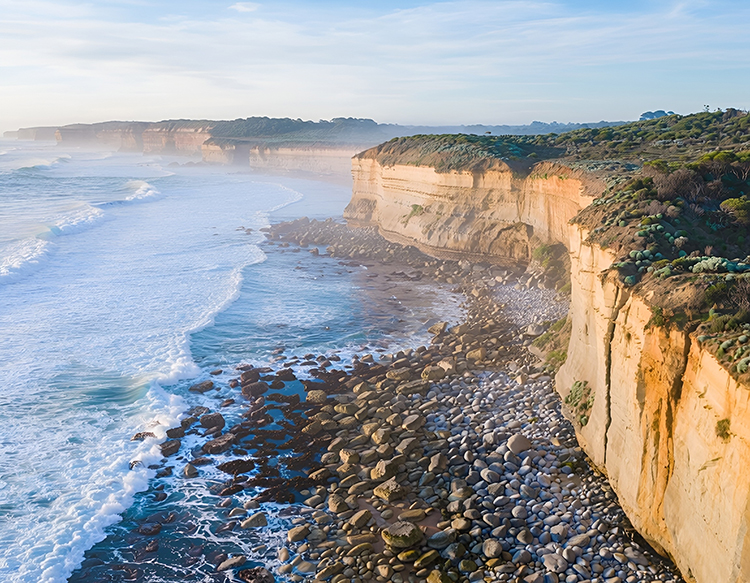
If anyone is qualified to be that champion, it’s Khatwa. With a geology degree, a PhD in earth science, and years of research under her belt, she finally found her true calling in the role of ‘Geoscientist in the Park’ for the US National Park Service. It was out here in the field, she realised, that she was best placed to help visitors understand the rocks, fossils, and landscapes around them. That revelation led to her taking on the job of education coordinator for the Jurassic Coast World Heritage Site, where she spent more than fifteen years helping the public unlock the stories written into ancient landscapes.
This wasn’t always, Khatwa explains, an easy task. ‘Geomorphology and geology are very complex subjects. There’s a lot of physics and chemistry that you need to understand in order to appreciate why the landscape looks the way it does. But I’d recently read Robin Wall Kimmerer’s book Braiding Sweetgrass, where the author beautifully outlines the connection between ecological sciences and her own indigenous knowledge, and I thought: There’s something here.’
Could The Whispers of Rock do for geology what Braiding Sweetgrass had done for ecology? Khatwa found her answer on a walk through the Chilterns with South Asian-led community walking group Dadima’s. ‘I was listening to South Asian women – Sikhs and Hindus – reflect on their own faith, and how that framed their engagement with the natural environment around them.’
The result is a book that weaves scientific insight with global human experience, drawing together stories and belief systems from the sacred megaliths of Stonehenge and ancient cliff-carvings of Petra to Māori reverence for pounamu (sacred greenstone) and Native American teachings on the living wisdom of plants and stone.
On more than one occasion, Khatwa writes that her approach might make some readers feel uncomfortable. She openly admits that her anxiety in the lead-up to publication was ‘very real’. ‘I think any geologist or any geographer who begins to speak about landscape and landscape evolution in the frame of spirituality would be terrified – I genuinely thought that this book could have been career-ending for me. That people wouldn’t understand why I was doing it, that they would see it as a threat to the ivory tower of science.’
Instead, the response from fellow scientists has been overwhelmingly positive. ‘As it turns out, people in the scientific community have been waiting for a book like this – one that places cultural respect and local tradition alongside scientific interpretation. As geologists and geographers, we bring our own perspective on how a landscape formed and evolved. Yet we can equally respect the communities who have lived there for thousands of years, and recognise that their truths are just as valid.’
Hear more about The Whispers of Rock at this year’s Cheltenham Literature Festival, where Anjana Khatwa will join fellow authors Natasha Carthew and Nicola Wilding in conversation with Caroline Sanderson as they explore the powerful connections between people, place and identity.
From rugged coastlines and crumbling rural economies to ancient geological histories, they’ll examine how landscapes shape our lives and stories.
Date: 13 October 2026
Time: 4.30pm