
• Skip to main content
  • Skip to secondary menu
  • Skip to primary sidebar
  • Skip to footer
Geographical

Geographical

Official magazine of the Royal Geographical Society (with IBG)

  • Geographical Home
  • News
  • Features
  • Opinion
    • Climatewatch
    • Front Lines
  • Podcast
  • Travel
    • Discovering Britain
    • Passport
  • Culture
    • Book reviews
  • Quizzes
    • Crosswords
  • Choose Geography
    • University directory
    • Masters courses
    • Course guides
      • Climate change
      • Environmental science
      • Human geography
      • Physical geography
    • University pages
      • Aberystwyth University
      • Brunel University
      • Cardiff University
      • University of Chester
      • Edge Hill University
      • The University of Edinburgh
      • Newcastle University
      • Nottingham Trent University
      • Oxford Brookes University
      • The University of Plymouth
      • Queen Mary University of London
    • Geography careers
      • Charity/non-profit
      • Education & research
      • Environment
      • Finance & consulting
      • Government and Local Government
    • Applications and advice
  • Magazine
    • Issue previews
    • Subscribe
    • Manage My Subscription
    • Special Editions
    • Geographical Archive
    • Advertise with us
  • Subscribe
    • Direct Debit Changes

Avian flu hits California’s northern elephant seals

27 February 2026
3 minutes

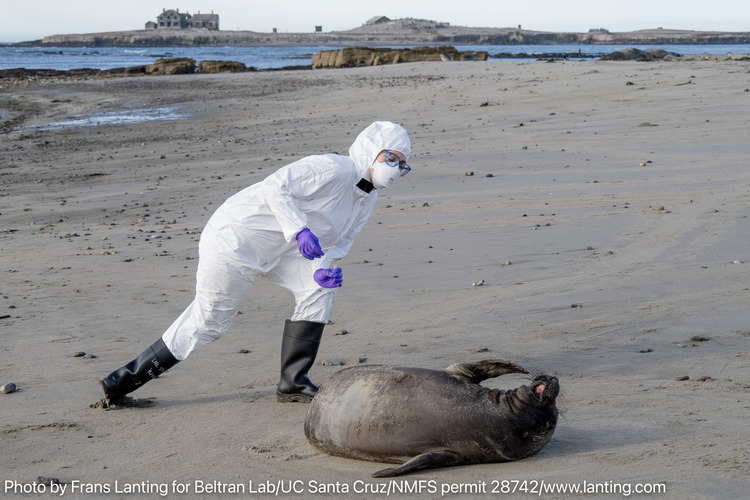
A researcher in a HAZMAT suit examines an elephant seal pup with symptoms of the virus. The outbreak marks the first cases of HPAI H5N1 in marine mammals in California and the first detection in northern elephant seals. The disease decimated populations of a related species, southern elephant seals, in Argentina in 2023.
A researcher in a HAZMAT suit examines an elephant seal pup with symptoms of the virus. Image: Frans Lanting

H5N1 avian flu outbreak marks the first cases in marine mammals in California and first detection in northern elephant seals


By Victoria Heath

Back in 2023 and 2024, a deadly strain of avian influenza – H5N1 – killed around 17,000 southern elephant seal pups on South American coastlines. Since then, researchers have kept a close eye on California’s northern elephant seals, which until now have remained free of the virus.

Lab tests, however, have revealed this week that the virus has breached this colony, marking the first time it’s been found in northern elephant seals. The research team collected samples from sick and dead elephant seals, which were analysed at the California Animal Health and Food Safety Laboratory System.


Check out out related reads…

  • Avian influenza detected in Antarctica
  • From mpox to rabies: A closer look at ten zoonotic diseases
  • Could earthquake activity rise in California?
  • Curbing elephant human conflict in Sumatra
  • Better World Video Awards 2024: Elephant Orphanage

As of 24 February, seven pups had tested positive for the virus. At the time of the lab results’ publication, 30 seals had died, with 29 of them weaned pups.

The elephant seal colony at Año Nuevo State Park is one of the most intensively studied in the world, with scientists monitoring the colony through flipper tagging and long-term tracking of individuals’ survival for more than six decades.

The highly infectious virus has been circulating the world as a panzoonotic – an animal pandemic – since 2020, infecting and killing approximately 700 species of birds and mammals on six continents, including cougars, polar bears, zoo tigers and rats. Animals that gather in large groups, like birds, are particularly vulnerable.

It has also infected humans – since 2024, 74 human cases have been diagnosed in the US, with two deaths. In these instances, most cases are attributed to hands-on contact with infected cows or poultry. Scientists stress that the current public health risk is considerably low, with no person-to-person transmission reported.

A researcher takes a nasal sample from an elephant seal pup.
A researcher takes a nasal sample from an elephant seal pup. Image: Frans Lanting

Since the colony was discovered to have been infected, California State Parks banned the public from the elephant seal viewing area of the Año Nuevo Coast Natural Preserve. Once confirmation had been made that H5N1 was responsible, more than 400 tours were cancelled for the rest of the season.

The virus is spread via contact with infected birds or animals, as well as their droppings. Animals can also catch H5N1 by eating an infected carcass.

Luckily, the virus outbreak among northern elephant seals was noticed very early on, thanks to monitoring by scientists at Año Nuevo and other locations in anticipation of a possible spillover into seals.

‘This is exceptionally rapid detection of an outbreak in free-ranging marine mammals’ said director of the Institute for Pandemic Insights at the University of California, Professor Christine Johnson. ‘We have most likely identified the very first cases here because of coordinated teams that have been on high alert with active surveillance for this disease for some time.’

What is H5N1?

The H5N1 virus was first discovered in 1996 in southeast China on a goose farm. It was transmitted within the poultry industry for several years, during which it spread over into wild birds and humans before spreading to Europe, the Middle East, Africa and later to North America, South America and, in early 2024, to Antarctica.

The current outbreak of H5N1 in North America was first detected in the winter of 2021 in Newfoundland and Labrador, Canada. It has now been confirmed in nearly all US states and Canadian provinces.

Themes News

Protected by Copyscape

Primary Sidebar

SUBSCRIBE

GEOGRAPHICAL WEEKLY LOGO FREE - Sign up to get context, clarity and perspective in a noisy world, every Friday

Popular Now

Hand in ballot box

Brazil’s presidential election heads to runoff in late October

California coast

Kelvin waves: the ocean phenomenon raising sea levels on the US West…

Chinook salmon in water

Why Alaska’s Chinook salmon collapse threatens Yukon River communities

Barcelona, Spain - October 31st 2022 -

Barcelona’s new ‘Netflix-style’ algorithm hoped to combat overtourism

Wind turbines in field

Ministry of Defence objects to at least four wind farms

Footer

  • Facebook
  • Instagram
  • LinkedIn
  • Reddit
  • TikTok
  • Twitter
  • YouTube

Geographical print magazine cover

Published in the UK since 1935, Geographical is the official magazine of the Royal Geographical Society (with IBG).

Informative, authoritative and educational, this site’s content covers a wide range of subject areas, including geography, culture, wildlife and exploration, illustrated with superb photography.

Click Here for SUBSCRIPTION details

Want to access Geographical on your tablet or smartphone? Press the Apple, Android or PC/Mac image below to download the app for your device

Footer Apple Footer Android Footer Mac-PC

More from Geographical

  • Subscriptions
  • Get our Newsletter
  • About Us
  • Contact Us
  • Advertise with us
  • Privacy policy
  • Terms & Conditions

Copyright © 2026 · Site by Syon Media