
Bryony Cottam talks to Valerie Trouet about the science of tree rings, what they can tell us about our past and future, and her new book In the Circle of Ancient Trees
Weather is a popular topic in Britain. On average, you’ll encounter the word 60 times in every million words spoken and written, which is the same frequency as the word ‘pub’. When polled, most Brits admit to talking about it within the last six hours – two-fifths within the last 60 minutes. It’s been suggested that we talk about our weather so much because – while it doesn’t have the seasonal range of Russia or the intense storms of the US – it is very changeable, the consequence of being an island on the edge of the Atlantic, at the tail end of a storm track.
The UK sits at the confluence of five major air masses – wind systems that pull in everything from cold Arctic air and snow to hot, dry air and Saharan dust – all steered by the shifting path of the North Atlantic jet stream. This conveyor belt of air helps to maintain the mild climates of Britain and western Europe, despite their northerly position – a phenomenon largely driven by the Gulf Stream, the warm ocean current that flows from the Gulf of Mexico. More than anything, however, the jet stream fuels our most severe weather.
Enjoying this article? Check out our related reads…
Jet streams meander as they circle the Earth, following the boundaries between hot and cold air. Bigger curves and loops can hold weather systems in place, leading to prolonged heatwaves or weeks of relentless rain. Scientists believe that climate change is already magnifying these loops, but to know for sure how warmer temperatures will affect the jet stream in the future, we need to understand how it has behaved in the past. Unfortunately, direct measurements only go back as far as the late 1940s, a tiny snapshot of a history that spans billions of years. Valerie Trouet wondered whether trees could tell us more.
Dendrochronology is a relatively young science. While Leonardo da Vinci and other early naturalists observed that tree rings formed annually and varied with the weather, it was only in the 1800s that people such as British scientist Charles Babbage, the computer pioneer, and American surveyor Jacob Kuechler began to suspect that these rings could be a window into the past.
Most experts in the field, however, would say that the science of dendrochronology started in the early 1900s with the man who coined the term. Andrew Ellicott Douglass, an American astronomer working at the newly established Lowell Observatory in Arizona, was no expert on trees; his interest was the sun. In particular, he was focused on proving a popular theory that sunspots – the cool, dark patches that appear during peaks of solar activity – led to increased rainfall on Earth. Back then, Arizona’s meteorological records barely covered the sun’s latest 11-year cycle, but a routine journey through the state’s expansive ponderosa pine forest led Douglass to a realisation.
If trees across the same region – all growing under the same weather conditions – share the same patterns of thick and thin rings, the patterns in a living tree could overlap with those in an older log, which could overlap with even older wood, creating a record of the local climate that spanned centuries.
Douglass never did prove his sunspot theory, but his work cross-matching tree rings eventually bridged the gap between modern climate records and those preserved in the ancient beams of the centuries-old Mesa Verde cliff dwellings in Colorado and the vast ruins of Chaco Canyon in New Mexico. The result was an unbroken timeline of the American Southwest dating back to 700CE. In 1937, he founded the University of Arizona’s Laboratory of Tree-Ring Research – or, as Trouet calls it, the ‘tree-ring mothership’.
As a master’s student studying environmental engineering at the University of Ghent in Belgium, Trouet had no idea she would one day become a world-leading expert in tree rings at the world-leading centre for tree-ring science, where she now teaches the newest cohort of future dendrochronologists. It was not, she wrote in her first book, Tree Story, a career that many in her field had dreamt of growing up. Instead, she had been preoccupied by the challenge of climate change; the satisfying puzzle of tree-ring patterns had simply offered a way to decode it.
Trouet says she learned a few things while writing Tree Story, a book that weaves the narrative of her own career into the broader history of tree-ring science. The first was that people like to read books about trees. The second was that time can add a new dimension to our fascination with them. ‘Trees are great, but they can also tell us so much about our Earth’s history, about our own history,’ she explains. One such tree is the Bosnian pine.

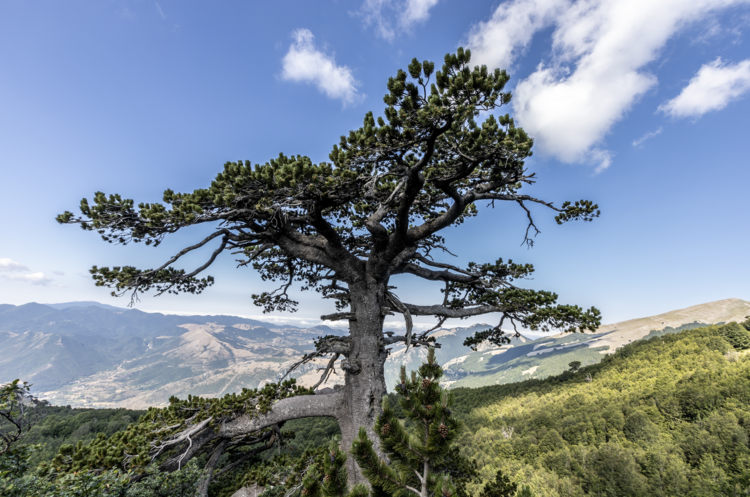
Before her move to the University of Arizona in 2011, Trouet held a four-year research position at the Dendro Sciences Unit of the Swiss Federal Institute for Forest, Snow and Landscape Research (WSL). It was here that she met Momchil Panayotov. A leading Bulgarian scientist and a prominent figure in European forest ecology, Panayotov’s work often centres on Bulgaria’s Pirin Mountains – a high-altitude, rugged glacial landscape and a refugium for the long-lived Bosnian pine (Pinus heldreichii), which has adapted to survive in these harsh conditions.
While looking through the WSL’s archive of pine tree samples from Bulgaria, Trouet noticed something strange. Across the samples, the ring grown during 1976 was often narrow and light. This came as no surprise to Panayotov; that summer had been particularly cold in Bulgaria. For Trouet, however, Belgium’s summer of 1976 was notable for entirely the opposite reason – it was one of the hottest and driest on record. ‘A climate dipole,’ she explains.
Climate dipoles are a common feature of the global weather system. The best-known example is the El Niño–Southern Oscillation (ENSO), which involves a recurring seesaw of ocean temperatures and air pressure between the eastern and western Pacific. Essentially, they function like a giant set of atmospheric scales: when one side rises in temperature or pressure, the other almost always drops. ‘So when summers in the UK are hotter than normal, the Balkans typically experience cooler-than-normal conditions, and vice versa,’ says Trouet. ‘We hypothesised that if the jet stream is responsible for this whiplash in the summer weather between the UK and the Balkans, we could use tree-ring data from both regions to reconstruct how the jet stream has changed over the past few hundred years.’
Dendrochronology has moved on since the early days of counting and measuring rings. Today we have access to advanced computer technology, including AI and, less fashionably but more importantly, affordable data storage. ‘We can now take very high-resolution images to study the wood anatomy in a quantitative way. So we’re not just measuring the width of a ring, we’re measuring intricate details such as cell size and wall thickness – how these change from year to year, over thousands of years, and whether there’s any information there that links to the climate. So that’s what we did, and it worked.’

In 2024, more than ten years after Trouet and Panayotov met in Switzerland, the team published its results: the first reconstruction of the North Atlantic jet stream spanning the last 700 years. By cross-referencing samples collected from Scots pines in the northern Cairngorms with those from Bosnian pines, they confirmed that this band of air has been driving European climate dipoles for centuries.
In places such as the Sierra Nevada, the vast mountain range that spans much of California and where Trouet has spent years extracting tree cores from giant sequoias and Douglas firs, tree rings have become essential to understanding the history of local climate events. ‘There were people here, of course, but we have no written record and very few oral histories prior to 1850.’
To Trouet, it was an unusual concept. ‘In Europe, we have a very long history of writing things down. We have records of when wildfires happened, when the grape harvests succeeded or failed, and exactly when epidemics occurred.’
‘Without our tree-ring research into California’s wildfire history, we wouldn’t have understood that, prior to 1900, these forests burned very frequently – every five to 15 years. By suppressing those natural fires for over a century, we have created a completely different landscape and fire regime. We only know the scale of that shift because we were able to study the fire history recorded in ancient giant sequoias.’ The same research revealed that the region’s 2015 snow drought – a crisis that returned in the winter of 2021 and again this year – had been unprecedented in the previous 500 years.
Because of Europe’s extensive written records, Trouet and her colleagues were able to cross-reference centuries of historical documents with their 700-year reconstruction of the jet stream. They found that the influence of the jet stream’s position reached far beyond the weather, affecting people through bountiful harvests and famines alike. ‘Take the plague, for instance. It occurred more frequently in the Balkans when the jet stream was in a southern position and the region was wet. Conversely, in the UK, it happened more often when the jet stream was in a northern position; summers were wet and cold, and people stayed indoors – the conditions were more conducive to spreading disease. It’s a remarkable example of how the jet stream’s position has influenced not just climate extremes, but societal extremes, for hundreds of years.’

Since the 1970s, scientists have used satellite observations to track the North Atlantic jet stream, revealing a trend in the data: the jet stream is gradually shifting north. If this trajectory continues, we will likely see a recurrence of weather extremes in the UK and across most of north-western Europe.
There’s a lot still to learn from trees. In October, Trouet published In the Circle of Ancient Trees, a collection of stories by ten dendrochronologists about ten extraordinary species and what we have discovered so far. Like Panayotov and his account of the Bosnian pine, each chapter is written by a scientist whose career has been inspired by a profound and lifelong connection to one particular tree.
‘I wanted the book to be written by people who grew up with these trees because that local connection provides a perspective you can’t get from data alone. And to show that scientists are people, too. Most scientists of my generation started this work because we wanted to make the world a better place. But with climate change evolving as it is, we’re also mourning. It’s hard to stay motivated knowing that there’s this disconnect between what we know as scientists and as a community, and what’s being done about it.’
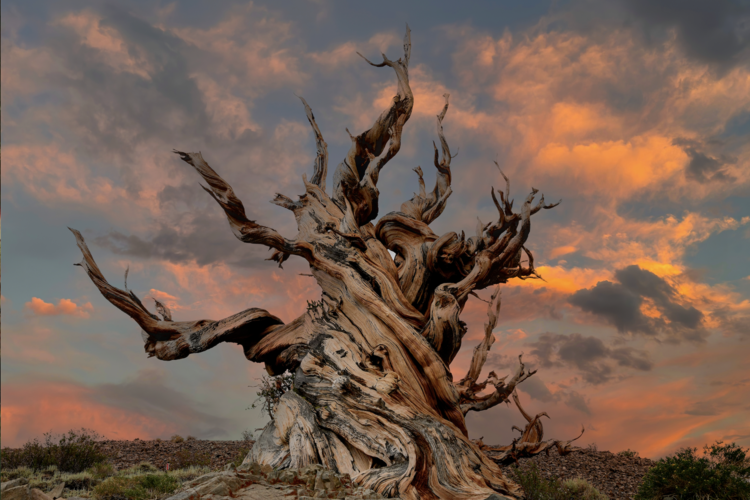
The trees featured include some of the world’s oldest – the European oak, which can reach more than 1,000 years old, the Qilian juniper, more than 3,000, and the Great Basin bristlecone pine, more than 5,000. But even these hardened species are facing threats that test their limits, from deforestation and wildfires to warming temperatures that spread pests and disease. Their loss would be devastating, particularly because trees are more than just living archives of our world – they shape it.
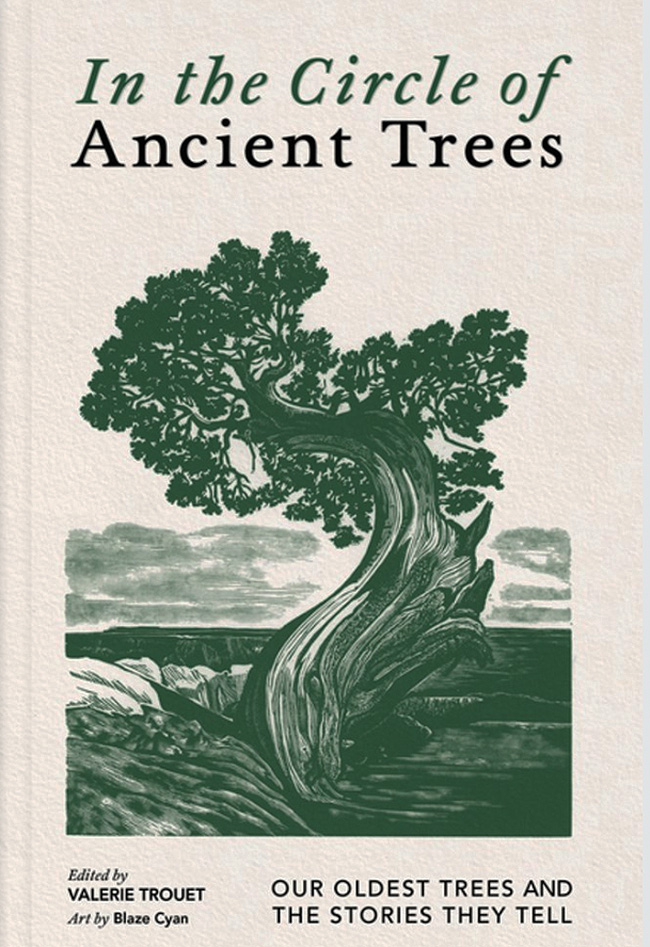
In the Circle of Ancient Trees: Our oldest trees and the stories they tell
Edited by Valerie Trouet
Illustrated by Blaze Cyan



