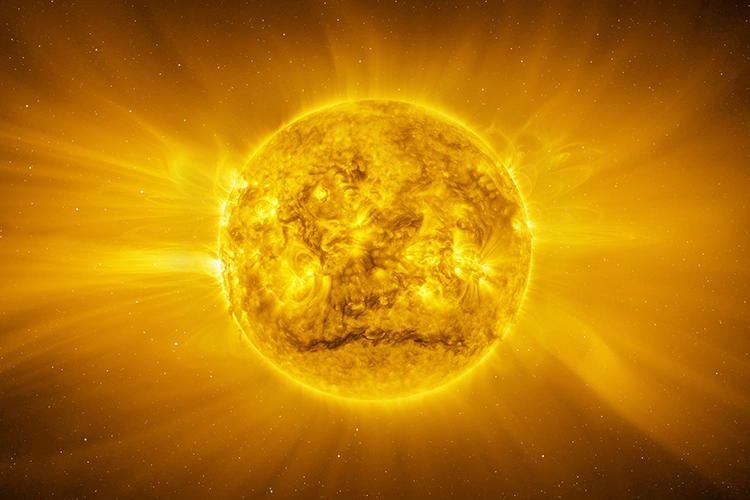
Intense geomagnetic activity from the cannibal solar storm could threaten critical UK communications and satellite orbits
By
The UK is preparing for what the British Geological Survey (BGS) warns could be the largest solar storm to hit Earth in over two decades, forecast for later today (12 November).
After an initial storm already triggered widespread aurora borealis displays across the UK and disrupted GPS and communications, scientists are now forecasting a more powerful ‘cannibal storm’ event that has the potential to reach the maximum G5 intensity on the NOAA storm scale.
Enjoying this article? Check out our related reads:
A ‘cannibal storm’ occurs when a faster-moving solar eruption overtakes an earlier, slower one, merging and amplifying its magnetic power. The combined energy from this coming event could have significant impacts on critical space and ground-based technologies, including satellite orbits, GPS, and national communication systems. For this reason, solar storms are listed on the UK’s National Risk Register.
Gemma Richardson, BGS geomagnetic hazard specialist, emphasised the real-world impact, stating: ‘Our data suggests that this event could be one of the biggest storms we’ve seen in 20 years.’
While certainty on the storm’s exact magnitude is impossible until it reaches Earth, the BGS anticipates it will be significant, with early indications showing some of the largest recorded ground measurements of solar energetic particles since 2005.
A silver lining to this extreme space weather is the increased chance of seeing the Northern Lights across the UK tonight, provided the skies are clear and dark. Observers in Scotland, Northern Ireland, and northern England have the best visibility prospects.
The G5 Scale
The impending storm has the potential to achieve G5 – the Extreme level on the NOAA’s five-level Geomagnetic Storm Scale. This classification, derived from the K-index that measures magnetic field fluctuations, signals the highest severity of space weather.
A G5 storm poses significant risks to technology:
- Grid Infrastructure: Widespread power voltage control problems and cascading protective relay trips may occur, potentially leading to complete grid collapse or blackouts.
- Satellite Systems: Extensive surface charging and drag could make tracking difficult, requiring constant corrections for orbits.
- Navigation and Communications: Low-frequency radio communication and GPS accuracy can be totally blocked or degraded for days.