


Multinational investment has transformed the Irish capital, but the wealth flowing through Dublin doesn’t always reach the people who live there

By
Over the past 15 years, Dublin has been the standout performer among major European cities, growing its economy by six per cent a year. Its only rival was second-placed Valletta; the capital of Malta grew by 5.7 per cent per annum over the same period. The average for Europe’s 169 largest cities was 1.7 per cent across the past decade and a half.
Dublin has lured multinational firms in key sectors, including biopharmaceuticals, business consulting and financial services, through favourable tax policies. These are important industries, but the standard bearers for the service-oriented boom are a handful of major tech players. Commercial giants including Apple, Amazon, Google, Meta and LinkedIn have their European headquarters or major administrative operations in Ireland.
Enjoying this article? Check out our related reads…
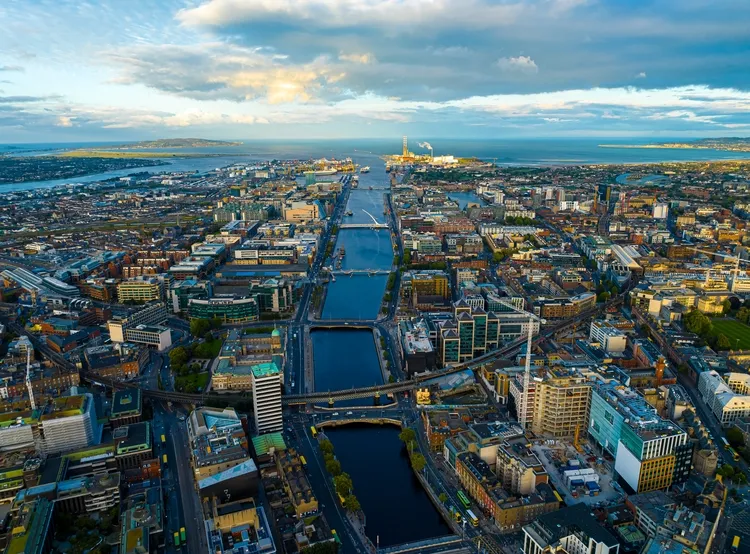
On a recent research trip to Dublin, the influx of new capital was readily apparent. As I walked along the banks of the River Liffey, from my dockside hotel towards the National Archives, I saw how the flat riverside was developing into a junior Silicon Valley. Nineteenth-century low-rise brick warehouses and stone wharves, with their relics of rusty capstans, are overshadowed by new office blocks of gleaming steel and glass, with coffee shops at street level. There was a confluence of internationalism and local flavour: tech O’bros taking a break with their emerald-green matcha lattes and packets of Tayto potato crisps.
The most striking feature of the waterscape speaks to Ireland’s past rather than its present. It’s modest in scale but visually arresting: six tall figures cast in bronze. Each is more than two metres tall but as narrow in the shoulders as an infant. One carries the body of a child. They appear to be moving forwards in slow motion – a family group spread apart by the exhausting effort of a march. They are taking the final steps towards a ship and the promise of salvation. The Famine Memorial on Custom House Quay, by Rowan Gillespie, commemorates the Great Hunger of 1845–52. The agricultural crisis that decimated Ireland’s rural economy in the mid-19th century led to a million deaths and was a direct result of British colonial policy. One of the enduring outcomes of the Great Famine was an exodus of Irish emigrants to America.
Today, Dublin is alive with tourism and immigration. During my visit, I was driven by a Ukrainian bus driver, greeted by Brazilian receptionists and served by Spanish waiters. Economic migrants are drawn to a dynamic economy rich in opportunity. While migrant faces populated the hospitality sector, the city hadn’t been lost to globalisation. Dublin’s most enduring cultural spaces drew in tourists but felt unique and deeply rooted in place. These, of course, were the pubs: comforting spaces that were new to me yet felt familiar, including city icons such as Bowes, Mulligan’s and Toners.
Ireland now ranks as one of the most developed countries in the world. In the UN’s 2025 Human Development Index (HDI), it was 11th, two places ahead of Britain. Previously, it ranked even higher, coming joint second with Switzerland behind Norway in 2020 and finishing ahead of other affluent nations including Sweden. Despite this silver-place finish, Ireland’s performance in health and education was only at the average level of the 66 nations in the ‘very high’ development group in 2020.
Something unusual is going on in Ireland’s story. The HDI is a composite of different development indicators, and Ireland’s persistently high ranking is distorted by its inflated gross national income (GNI) per capita.
The UN in 2025 put Ireland’s GNI per capita at US$87,360, compared with US$54,550 for the UK. Anyone who knows the two countries will be able to tell you that Irish people aren’t more than one-and-a-half times as wealthy as Britons, and that poverty exists in both countries. Ireland’s income is greatly exaggerated by the inflow of profits to multinational corporations based in Dublin that take advantage of its controversial tax-haven status. This predominantly foreign wealth doesn’t improve the living standards of most Irish people.
In the city-centre shopping district, by the waterfront and in the bustling pubs, the poverty experienced by Ireland’s disadvantaged people isn’t immediately apparent. There are signs, though. Drinking and drug use in the alleys suggest a social crisis, while gestures against gentrification and displacement disrupt the city’s success-story narrative.
One simple motif I saw was a guerrilla decal stuck to an apartment lockbox that read, ‘By staying here, an Irish family loses a home.’
While the argument that tourism is helping to push housing prices far beyond affordable levels may have merit, the broader picture is that Ireland’s policymakers aren’t effectively controlling international capitalism, and the economic boom has produced losers as well as winners.



