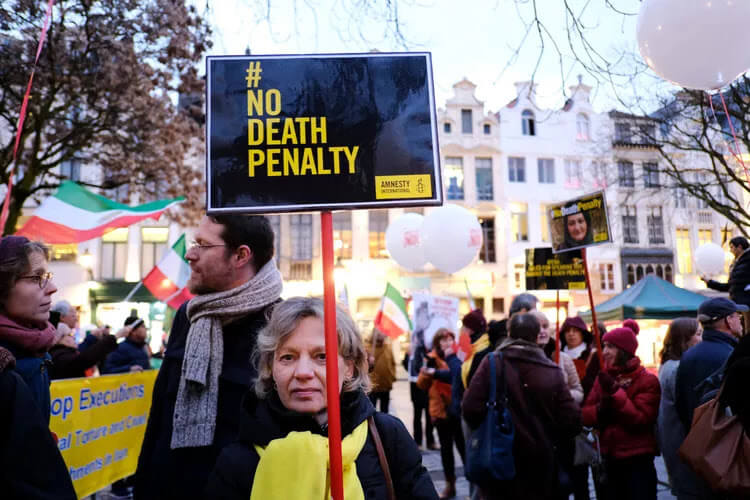

As the world moves towards abolishing the death penalty, executions continue to expose deep divisions over human rights and justice
By
When the State of Tennessee strapped Christa Pike to a gurney at Riverbend Maximum Security Institution on the evening of 30 September, it did so having been warned by her lawyers about collapsing veins, degraded drugs and an execution protocol they described as ‘veiled in secrecy’. Officials injected her with pentobarbital, waited, and then injected a second dose, while witnesses on the other side of the glass listened to her continue to breathe and, at times, to snore. More than an hour later she was taken by ambulance to a Nashville hospital, where she regained consciousness.
Volker Türk, the UN high commissioner for human rights, described the prolonged suffering caused by repeated failed attempts as ‘abhorrent and cruel’, while nine independent UN experts called the two botched executions ‘a flagrant breach of the prohibition of torture and arbitrary deprivation of life’.
In Tennessee, the political debate moved in quite another direction, with Marsha Blackburn, the Republican candidate for governor, calling for the state to ‘bring back the electric chair’. And Donald Trump later approved a firing squad for Nidal Hasan, the army psychiatrist who killed 13 people at Fort Hood in 2009. This will be the first US military execution since 1961.
The distance between Geneva and Nashville demonstrates how the international legal argument has shifted in ways that the politics of executing states has not. Human rights law has long treated capital punishment as something to be contained rather than prohibited, and the International Covenant on Civil and Political Rights permits it only for ‘the most serious crimes’, only after a fair trial and never for offences committed by children.
In April, the UN special rapporteur on extrajudicial executions, Morris Tidball-Binz, concluded that those safeguards cannot do the work asked of them, finding that the death penalty ‘is always incompatible with the prohibition of torture and the protection of human dignity’. The suffering, he states, is built into the punishment itself rather than arising from occasional failures of practice.
Related reads…
Even measured against the older and narrower standard, the record of the world’s executing states is grim, with Amnesty International counting at least 2,707 executions in 2025, the highest figure since 1981 and one that excludes the thousands believed to have been carried out in secret in China. Iran accounted for at least 2,159 of the recorded deaths and Saudi Arabia for at least 356, and nearly half of all recorded executions were for drug offences, which often fall well short of the threshold of ‘most serious crimes’.
In Saudi Arabia, most of those put to death for drugs this year have been foreign nationals, among them Ethiopian migrants convicted of non-lethal offences, and at least three people worldwide were executed last year for crimes committed when they were children.

Iran’s use of the death penalty since the January protests shows how quickly fair trial guarantees disappear once executions become an instrument of political control. Türk’s office has reported that 12 defendants were sentenced to death after a single closed hearing lasting three hours, that some were executed within weeks of their arrest, and that confessions were allegedly obtained through torture.
Amnesty believes at least 60 more protesters face execution, three of them arrested as children, and Türk has said plainly that the executions are being used to ‘instil fear among the population and suppress dissent’.
In Israel the discrimination lies in the statute itself, since the Knesset voted in March to make hanging the default sentence for Palestinians convicted in military courts of deadly attacks, to be carried out within 90 days. Türk called the law ‘deeply discriminatory’ and warned that applying it in the occupied Palestinian territory would constitute a war crime.
The United States sits uncomfortably in this company, having carried out 47 executions in 2025, its highest total since 2009, and remaining the only country in the Americas that still executes people, even as public support stands at a 50-year low and most executions are concentrated in a few states, principally Florida. When its own executions fail in full view, its political leaders reach for new methods to extinguish life, rather than asking whether the punishment can be justified at all.
The broader movement, however, is running the other way. Lebanon’s decision in August to abolish the death penalty for all crimes made it the first country in the Middle East to do so, and by June this year 92 states had ratified the Second Optional Protocol to the Covenant, a commitment to abolition from which there is no withdrawal. In December 2024, more than two-thirds of UN member states supported a global moratorium for the first time, with another vote due before the end of this year.
This year’s World Day Against the Death Penalty was commemorated on 10 October under the theme, ‘Stories for life’. The observance asked who actually ends up on death row?
Across systems as different as Iran, Saudi Arabia and the United States the answer is strikingly consistent: the poor, migrants and those whose trials would not survive serious scrutiny. Christa Pike’s case drew global attention because its cruelty was so visible, but most of the world’s executions take place far from any witness room, and it is that invisibility, more than any argument about deterrence or justice, that allows them to continue.