
• Skip to main content
  • Skip to secondary menu
  • Skip to primary sidebar
  • Skip to footer
Geographical

Geographical

Official magazine of the Royal Geographical Society (with IBG)

  • Geographical Home
  • News
  • Features
  • Opinion
    • Climatewatch
    • Front Lines
  • Podcast
  • Travel
    • Discovering Britain
    • Passport
  • Culture
    • Book reviews
  • Quizzes
    • Crosswords
  • Choose Geography
    • University directory
    • Masters courses
    • Course guides
      • Climate change
      • Environmental science
      • Human geography
      • Physical geography
    • University pages
      • Aberystwyth University
      • Brunel University
      • Cardiff University
      • University of Chester
      • Edge Hill University
      • The University of Edinburgh
      • Newcastle University
      • Nottingham Trent University
      • Oxford Brookes University
      • The University of Plymouth
      • Queen Mary University of London
    • Geography careers
      • Charity/non-profit
      • Education & research
      • Environment
      • Finance & consulting
      • Government and Local Government
    • Applications and advice
  • Magazine
    • Issue previews
    • Subscribe
    • Manage My Subscription
    • Special Editions
    • Geographical Archive
    • Advertise with us
  • Subscribe
    • Direct Debit Changes

The newfound potential for Atlantic seaweed

27 May 2026
2 minutes

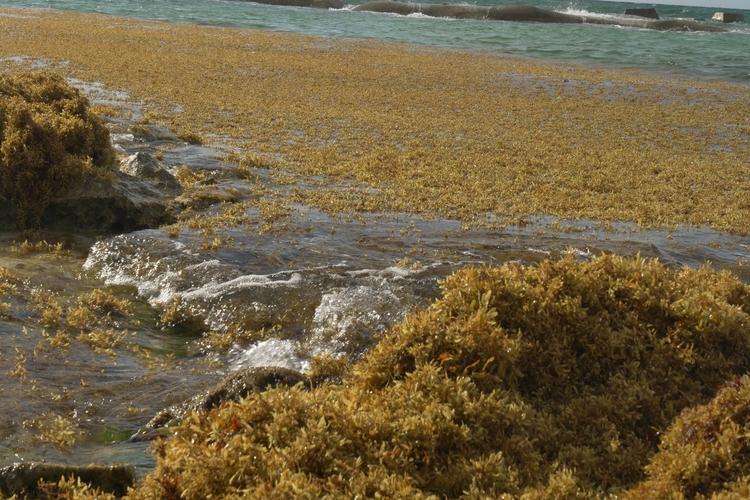
Cancun, Mexico. May 9 2024. Sargasso weed (sargassum seaweed)  covers the beach at El Dorado Royale hotel, Cancun, Mexico.
Sargassum off the coast of Cancun, Mexico. Image: Shutterstock

A new study shows how Atlantic seaweed could power carbon dioxide removal and biofuel production


By Coby Schlosberg

Spanning the Caribbean, Gulf of Mexico and West African coasts, large quantities of Sargassum seaweed have become a persistent socio-economic challenge. Thick mats of algae cover beaches, disrupt fisheries, harm tourism and release damaging gases as they decay. Both sides of the Atlantic are coming into contact with thick amounts of algae, with clean-up costs spiralling into hundreds of millions of dollars every year.

However, a new study by international researchers suggests that behind the growing problem could be an untapped opportunity. The research, which examined the Great Atlantic Sargassum Belt, shows that Sargassum prevalence can be predicted. This is significant because the ability to predict Sargassum blooms greatly increases the likelihood of using them for climate solutions, such as marine carbon dioxide removal or biofuel production.


Enjoying this article? Check out our related reads:

  • Turning the Caribbean’s seaweed crisis into a climate-saving industry
  • How can we make expeditions more planet-friendly?
  • Can seaweed really help fight climate change?
  • Farming seaweed in UK waters for a sustainable future
  • Why feeding cows seaweed instead of grass could help the planet

The Great Atlantic Sargassum Belt has expanded since its formation in 2011 to stretch across 8,000 km from West Africa to the Caribbean. By 2025, its biomass exceeded 37 million tons – about six times the total body mass of Italy’s population. While the expansion has heightened its impacts on coastal communities, it also represents a significant, naturally occurring pool of carbon captured through photosynthesis.

Using a model based on satellite observations and oceanographic data, the researchers reconstructed Sargassum variability from 2011 to 2022 and successfully predicted concentrations for 2023 and 2024. This predictive capability is a vital step forward because it reduces the scope of uncertainty surrounding the future of the blooms and improves the feasibility of long-term planning.

‘Sargassum absorbs large amounts of carbon dioxide as it grows,’ said the leader of the study and CMCC scientist, Annalisa Bracco. ‘The key challenge is that when it reaches the coast and decomposes, much of that carbon is released back into the atmosphere. If we can intervene before this happens, this system could instead be part of the solution.’

The persistence and predictability of the Great Atlantic Sargassum Belt suggest opportunities to transform it from a challenging environmental phenomenon into one that creates opportunity. For example, offshore harvesting for deep-ocean carbon storage or conversion into biofuels and other materials is a potential approach that has benefits for emissions reductions and clean-up costs.

The study reveals that the drivers behind the growth of Sargassum have fundamentally changed over time. In its early years, physical processes largely drove the expansion of the belt. This particularly occurred through stronger winter winds that deepened the ocean’s mixed layer and brought nutrients to the surface. 

Over time, the system has evolved into a self-sustaining ecosystem. Entire communities of marine organisms are hosted throughout the belt. These organisms recycle nutrients – especially nitrogen – within the floating mats. Meanwhile, decaying algae release additional nutrients back into the water.
Themes News Oceans

Protected by Copyscape

Primary Sidebar

SUMMER SALE

GEOGRAPHICAL WEEKLY LOGO FREE - Sign up to get context, clarity and perspective in a noisy world, every Friday

Popular Now

Floating island in Canada

The newly-discovered Canadian island that appeared to vanish

QUIZ: Country Shapes – Hard

QUIZ: Country Shapes – Hard

Mosquito close up

Invasive tropical mosquito species detected in London

Industrial waste flowing into a waterway

The whistleblower who says England’s pollution watchdog buried the evidence

QUIZ: Geography Extremes

QUIZ: Geography Extremes

Footer

  • Facebook
  • Instagram
  • LinkedIn
  • Reddit
  • TikTok
  • Twitter
  • YouTube

Geographical print magazine cover

Published in the UK since 1935, Geographical is the official magazine of the Royal Geographical Society (with IBG).

Informative, authoritative and educational, this site’s content covers a wide range of subject areas, including geography, culture, wildlife and exploration, illustrated with superb photography.

Click Here for SUBSCRIPTION details

Want to access Geographical on your tablet or smartphone? Press the Apple, Android or PC/Mac image below to download the app for your device

Footer Apple Footer Android Footer Mac-PC

More from Geographical

  • Subscriptions
  • Get our Newsletter
  • About Us
  • Contact Us
  • Advertise with us
  • Privacy policy
  • Terms & Conditions

Copyright © 2026 · Site by Syon Media