As the UK transitions away from fossil fuels to renewable energy, the underlying infrastructure used to generate and transport electricity is changing dramatically
By
From huge tracts of empty mountain plateaus to small, nature-rich sites and shorelines, the British countryside faces great change. The choice, argue some supporters of renewable energy, is simple. That change must happen through the construction of wind turbines and pylons to carry electricity from renewable sources – mainly offshore wind, but also onshore wind, solar and tidal energy – otherwise change will come more catastrophically, through the impacts of climate change.
Not everyone agrees, particularly if they live adjacent to a major project. Looking at the felled forest trees around the Highland village of Contin, the exasperation in Dr John Heathcote’s voice is palpable. Contin and neighbouring towns such as Beauly face years of upheaval thanks to two electricity lines scheduled to come through the area: a 400kV overhead line from Spittal in Caithness to Beauly, and a 525kV underground line from the Isle of Lewis to Beauly.
Enjoying this article? Check out our related reads…
‘The case for underground cables is that you can’t see them, but you definitely see the disruption and damage to the forest, with tree felling and road widening,’ says Heathcote, who is secretary of Contin Community Council. It turns out, he says, that the proposal for the underground cables had been planned for 20 years but not publicly communicated until it was too late. ‘We have not had the opportunity to ask questions. The attitude has been that this is all permitted development. It’s all very high-handed. It may be that the route chosen is the least-worst option – but there is no way of us knowing.’
Heathcote’s view is typical of the cognitive dissonance many people will feel. While the case for transitioning away as speedily as is practical from fossil fuels is unarguable, the instinctive reaction of many in rural towns and villages – and of walkers, cyclists and other visitors to the countryside – can become ambivalent when confronted with lattices of steel pylons and turbines breaking the skyline. ‘I’m convinced of the need to act to reduce climate change,’ says Heathcote, ‘but there is widespread concern at how the whole process is being imposed on communities like ours. We are not happy.’
‘The damage being done to Contin is quite extensive.’
A changing landscape
The rationale for the upheaval is a combination of energy targets and geography. National Grid, which is tasked with funding and overseeing the Great Grid Upgrade, argues that the UK’s electricity grid was originally built – almost 90 years ago – to connect electricity generated in power stations using fossil fuels, such as coal from the Midlands, northern England and South Wales. In 1963, coal accounted for almost 80 per cent of electricity production, and hundreds of coal mines fed large power stations that pumped electricity into a grid that still supplies our homes today. Oil added a further 10 per cent.

In contrast, in 2024 the country went through its first year without any use of coal power, and the government wants at least 95 per cent of electricity generation and 100 per cent of demand on the island of Great Britain to come from low-carbon sources by 2030. Overall, in 2025 renewables supplied more of the UK’s electricity than any other source, making up 47 per cent of the total, followed by gas (28 per cent), nuclear (11 per cent) and net imports (10 per cent). The country also ran on 100 per cent clean power, after accounting for exports, for a record 87 hours.
However, while power generation decreased by 20 per cent from 2010 to 2024, demand is now increasing as electric vehicles, heat pumps and data centres connect to the grid in larger numbers. Electricity demand is expected to increase from 300TWh in 2020 to 450TWh by 2035, according to the Climate Change Committee, and to 600TWh by 2050. The government has set a target of adding up to 50GW of offshore wind to Britain’s energy mix by 2030 and is targeting a fivefold increase in solar deployment, to 70GW, by 2035. ‘As the UK moves away from fossil fuels and increases clean energy generation, which is largely offshore, we need to connect electricity to new places,’ says a National Grid spokesperson. ‘Significant new infrastructure is needed to connect this clean energy from where it’s now generated to homes and businesses. The existing infrastructure simply doesn’t have the capacity to transport the volume of energy that will be generated offshore.’
This upgrade is happening at pace. According to National Grid, five times more electricity infrastructure will be built between 2023 and 2030 than in the previous 30 years. This will involve six new subsea high-voltage cables, 550 kilometres of new overhead power lines and 1,300 steel pylons. More than half the schemes will affect the east coast of Britain. The majority of this additional capacity will be provided by overground pylons, after the government ruled out burying electricity cables underground in 2024. Last year, an independent report by the Institution of Engineering and Technology concluded that underground cables were, on average, around four-and-a-half times more expensive than overhead lines, while cabling out at sea could be up to 11 times more expensive. However, there was a caveat: while the report concluded that the financial case for pylons was incontrovertible, it also embraced the wider picture and stressed the importance of considering both cost and ‘non-cost factors’, such as visual and environmental impacts.

Another issue emerges when local communities start joining the dots between schemes. A one-off scheme can be argued for or against in isolation. But when one scheme after another appears, and is approved, the aggregation of infrastructure, with accompanying blight, ignites raw feelings. ‘Landscapes in the east of the country and along the coast are being changed from relatively rural to industrial,’ says Jackie Copley, campaigns lead for CPRE. The proliferation of solar farms, wind turbines and pylons, and the disruption caused by underground cabling, is leaving many communities ‘overwhelmed’, she says, while local residents often complain that central government is riding roughshod over genuine conservation concerns.
Copley is unequivocal about the existential threat posed by climate change ‘and that rural areas have a role to play in delivering clean power.’ Yet the planning system feels high-handed to most rural communities, she argues, gets people’s backs up and consequently leads to poorer outcomes. ‘We recognise the cognitive conflict – this isn’t Nimbyism. Pretty much every objection letter sent to planners begins with a sentence expressing support for climate action, but that proposals are too big in scale,’ she says. ‘You need to do it in a strategic way. If you planned this development on a spatial basis, all regions would bear their fair share, but it is too clustered in the eastern counties.’
A Strategic Spatial Energy Plan for 2030 to 2050, which will spell out what energy sources Great Britain needs, and broadly where, is due to be published in the autumn of 2027, but Copley says this cannot come soon enough. She is similarly frustrated that major projects are proceeding apace before the publication of a Centralised Strategic Network Plan in 2028, which looks at the transmission networks that carry energy over long distances and will set out how electricity, gas and, potentially, hydrogen systems need to evolve together over the next 25 years. Similarly, Regional Energy Strategic Plans, intended to give local voices a say, are not planned until the end of 2028. National Grid has confirmed that six of its major projects have already started construction, three have been submitted for approval and a further three will be submitted by this summer.
Protests along the coast
Among the most contentious projects is a proposal to build a 114-mile network of pylons and cables between Norwich and Tilbury as part of a new 400 kilovolt electricity transmission connection. This would create new electricity capacity across East Anglia, a region that has historically had limited transmission infrastructure, but it is opposed by campaigners who fear it would damage the character of the Stour Valley. The plans include about 20km of underground cabling through the Dedham Vale National Landscape, along the Suffolk – Essex border, in the heart of what is known as Constable Country. More than 39,000 people have signed a petition calling for an offshore grid or for the cables to be run underground.
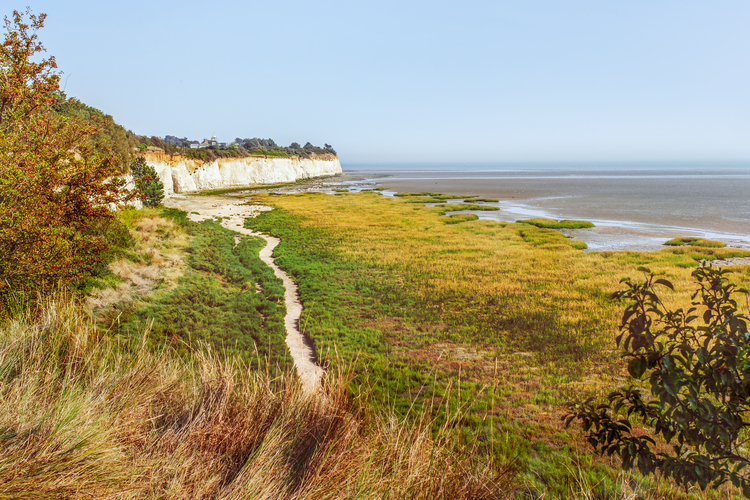
Further south, proposals for Europe’s largest converter station have provoked a strong reaction. The Sea Link scheme centres on a 28-metre-high, 90,000-square-metre (nine hectare) electricity converter station on Minster Marshes, adjacent to a protected SSSI wildlife site, to connect wind-generated electricity from Suffolk to Kent via undersea cables. The main cable will come onshore through Pegwell Bay Nature Reserve, which enjoys not only SSSI but also Ramsar and National Nature Reserve status. The Save Minster Marshes Campaign Group says the plans will result in the complete removal of habitat for overwintering and spring-breeding birds, cause the loss of marshland – which is both a carbon sink and a soak for rising groundwater and flooding – and that consultation has been minimal, despite there being cheaper and less environmentally damaging alternatives.

The plans will also affect agriculture, says local farmer Pippa Southorn. ‘We do not plough the soil; we use a no-till method, which protects this soil type and has enabled it to form a wealth of microbiology, and has significantly reduced compaction and runoff,’ she says. ‘There is a chance the salt layer from the sea, which sits at about 60 metres deep, could be brought to the surface and contaminate the entire area.’ Campaigners are backed by Kent Wildlife Trust, which warns of the impact on Kent’s largest population of seals, on ‘a vital wildlife corridor and nationally important ecosystem’, and on protected species such as the golden plover, beavers and water vole. ‘We support renewable energy, but not at the cost of wildlife,’ says Emma Waller, planning and policy officer at Kent Wildlife Trust. A National Grid spokesperson says: ‘We’ve been listening to local communities and representatives over the past three years to help shape our proposals. We are committed to protecting wildlife throughout all stages of the Sea Link project.’
Other east coast projects propose 135km of overhead lines between Grimsby in Lincolnshire and Walpole in north Norfolk, via the Lincolnshire Wolds National Landscape, while a related pylon route would run 60km inland from Weston Marsh, just outside Spalding, to Melton Mowbray in Leicestershire. National Grid says the scheme will connect new sources of electricity planned in the area, including offshore wind, solar, gas-fired generation, interconnectors, battery storage and subsea links from Scotland. Lincolnshire County Council has objected to the proposal, saying it would ‘permanently change’ the county’s landscape, that local communities would be ‘overwhelmed by substations and pylons’, and warning of ‘the impact of the continual loss of high-quality farmland on national food security’.
Confrontation elsewhere
Substantial projects are also in train for the west coast as upgrades seek to connect Scotland and Wales. The Western Link 2 scheme intends to transport clean energy from offshore sources along Scotland’s western coast to a proposed converter station in Ayrshire. From there, National Grid plans to develop a new high-voltage direct current link to carry this energy to the Gwynedd coastline in north Wales. The proposed route will pass through Scottish, Northern Irish, Isle of Man and Welsh waters, but will also involve stretches of pylons. Farmers in Cumbria have objected, warning that the loss of land to pylons could make their farms economically unviable.
Wales is also seeing protests. In January this year, more than 300 farmers and landowners were granted permission to challenge energy firm Green GEN Cymru in the High Court over proposed electricity infrastructure developments that, they say, would see ‘energy infrastructure and pylons spanning 200km across Powys, Ceredigion, Carmarthenshire and Montgomeryshire in Wales and across the Welsh border into Shropshire’. The judicial review was filed on behalf of community groups Justice for Wales and Campaign for the Protection of Rural Wales, challenging the company’s actions in attempting to access private land to carry out surveys for three major overhead pylon routes.
A focus of opponents’ ire is the proposed Nant Mithil energy park project, which would erect 36 turbines, each 220m high, on the hilltops of Radnor Forest. These would connect to the national grid in Carmarthenshire via a 100km pylon network that, supporters say, would power 200,000 homes and save about 350,000 tonnes of CO2 each year.
A need for big-picture thinking
Back in Contin, Heathcote expresses a sentiment felt in many communities. ‘My biggest gripe is that there is no over-arching plan. The communities intended to host all of this infrastructure are being given little or no say in the process, and are intended to derive very little benefit,’ he says. ‘It all seems much the same as a developing country being ransacked by mining interests. There has to be some honesty and more technical expertise within government to give us a level-headed approach. I’m pretty gloomy. You see politicians flinching from the political difficulties, trying to get things done in a hurry. There’s going to be a mammoth U-turn at some point, when we all realise that ploughing straight on is just going to lead to a crash.’

At Minster Marshes, campaigner Kaz McKenzie sees history repeating itself. ‘A lack of joined-up thinking has been the hallmark of UK governments over many years. Trying to fix this broken system is what’s needed. Of course we support renewables – it’s the only way forward – but you cannot have a green energy revolution by trashing the environment. Habitat restoration is one thing, but protecting what we have is surely the first step?’
CPRE’s Copley argues that a change of priorities is needed. ‘Community-led projects work best – if planners spoke properly to local people then they would understand which local patches are special to them and which areas they are happy to see developed – degraded landscape rather than relatively tranquil areas. That can make a bitter pill easier to swallow.’
‘The current approach often seems wrong-headed,’ she continues. ‘It sometimes feels that things are the wrong way around – we spend billions on upgrading the grid and disrupting rural areas when we could be sticking solar on every rooftop in urban areas, on car parks and warehouses. The message seems to be that we can use just as much electricity as ever, but that it’s okay because in a few years’ time it will all be renewable energy. There doesn’t seem to be much talk of reducing energy use.
‘With far better community engagement we can get [the switch to renewables] across the line, but if we don’t get the population behind this then we are going to find it tough.’