Few journalists have reached Myanmar’s Karenni State since the 2021 coup. Sean Sutton reports on the communities determined to return home
Photographs by Sean Sutton
Reaching Myanmar’s Karenni State took weeks of planning. Routes changed repeatedly as the security situation evolved, and nothing was certain until the final moment. Eventually, everything fell into place, and almost 37 years after my first visit, I crossed back into a country transformed by civil war.
The journey from the Thai border took almost 18 hours. Pickup trucks edged across rivers on improvised ferries built from narrow wooden boats before climbing into the mountains. As we travelled deeper into Karenni, villages bore the scars of recent air strikes and drone attacks. Churches, schools and homes stood damaged or abandoned. Although the technology of war had changed dramatically since I first came here in 1989, the humanitarian consequences felt painfully familiar.
Enjoying this article? Check out our related reads…
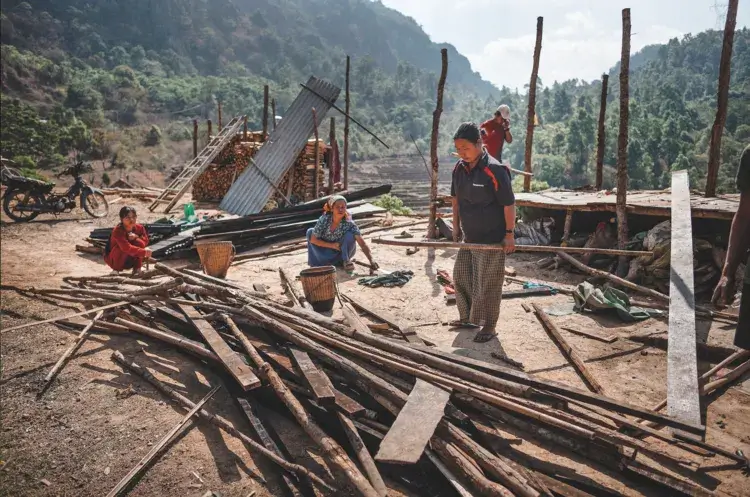
One of the first places I visited was an informal camp where dozens of families had arrived only hours earlier after fleeing renewed fighting near Moe Bye. It was the second time many had been displaced. They had escaped heavy bombing after Myanmar’s military seized power in a 2021 coup, rebuilt their lives, and now found themselves starting again. ‘We left in 2021 because of heavy bombing,’ Pio told me. ‘Our houses were destroyed. We built shelters near our fields, but now we have fled again because of daily drone and artillery strikes.’
Families of every generation worked side by side, cutting bamboo, carrying timber and erecting shelters that would become home within a day or two. Toddlers played between piles of bamboo while grandparents worked alongside younger relatives. It was impossible not to notice how practised everyone had become. This wasn’t the first time they had rebuilt their lives.
The uncertainty weighed heavily.
‘It will be much harder for us to grow food now, and there is little water here,’ said Mobi, a village committee member. ‘We are all very concerned for the future.’
Another woman described fleeing under artillery fire. Last August, she said, one villager was killed by a landmine while collecting mushrooms. Three others lost legs after stepping on mines in fields or forests.
‘This is how we live in Myanmar,’ she said. ‘We want justice and peace as soon as possible.’
Close to the front line
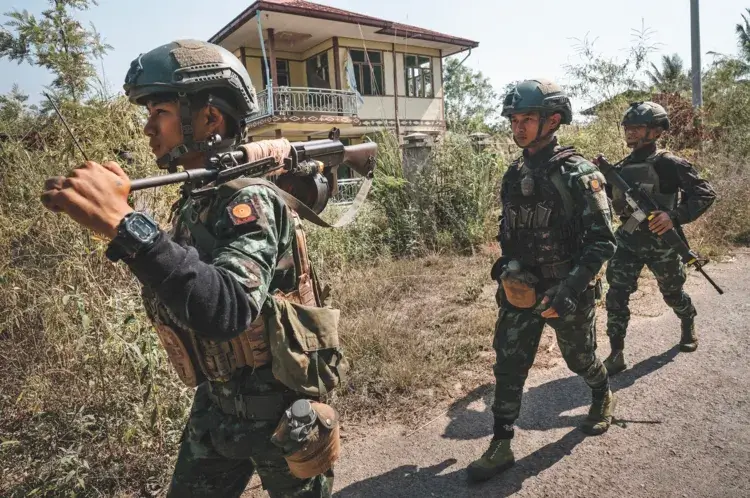
From the camp, I travelled towards Demoso, spending time with resistance fighters operating close to the front line. In one abandoned neighbourhood, soldiers from the Karenni Nationalities Defence Force (KNDF) and the People’s Defence Force occupied positions little more than 30 metres from troops belonging to Myanmar’s military junta, known as the Tatmadaw. Damaged houses lined deserted streets where gardens had become overgrown, and warning bells hung across narrow paths and driveways to alert the troops to any surprise attacks. The brigade commander explained that landmines were used by both sides to defend positions. Wherever possible, he said, the KNDF recorded GPS coordinates when mines were laid so they could later be recovered if the front line moved.
NEARLY 80 YEARS OF CONFLICT
Myanmar has experienced almost continuous armed conflict since gaining independence from Britain in 1948. Home to more than 130 recognised ethnic groups, the country has long been divided between a central government run by a brutal military junta and ethnic armed organisations seeking greater autonomy or a federal system of government.
Myanmar’s civil war is one of the world’s longest-running conflicts. The current phase began on 1 February 2021 when the armed forces regained power in a military coup, overthrowing the elected government led by Aung San Suu Kyi’s National League for Democracy. The military alleged widespread electoral fraud, but independent observers found no evidence that would have changed the election result.
The coup triggered nationwide protests, which were met with deadly force. As the violence escalated, many civilians joined newly formed People’s Defence Forces, fighting alongside long-established ethnic armed organisations. Today, resistance groups control large areas of the country. However, the military, which relies heavily on artillery, air strikes and drones, has regained territory in several parts of the country in recent month.
Karenni State has become one of the conflict’s fiercest battlegrounds. More than 3.5 million people have been displaced across Myanmar and the country is now regarded as the world’s most landmine-contaminated, with civilians accounting for many of the casualties. Even where the fighting has moved on, hidden explosives continue to prevent families from returning home.
Driving away from the fighting, we passed through villages where people had begun returning, before reaching another that remained almost deserted. ‘This is because of the landmines,’ the commander explained. ‘The Tatmadaw were based here before we pushed them out. They laid a lot of mines and there have been many accidents.’
One of the few residents to return was Bue Reh. Rather than waiting indefinitely in a camp for internally displaced people, he had begun clearing around his own home. ‘The military told us there were landmines all around,’ he said. ‘The KNDF cleared some of them, and I helped. We didn’t have any equipment, so it was hard. I found four mines around my house.’
He thought the danger had passed. Then one friend arrived to collect roofing sheets and lost a leg. Another stood on a mine while walking with his cow. ‘Many families want to come back and farm their land,’ he said. ‘But they can’t because of the landmines.’
His story would become one of the defining themes of my journey through Karenni. Families weren’t returning because the danger had disappeared. They were returning because years of displacement had become unsustainable. Aid was becoming harder to obtain, children had grown up in temporary camps, and people wanted to rebuild their homes and cultivate their land. Again and again, landmines emerged as the obstacle standing between survival and recovery.
Documenting strife
My return to Myanmar had been nearly four decades in the making. In 1989, while travelling through Southeast Asia hoping to become a documentary photographer, I noticed a handwritten notice pinned to the wall of a guesthouse in the Thai border town of Mae Sot. It invited volunteers to visit refugee camps along the Myanmar border.
Myanmar had been gripped by ethnic conflict for more than 40 years. Since gaining independence from Britain in 1948, successive governments and the military had fought armed groups representing many of the country’s ethnic minorities, particularly in the mountainous border regions. I knew very little about the conflict, but I decided to go. That decision shaped much of my professional life.
During the next two years, I spent months travelling through areas controlled by ethnic resistance groups. It was there that I first understood the true legacy of landmines. They weren’t simply another weapon of war. Long after the fighting had moved on, they prevented families from returning home, farmers from cultivating their land and entire communities from rebuilding.
Over the following three decades, I photographed conflicts across Asia, Africa, the Middle East and Europe. Again and again, I found myself documenting communities living with landmines and unexploded ordnance. Afghanistan, Cambodia, Angola, Iraq, Syria and Ukraine were all different conflicts, but the questions people asked were remarkably similar. How do you rebuild when the land beneath your feet is still dangerous?
Air strikes on hospitals
The following day, I visited one of the few hospitals serving communities close to the front line. It was a modest facility, but one of the only places able to provide surgery and emergency treatment across the region. Not long before my visit, it had itself been targeted in a Tatmadaw air strike. Fortunately, the bomb caused no casualties, but it was another reminder that even hospitals no longer offered sanctuary. Dr Yori explained how the conflict had changed. ‘Forty to 50 per cent of our casualties are now caused by drone strikes,’ he said. ‘Twenty to 30 per cent are from landmines. The rest are gunshot wounds and fragmentation injuries.’
The figures reflected what I had seen throughout Karenni. Drone warfare may have transformed the battlefield, but landmines continue to injure civilians and soldiers long after the fighting has moved on. Unlike an airstrike, they remain buried beneath the soil, shaping every decision about whether it was safe to return home.
From the hospital, I travelled to a rehabilitation centre where young resistance fighters were learning to walk again. Before the coup, many had expected very different lives. Some had been students, others carpenters, mechanics or miners. None had imagined becoming soldiers.
Twenty-eight-year-old Aung had been making furniture before joining the resistance. ‘I saw junta troops shooting protesters,’ he said. ‘I had to do something.’ He lost his leg while carrying ammunition to the front line.
Nearby, Poe described trying to recover the body of a friend killed by mortar fire. ‘That’s when I stood on the mine,’ he said. ‘I remember lying on my back looking up at the sky through the trees while my friends carried me away.’
Elsewhere, another group of young fighters told me they had all joined the resistance together. Eleven friends enlisted on the same day. Four had since been killed and three had each lost a leg after standing on landmines.
Listening to them, I was reminded of conversations I had had in conflicts across the world. A landmine rarely destroys just one life. Its effects spread through families, friends and entire communities.
One village’s determination
Towards the end of my time in Karenni, I visited a village where families had recently begun returning after almost two years of displacement. For security reasons, I’ve chosen not to identify either the village or some of the people I met. Before the war, around 400 families lived there, farming rice, chillies and sesame on fertile land beside a reliable water supply. Village leader Su Su had lived there for seven years. ‘People came because the land was good,’ she said. ‘It was a good place to live.’
As fighting drew closer in 2022, villagers dug shelters and stored food, hoping they might ride out the conflict. Instead, they fled.
‘When the bombing began in 2023, we had to leave,’ Su Su said. ‘We thought the resistance would win quickly, but we stayed in the jungle for almost two years.’
The village stood empty while fighting raged around it. Houses were damaged by shelling and airstrikes, gardens became overgrown and fields lay abandoned.
When resistance forces eventually pushed the Tatmadaw from the area, many villagers believed they could finally return. They soon discovered that the military had seeded the village and surrounding farmland with landmines, making it too dangerous for families to move back or begin cultivating their land.
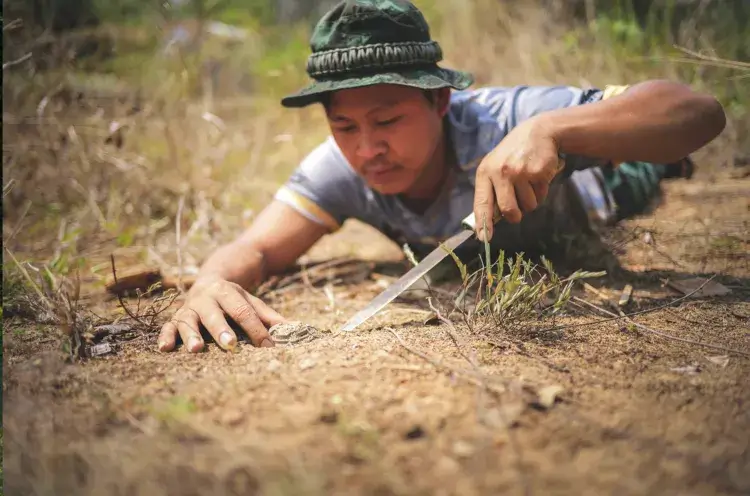
The clearance work itself was painstaking. For the villagers, however, it represented something far more important than the removal of explosives. Every area declared safe meant another family could return, repair a roof, clear a garden or prepare a field for planting.
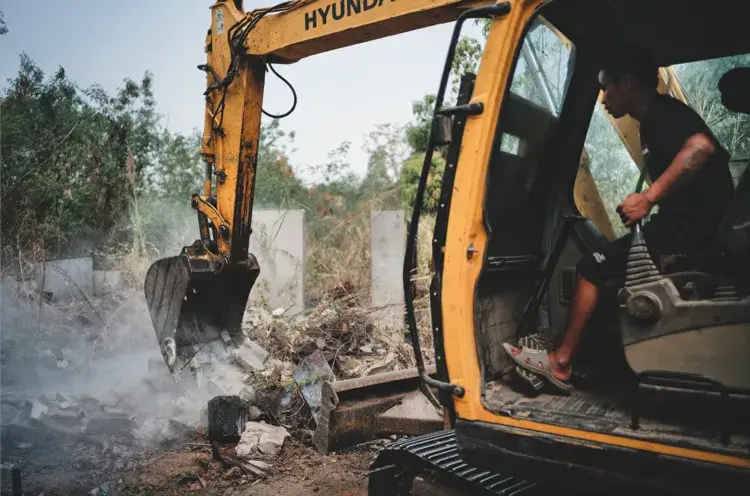
An explosive ordnance clearance team, supported by local volunteers, worked behind two excavators that stripped away vegetation and scraped back the upper layer of soil. Once the ground had been prepared, it was searched using locally developed, specially adapted rakes to minimise the need for people to work directly over suspected hazardous ground. During the first 27 days of the operation, the team recovered 13 anti-personnel landmines together with numerous items of unexploded ordnance, allowing more than 30 families to return to the village.
Over more than 35 years photographing conflict, I’ve documented humanitarian mine clearance in countries including Angola, Cambodia, Iraq and Ukraine. There, highly trained deminers worked with specialist equipment under carefully controlled conditions. Karenni was different. The war was still being fought, and no international humanitarian demining organisations were operating in the areas I visited. Everyone understood the risks. Su Su had already told me she expected more accidents before the village was finally safe.
Following the clearance teams, I found myself wondering what had become of everything they recovered from the ground. The answer came in a nearby town. Three ordinary family homes were being used to store recovered explosives until they could be destroyed. Their brick-built bathrooms – stronger than the surrounding wooden houses – had become makeshift armouries.

Inside one small bathroom, neat rows of anti-personnel landmines lay alongside grenades, mortar bombs, rocket-propelled grenades and other unexploded ordnance. The detonators had been removed from the landmines, but much of the remaining ammunition still retained its original fuses. Two improvised explosive devices even had their tripwires attached. The arrangement reflected necessity rather than best practice.
Outside, pigs wandered freely around the garden. Inside the house, family life continued much as normal. Only a few metres away, a baby slept peacefully beneath a mosquito net. The contrast was extraordinary.
Although only around a third of the village had so far been cleared, there were already signs of recovery. Houses were being repaired, gardens reclaimed and families gradually returning to land they had abandoned almost two years earlier. It wasn’t simply about removing landmines. It was about making ordinary life possible again.
One resident, Joses, had returned despite knowing the risks. ‘I really want to go back to the village,’ he told me. ‘We are not doing anything here. We are wasting our time. We can’t do anything to better our lives. At home, we can build our house, improve our house, grow food and develop our lives with our future in mind, but here we are just treading water. We have been trying to survive. We need to go home so badly.’
His words echoed almost every conversation I had during my time in Karenni. People weren’t asking for an easier life. They wanted the chance to work, grow food and support their families. Remaining dependent on humanitarian aid was never intended to be permanent. Without access to their land, however, many had little choice.
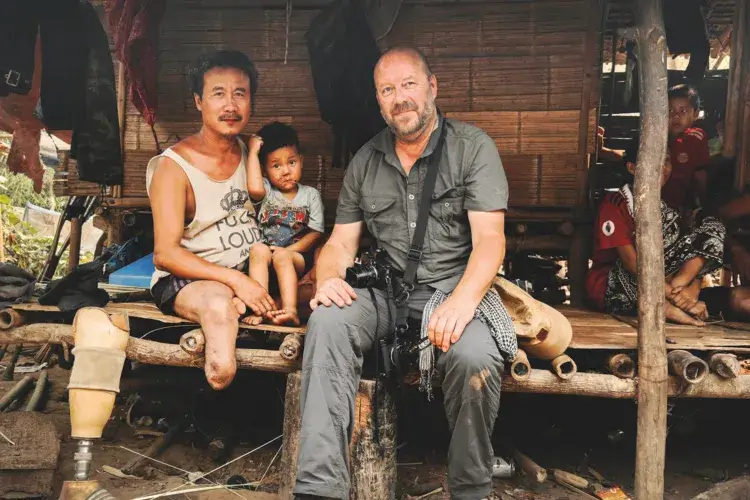
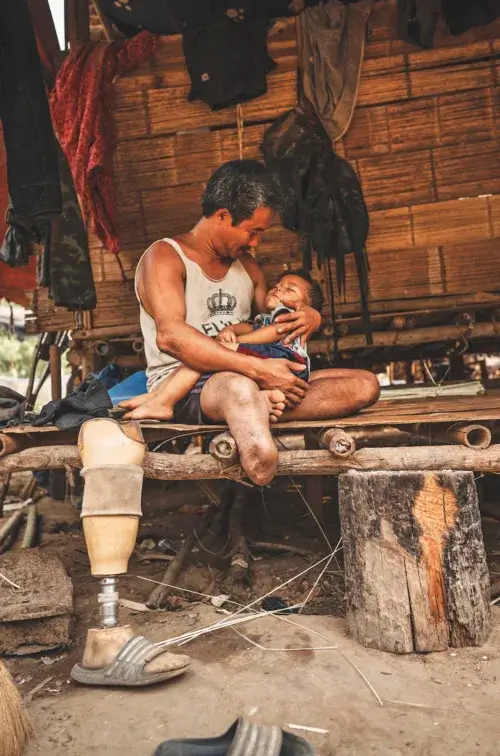
Before leaving the village, I met Oo Hpar, who had returned despite losing his leg after stepping on a landmine in 2023. As we talked, his three-year-old son, David, wandered in and out of the house, occasionally stopping to watch his father before running off to play.
‘I didn’t know there were landmines,’ Oo Hpar said. ‘They were hidden under the ground. That’s how I stood on one and changed my life forever.’
Like so many others, he spoke less about the accident than about the future. He wanted to rebuild his home, support his family and see the village thrive again.
Before I left, I walked to the church that had been destroyed in a Tatmadaw airstrike. Its roof had collapsed and the walls were blackened by fire. The surrounding ground was still thought to contain landmines. Even here, where people hoped one day to gather again, the war had left two legacies. One was visible in the shattered building; the other remained hidden beneath the soil.
‘The resistance told us we couldn’t come back because there were so many landmines,’ Su Su said. ‘Some people tried to clear them, but there were many accidents.’
Life in the jungle camps became harder with every passing month. Food grew scarce and aid became less reliable while productive farmland lay only a few kilometres away.
‘My family was the first to return,’ she said simply. Walking through the village, it was easy to understand why. Fruit trees still stood beside many of the houses. The fields remained fertile despite two years of neglect. The village itself had survived. The problem was reaching it safely.
When Su Su came home, she began clearing around her own house. ‘I used a rake,’ she said. ‘My 68-year-old mother used one as well. She found a hand grenade.’ She shrugged. ‘We just had to do it.’
That sentence stayed with me. Nobody I met underestimated the danger. They simply felt they had no alternative. Remaining indefinitely in displacement camps meant surrendering any hope of rebuilding their lives.
The community tried several ways to make the village safe. At one stage, they even drove a heavy road roller through suspected minefields, hoping its weight would detonate buried explosives.
Eventually, with support from Free Burma Rangers – one of the few humanitarian organisation that provides emergency medical care and relief in Myanmar’s conflict areas – two excavators were brought in and a more systematic clearance operation began.
‘They cleared house plot by house plot,’ Su Su said. ‘As each area became safe, families came back.’
Working for the future
By the time I left the village, it had come to represent far more than a single community’s attempt to return home. It was only one of many places I visited during three weeks in Karenni, yet it brought together so much of what I had witnessed across the region. I had travelled through active front lines, hospitals, rehabilitation centres and camps for displaced families, met young resistance fighters adapting to life after losing limbs, and watched communities trying to make their land safe enough simply to grow food again.
Everywhere I went, the stories were different, but the underlying reality was the same. The fighting had driven people from their homes. Landmines prevented many from returning. Communities were trying to rebuild while the war continued around them.
What struck me most, however, was that almost nobody dwelt on the past. Instead, people spoke about the future. They wanted to repair their homes, plant rice and sesame, send their children to school and become self-sufficient again. They wanted clinics, roads and clean water. Above all, they wanted conflict to stop dictating every decision they made.
That determination was visible everywhere. Families who had spent two years in makeshift camps were repairing damaged houses. Children cleared gardens that had become overgrown. Churches and schools still bore the scars of war, yet people talked not about abandoning them, but about rebuilding them. Even the painstaking work of mine clearance was viewed not simply as an emergency response, but as the first step towards restoring a functioning community.
I was told that similar stories were unfolding across Myanmar. In Chinland, Sagaing and Bago, communities were also trying to return home while living with the constant threat of landmines, unexploded ordnance and renewed fighting. Local leaders were keen for these places to be documented, believing that the humanitarian consequences of the conflict remained largely unseen beyond Myanmar’s borders.
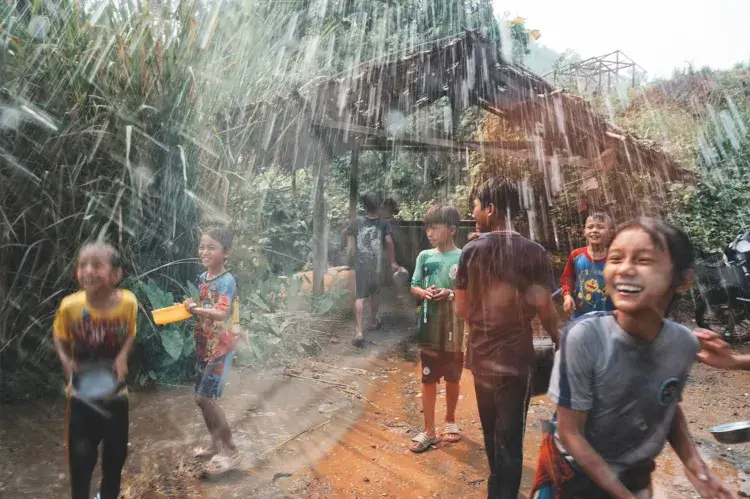
My final photographs were taken during Thingyan, Myanmar’s traditional water festival celebrating the New Year in April. Children chased one another through the village, throwing water and laughing as adults looked on outside houses that only weeks earlier had stood empty. It was an ordinary scene, repeated across Myanmar every year. Here, it felt extraordinary, simply because ordinary life had returned.
As I left Karenni, I thought back to the chance encounter with a handwritten notice pinned to a guesthouse wall in Mae Sot almost four decades earlier. It had introduced me to a country that would shape much of my professional life and to an issue that would take me to conflicts across the world. Returning after so many years, I found that many of the questions I first encountered in Myanmar remain unanswered.
If one small village in Karenni can reveal so much about the humanitarian consequences of this war, how many similar stories are still waiting to be told?