Trail running was once baffling, even laughable, in rural China. Today, it’s a booming sport drawing thousands into the mountains
Words and photographs by Leon McCarron
This past autumn, I went to the mountainous Sichuan province of western China, on the edge of the Tibetan Plateau, to take part in a trail race. It was my first trip to the country in six years, and I found myself thinking at length about two previous visits. The first was in 2010, when I walked the length of the country from north to south. It took seven months to cover the 5,000-odd kilometres, and for the most part, my walking partner and I were complete oddities to everyone we met.
The idea of travelling on foot for fun was anathema to the locals, to the point that, often, if we were close to a road, cars would slow down to offer us a ride. Almost a decade later, in 2019, I spent four months in China. Along with two colleagues, my goal was to create a 100-kilometre trail in a rural part of the centrally located Hunan province, knitting together pre-existing pathways that criss-crossed the mountains.
Enjoying this article? Check out our related reads…
We spent time in rural villages, where many residents had never encountered a foreigner. It was no surprise that our attempt to convey the idea of using old village paths as a platform for modern hiking trails wasn’t immediately well understood. On the days when we scouted routes by running along them, we were generally met with fits of laughter at how totally ridiculous it was to jog through the mountains. We’re used to that, of course – it takes time to introduce new ideas.
What was more surprising, perhaps, was that the challenges in the villages were the same as those we faced with donors and local government. At every level, we had to advocate for the importance and benefits of outdoor and adventure tourism. Towards the end of the process I remember my colleague Dennis Hu, a Hunanese native who had set up the project, telling me, ‘The outdoor industry is about to really, really blow up in China. Someday we’ll have trails like this everywhere.’ His point was that we had to persevere. And he has been proved right, although it has not been a smooth path to get there. The event that I took part in last year was the Kailas FUGA Gongga Extreme Glacier Challenge Race.

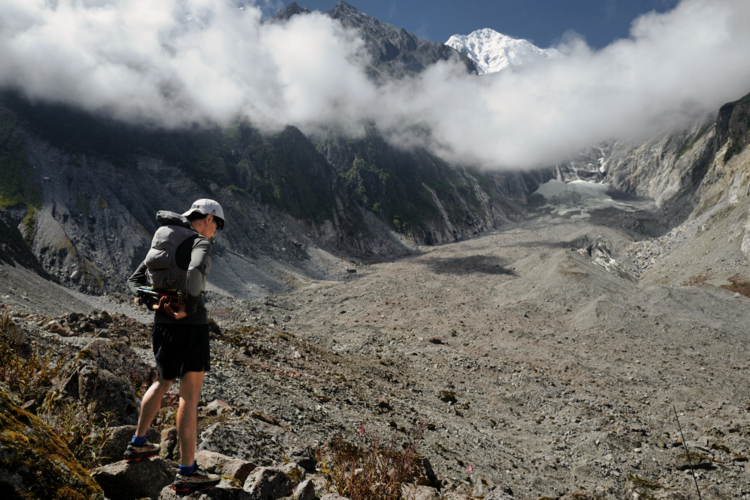
There were three courses on offer: a 100-kilometre option, with more than 6,000 metres of elevation gain, including A runner begins the journey onto the glacier, with the Daxue mountain range visible in the distance Runners approach the edge of Moxi town at the end of the 55-kilometre course a four-kilometre section of glacier crossing, and then shorter, though still mountainous, 55- and 30-kilometre distances. Having spent much of the summer writing a book at sea level, I opted for the 30 kilometre. At the heart of all three courses was Gongga itself – a 7,509-metre pyramidal peak, surrounded by the wider Daxue range. Gongga’s height makes it the third-tallest mountain in the world outside of the Himalaya– Karakoram range.
Surrounding it is a 10,000-square- kilometre nature reserve marked by alpine lakes, dramatic rock formations and heavy forest, as well as glaciers. The mountain is deeply important in Buddhism, too. Pilgrims come to circle the base and visit a monastery on its flanks. Just to gaze upon the mountain could be enough to erase sins, I had read.
‘The eye sought vainly for a haven of refuge,’ wrote an American climber from the first party to reach the summit, in 1932, ‘for some fair nook in this dazzling waste of desolation in which to rest, but none was vouchsafed in the cold, thin air.’ For many years, more people died attempting to reach the summit of Gongga than successfully stood atop it. I suppose that’s part of the complex appeal of mountains: the fairy-tale impression from a distance, the meaning we imbue them with, the harsh reality of our powerlessness if we go too close.
Part of why I like trail running is the benefit of proximity to mountains without quite so much jeopardy. The Gongga Extreme Glacier Challenge Race is one of more than 500 trail events that took place in China in 2025, with some estimates putting the number of trail runners in the country at more than eight million

The Ultra-Trail du Mont-Blanc (UTMB) World Series – the world’s leading trail running circuit – now has five races in China (including one in Hong Kong), and Chinese athletes are appearing on the podiums in some of the world’s top competitions. The boom in trail running hasn’t happened in isolation; it’s part of an explosion in the outdoor industry in general. Last year, according to Chinese media, more than 400 million Chinese took part in some form of outdoor sport. Hiking and cycling are the most popular, and some of the most scenic provinces, including Sichuan, have reported a 30 per cent increase in hikers year on year since 2022. To me, as an outsider, it all seems quite remarkable.
But even for Chinese friends, more used to the rapidity of change in their country, the speed is surprising. So how did it happen? There have been two waves of development. One of my fellow racers at Gongga, Ding Zhijian, began running in 2007. ‘It was a very small community then,’ he explained to me. Ding recalls there being just six races nationwide. He and others mark 2010 as the beginning of a broader interest in road running, with trails following a few years later. Ding now manages a mountain running club for the brand FUGA. There are 300 members, he told me when we met. He had just completed a 450-kilometre ultra marathon himself the week before and was preparing to race the 100-kilometre at Gongga.
‘We invite people who are elite or who have influence in the community. And they have to love mountains,’ he added. Many of his community began running during the mid-2010s. But by most accounts, the racing scene back then was chaotic. Events were reported to be disorganised, sometimes with too few volunteers or aid stations. Enthusiasm had grown quicker than the industry could keep up with. That was around the time that I was working in Hunan and struggling to find the right partners for the trail project. It felt as if China was on the cusp of something, my colleague Dennis had said then, but wasn’t quite there. In 2020, shortly after our team left Hunan, China and the world changed abruptly.

party atmosphere
The Covid-19 pandemic halted all races, and many smaller organisations that had facilitated the outdoor tourism spike were shuttered. Then, in 2021, just as the community began to recover, tragedy struck. At an event in Gansu province, freak, fierce weather hit racers on an exposed section of the course and 21 runners died. In the fallout, five of the organisers were jailed, and all trail races were cancelled once more. It was nearly a year before they restarted. When they did, it was with much stricter regulations and oversight from the government. The current phase of growth began in the wake of that Gansu disaster.
Now, alongside the new safety protocols, it’s standard for runners signing up for 100-kilometre races to provide proof of completing shorter events. All participants must complete medicals and comply with a kit list. At the Gongga race, I saw this for myself. There, the day before the race, I joined a line to register and unpacked my race bag for the stewards. On the morning of the race, loud music plays at the starting line and athletes warm up in a party atmosphere.
Gongga, a difficult and technical course on par with some of the most challenging races of a similar distance anywhere in the world, took seven years to organise. The race director and team had worked extensively with local government and the local community. When I explored the glacier section in the days prior to the race, I found specialist mountain rescue teams setting up across the moraine. I began my race at 7am on a fresh autumnal morning.
There were 1,000 participants in total, which is quite a small field compared to some trail races in China. Ultras close to big cities, such as those around Guangzhou and Beijing, cap entrants at 10,000. As with most races in the country, they sell out quickly, some resorting to a lottery system. The course took us out of a small town called Moxi, across a glacial river and then up into a forest of fir and spruce. A long and often steep climb followed, leading to a ridgeline high above the valley. Along the way, I ran for stretches with other runners. Most had come from big cities. Some flew, but many took high-speed trains. ‘We have such good infrastructure that it’s easy to get anywhere, even just for a weekend,’ Wang Lijun, who had come from Hong Kong, told me. It meant that no part of the country felt too far to travel to for a race, he said.
Wang, like others, often took an extra day or two to explore the wider area of each race. He had been looking forward to Gongga in particular because the setting was Runners on a long and steep climb through the forest, with 200 vertical metres still to climb before the summit unique, even within the pantheon of what China has to offer. ‘This view makes me run faster and happier,’ he said, looking across the valley. It’s becoming increasingly popular for participants to add sightseeing to their race itinerary, which helps develop the broader tourism industry around race locations. Now, as my colleague Dennis predicted, many scenic areas have created short, simple walking routes to tempt day or weekend hikers. In Moxi, a restaurant owner told me that the weekend sporting events were her favourite type of tourism.
‘People stay for a few days and eat lots. If they like it, they come back night after night.’ One of the small handful of international racers present was a British woman, Harriet Gaywood, who has written a book about a year of trail running in Asia. Athletes scouting the route in the days before the event take a break to chat, with the dramatic scenery of the Gongga landscape in the background majority of races detailed in Trailing Around Asia: Mud, Sweat and Bears are in China. The book is a reminder of the diversity of the country, from the arid expanses of the Gobi Desert to the humid sub-tropics of the south and the alpine peaks of the west. Gaywood also writes about the courses themselves. Generally, she says, they are ‘laid out by people with a deep knowledge of the local area, creating routes that traverse forgotten stone paths, bamboo forests, tea plantations, farm steadings and temples, and which rely on the goodwill of local villagers and farmers.’

It’s often these same local people who man the checkpoints. Just as with the type of trails that I help create, racecourses rely on expertise to design routes that flow well and offer the desired amount of challenge, but which can also be carefully managed and maintained. They also require the complete buy-in of the local community to be sustainable.
Working hours can be long in China, often with pressure to progress quickly and earn more money. City life can feel overwhelming, one runner told me. ‘I love talking a bit with people from each area,’ said Liu Xiaoxiao, from Beijing. We met at a checkpoint on a high ridgeline as Liu offered me some watermelon. ‘I learn about the place, and everyone is so friendly,’ she told me. ‘They give me tips and make me feel very welcome.’ She took another piece of fruit, thanked the volunteers and started back down the mountain. Li Junhao, also running the 30-kilometre course, said he ran for three reasons. ‘Food, scenery and medals!’
There was always a local delicacy to try, he told me, and the standard of goody-bags for finishers was high quality. ‘I came to Gongga because of the chance to see such a high mountain,’ he told me, echoing Wang Lijun from Hong Kong. Li was on course to complete 15 trail races in 2025 and was aiming for 20 in 2026. Others spoke to me of their desire to escape the stress of the city and their jobs. The countryside is an antidote, and trail running has become a popular activity that combines a desire for freedom, temporary escape and a reconnection with nature and oneself. This isn’t unique to China. It’s roughly the same formula that has made trail running one of the fastest-growing outdoor sports in the world. It’s just that in China, changes tend to happen quicker, and on a larger scale, than just about anywhere else.
The country’s apparel industry, as a result of all this enthusiasm, is growing strongly, in contrast to the rest of China’s consumer spending. Outdoor gear sales have almost doubled since 2019, with footwear sales highest of all. Many of the largest international brands have a strong and growing presence in the country. Arc’teryx – one of the world’s most recognisable brands – now has more stores in China than in North America. Local brands are thriving, too, and some, such as Kailas FUGA, which co-ran the Gongga race, are extending their activities well beyond gear. Kailas holds another 160 sporting events annually, sponsors athletes and offers mountaineering training programmes, meaning that it’s actively building the same community that, in turn, drives its business. After a few hours, and nearly two vertical kilometres of climbing, I followed the final stretch of the race course back towards Moxi village.
There, residents were lined up with Chinese flags and novelty hats to cheer us over the finish line. Loud music played and runners faster than me milled around with medals and paper plates of food. Later, awards ceremonies bestowed footwear, more medals, cash prizes and ceramic gifts, among other items, on the winners. Liu Xiaoxiao, whom I had met earlier, on the ridgeline, said that this was her favourite part. ‘I love the community,’ she told me. ‘Look how many women there are taking part,’ she added. ‘I feel very comfortable, very happy.’ The Gongga Extreme may be a race that helps cross a new threshold, too: a careful nudge towards more challenging courses in China. This is the next step for China if it wants to move beyond the domestic market.
‘We welcome runners from all over the world,’ said Kailas founder Baggio Zhong of Gongga. ‘In the future, I want it to be among the world’s most important races.’ Afterwards, I thought back to my previous visits to China. Outdoor tourism now is not only far more widely understood; it has become a highly desirable activity. Trail running, for its specific blend of escapism, challenge and community, seems likely to continue to thrive.