
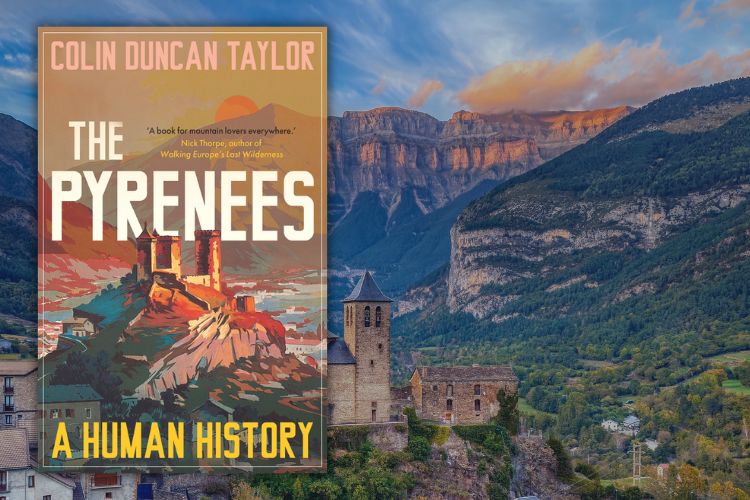
What are the Pyrenees? It’s likely, says writer Colin Duncan Taylor, that you already have your own ideas. But in this extract from his new book, The Pyrenees: A human history, he digs a little deeper to reveal how human history is woven into the landscape, from the present day back to its very first inhabitants…
Sponsored post
High above the valley of the Verdouble, a cave burrows into soaring limestone cliffs. Its entrance makes a perfect lookout point.
Starting from the northern end of the valley, vertical walls of limestone sweep around to the east, and behind them is Perpignan and the sea. Down on the valley floor, the arable land is planted with vines or wheat, and the river meanders southwards between tree-lined banks towards the village of Tautavel. Further south rises the brooding mass of the Canigou, the sacred mountain of Catalonia.
The cave itself is above the western side of the valley, hollowed out of the rock by millions of years of running water. This is a hunting lodge used by early humans for an extraordinary length of time.
‘CAUNE DE L’ARAGO. GROTTE PRÉHISTORIQUE.’ The words are stencilled on plywood so weathered it looks like rock. Two images separate the lines of text. Time has reduced one of them to an indecipherable squiggle. The other is an artist’s impression of a hunter in his early twenties who made himself at home here with his family 450,000 years ago. The front of his skull is displayed in the museum a couple of kilometres down river, or to be more accurate, a replica is on show. The original is exceptionally precious because this is the oldest human face discovered in Europe.
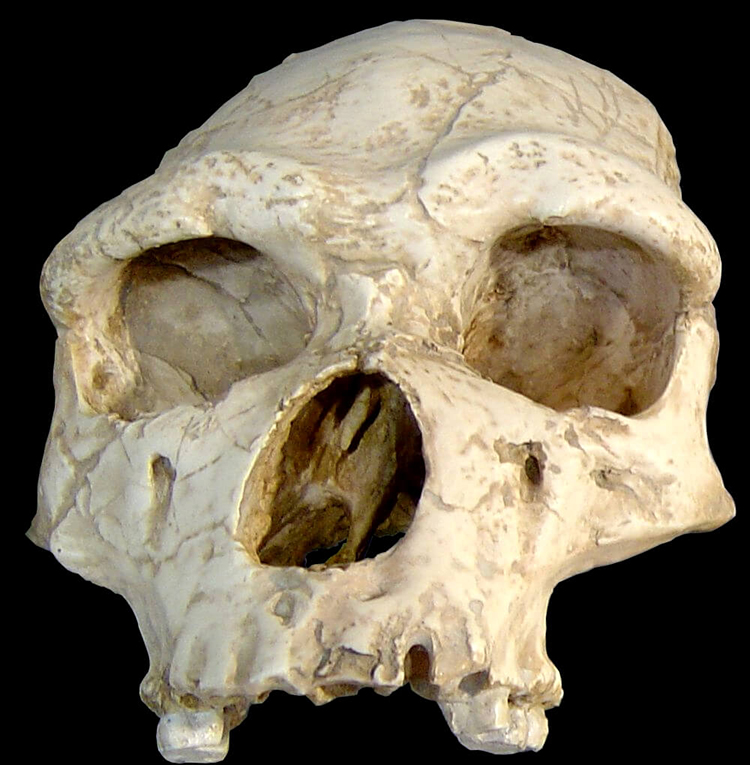
Archaeologists refer to its owner as Arago 21 because he is the twenty-first example of a type of early human called Tautavel Man whose partial remains have been discovered in this cave. By our standards, this facial skeleton with its receding forehead and thrusting jaw belonged to a young man, but in those days it was rare for humans to live much beyond their mid-twenties. Arago 21 was a senior citizen, and perhaps the rest of him was eaten because other human bones found in the cave show signs of cannibalism.
Despite the venerable status of his skull, Arago 21 was something of a latecomer to this valley, and even to this cave. The first humans probably arrived around a million years ago, but although they and Arago 21 walked upright and had an anatomy not dissimilar to our own, they are not thought to be our direct ancestors. Called Homo erectus, they evolved into
Neanderthal man who, in Europe, became extinct after having lived alongside our own species, Homo sapiens, for several thousand years.
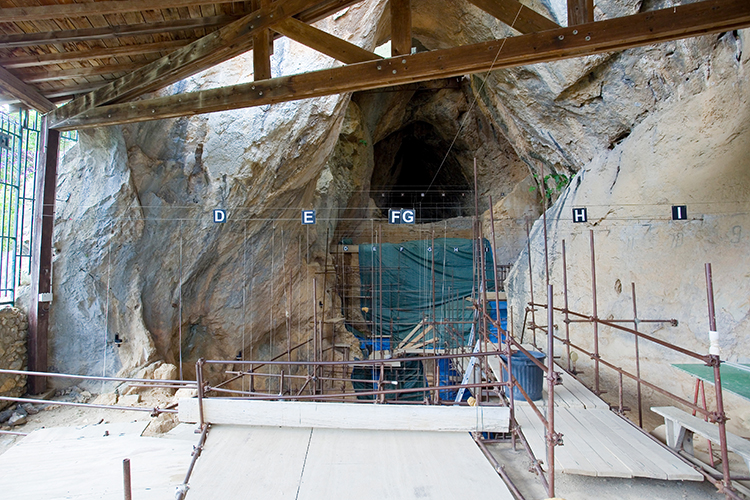
Archaeologists and palaeontologists have been digging around inside the Caune de l’Arago since the nineteenth century, but professional excavations only began in 1964, and they have continued ever since. The casual visitor, however, can only glimpse the cave through a palisade of iron bars that protects the site. Just inside the bars, a glass-fronted noticeboard displays a diagram and a work schedule for the excavations, and beyond it, scaffolding leads into darkness and letters of the alphabet delineate each zone of study.
The diagram is particularly useful because it shows the cave in cross-section and explains why the Caune de l’Arago is of such exceptional scientific interest. The hillside rears up from the river, curves over a lip at the cave entrance, and then the floor slopes down towards the interior before rising up again, thus forming a bowl. This underground hollow has acted as a time trap.
During a period lasting from 700,000 until 100,000 years ago, it captured 16 metres of sediment, and contained within the different layers are human remains, the bones of the animals they hunted and ate, the tools they made, and pollen and seeds that blew in with the wind or were carried in by humans and other creatures. Some layers show no trace of human activity. Instead, animal bones reveal the cave was at times occupied by bears, lions or wolves. More recently, objects a mere 5,000 years old have been discovered just outside the entrance.

This treasure trove of archaeological data has helped scientists understand the fluctuating climate and the changing flora and fauna to which early humans had to adapt. For example, 560,000 years ago the climate was cold and dry, herds of reindeer browsed on the open steppe, and the wind carried sand into the cave. Then, 500,000 years ago, the weather became warm and humid, forests of beech, chestnut and oak covered the valley, deer were the dominant species, and a layer of clay soil washed into the cave from above.
By the time Arago 21 went hunting, the climate had turned colder again. Horses, bison and rhinoceros grazed among birch and Scots pine, and the wind blew sandy soil into the cave to form yet another layer of silt.
Our brains may be 25 per cent larger than the one that resided inside the skull of Arago 21, but trying to make sense of the timescales represented by the layers of sediment in the Caune de l’Arago would send most minds into a spin. In all, around twenty distinct periods of human occupation have been identified among the different strata of the cave floor.

To reach the river from the cave today, a narrow path winds through a landscape where prickly shrubs and green olive trees cling to meagre soil between rugged outcrops of limestone. Eventually, the rocky path emerges onto a sandy beach beside the Verdouble. Here, the river emerges from towering limestone cliffs and widens out to form a shallow lake. For hundreds of thousands of years, Homo erectus not only hunted large herbivores around here: he or she also trapped rabbits on these slopes, caught beavers in this river, and gathered fruits, roots, seeds and wild plants from this countryside.
On a typical summer’s day in the twenty-first century, the same lazily flowing water and wide sandy banks attract day trippers in search of modern diversions. Families with young children and amorous teenagers in brightly coloured swimwear lie on beach towels or frolic in the water. More intrepid visitors paddle or clamber their way upstream into the gorge, and the truly adventurous take advantage of the steep walls of limestone which make this a paradise for rock climbers. A smoking barbecue provides an odorous reminder of the first fire lit deliberately inside the Caune de l’Arago, whenever that may have been.

This is an extract from:
The Pyrenees: A human history
by Colin Duncan Taylor
20% off* plus free P&P at yalebooks.co.uk with the code PYR26
*T&Cs: UK customers only. Offer ends 31 October 2026.



