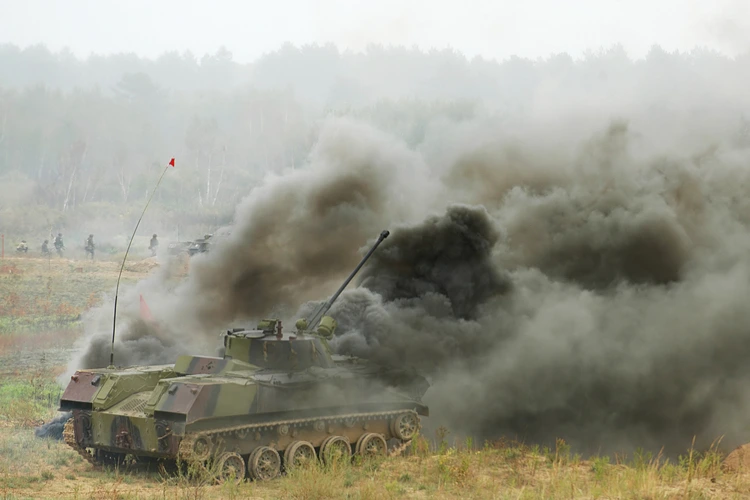
From Ukraine to Gaza, conflicts are fuelling a surge in greenhouse gas emissions – yet military pollution remains largely unreported and unregulated
By
In a world already struggling to reduce carbon emissions, war is an unwelcome accelerant. Conflict is not a new phenomenon, yet its environmental impact remains one of the least discussed aspects of warfare. Understandably, most headlines focus on the human cost – the lives lost, the refugees displaced, the trauma endured. But behind the humanitarian crisis lies another story: the silent damage inflicted on the planet itself.
Enjoying this article? Check out our related reads:
The military emissions gap
Militaries are among the world’s largest institutional emitters of greenhouse gases – from the fuel burned by fighter jets, tanks and aircraft carriers to the energy consumed in manufacturing weapons and ammunition. Yet countries are not obliged to record or report their military emissions under the Paris Agreement. This lack of transparency has created what researchers call the military emissions gap.
According to the Conflict and Environment Observatory (CEOBS), global militaries are responsible for roughly 5.5 per cent of total greenhouse gas emissions – more than the entire aviation and shipping industries combined. And because reporting is voluntary, the true figure is almost certainly higher.
‘Without accurate accounting, we’re fighting climate change with one eye closed,’ says Dr Stuart Parkinson, director of Scientists for Global Responsibility. ‘The emissions from defence sectors are vast, yet they remain hidden in plain sight.’

Conflict as a climate amplifier
The environmental toll of war doesn’t end with military operations. Armed conflict itself destroys ecosystems, releases carbon and disrupts land management. A study by Eco Action found that between 2022 and 2024, the war in Ukraine generated over 230 million tonnes of CO₂ – roughly equivalent to the annual emissions of a country like Colombia. Warfare accounted for 36 per cent of that total, while reconstruction and infrastructure damage made up another 27 per cent. Wildfires caused by shelling added yet more emissions, contributing 21 per cent.
In Gaza, researchers estimate that the first 15 months of fighting produced more than 32 million tonnes of CO2. The rebuilding process could emit between 46 and 60 million tonnes more – a devastating addition to global totals.
And the long-term consequences extend far beyond CO₂. Explosions release heavy metals and toxic residues that contaminate soil and groundwater. Bombing campaigns can ignite oil fields and chemical plants, leading to air pollution that affects neighbouring countries. In Syria, for instance, years of conflict have degraded farmland, poisoned water supplies and caused widespread desertification – an environmental collapse intertwined with the humanitarian one.
The United States: a global footprint
No military emits more carbon than that of the United States. Since the attacks of 11 September 2001, US forces have conducted operations across multiple continents. A Boston University study found that between 2001 and 2018, these activities produced 1.3 billion tonnes of CO2 equivalent. Operations in Afghanistan, Iraq, Pakistan and Syria alone generated about 440 million tonnes, with the 2003 invasion of Iraq responsible for 250 million.
‘The Pentagon is the single largest institutional consumer of fossil fuels in the world,’ says Neta Crawford, co-director of the Costs of War project. ‘Even when you exclude the conflicts themselves, maintaining bases, vehicles and supply chains consumes enormous amounts of energy.’
And the effects ripple outward. Wars displace millions, forcing people to migrate across borders. Those movements increase emissions from neighbouring countries that must suddenly provide food, water and housing – Lebanon, Jordan and Turkey among them.

Environmental scars of past wars
While the current numbers are alarming, the idea that war damages the environment is not new. The Vietnam War left behind a toxic legacy through the widespread use of Agent Orange, which defoliated forests and poisoned soil for generations. During the 1991 Gulf War, the burning of Kuwaiti oil wells released an estimated 500 million barrels of crude into the atmosphere, turning skies black and coating the desert in soot.
Even the Second World War reshaped landscapes – through the extraction of natural resources, the destruction of cities, and the creation of hazardous waste sites that lingered for decades. Each conflict leaves its mark, not only on people and politics, but on the planet’s capacity to recover.
A new legal frontier
There are growing calls to make environmental destruction during conflict a recognised crime. In July 2025, the International Court of Justice (ICJ) delivered a landmark advisory opinion on states’ obligations to tackle climate change. It concluded that countries must take ‘all necessary measures’ to prevent harm to the climate and to cooperate internationally to do so. Crucially, that includes assessing and reporting emissions linked to armed conflict.
While the opinion isn’t legally binding, it carries significant moral and political weight. The challenge, however, lies in enforcement: no international body has the power to compel compliance.
Meanwhile, the UN International Law Commission has developed draft principles for the protection of the environment in times of war, approved in late 2022. These guidelines recognise that conflict often magnifies environmental crises and call on states to integrate environmental protection into their military planning.
And yet, as with many such frameworks, implementation depends on political will – something that tends to vanish in times of war.
The push to criminalise ecocide
Among the most radical proposals is the introduction of ecocide as a crime under international law – akin to genocide or crimes against humanity. The term refers to unlawful or wanton acts committed with knowledge that they are likely to cause severe, widespread or long-term damage to the environment.
Only a handful of countries, including Belgium, Mexico and Vanuatu, have moved towards codifying ecocide in law. Campaigners hope that recognising it at the International Criminal Court would make political and military leaders personally accountable for large-scale environmental destruction.
‘If the destruction of ecosystems is treated as a crime, it changes the calculation for decision-makers,’ argues Jojo Mehta, co-founder of Stop Ecocide International. ‘It introduces a deterrent effect – a reminder that environmental damage isn’t collateral, it’s criminal.’
Can militaries go green?
There is some movement within defence sectors to address their climate impact. NATO, for instance, has launched a Climate Change and Security Action Plan aimed at improving emissions tracking and exploring alternative fuels. Some countries, including the UK and Denmark, are testing biofuels and electric vehicles for military use.
Yet these initiatives remain small compared to the scale of the problem. Military technology is designed for reliability and power, not efficiency. And when national security is at stake, environmental concerns often fall to the bottom of the priority list.
‘We can’t decarbonise war,’ says environmental scientist Doug Weir of CEOBS. ‘But we can reduce its footprint, improve accountability, and build systems that make peace more sustainable than conflict.’
A call for accountability
Ultimately, the environmental toll of war is a shared global burden. The carbon emitted during a conflict in one region contributes to climate impacts everywhere. As wars grow more protracted and destructive, understanding – and accounting for – their ecological costs becomes not just a moral imperative, but a climate necessity.
If future peace agreements included commitments to environmental restoration and emission reduction, conflict recovery could also become a path to planetary healing. Until then, the world continues to fight two battles at once: one against each other, and one against time.