
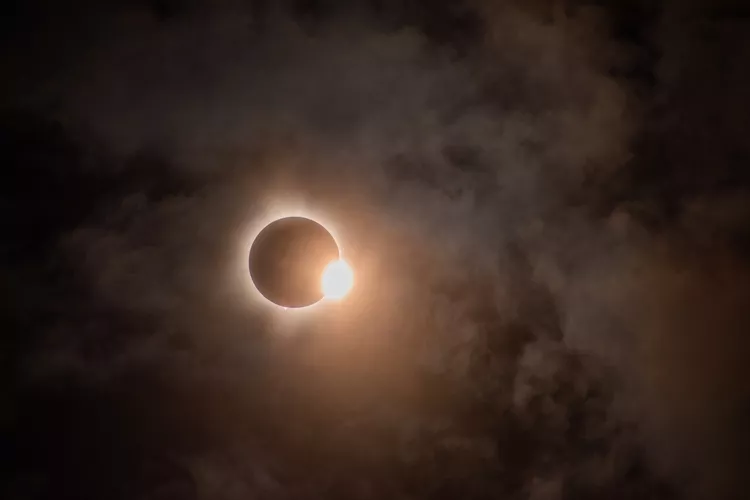
As a solar eclipse is set to hit the skies next week, learn more about the impacts that such an event can have on weather – and why
By
Next Wednesday (12 August), a solar eclipse is set to occur across the Arctic Ocean, Greenland, Iceland, the Atlantic Ocean, Portugal and northern Spain. In the UK, the southwest will experience the strongest eclipse: around 90–96 per cent of the sun will be covered by the moon. Spectators in parts of Greenland, Iceland and northern Spain will see a total eclipse.
All eyes will be to the skies as the moon’s shadow passes across the Earth, but beyond the striking visual impact, the solar eclipse may play another role: in altering the planet’s weather, through cloud formation, wind speed and temperature.
By analysing the types of clouds present in the skies before and after solar eclipses, researchers at the Royal Netherlands Meteorological Institute found a striking relationship between the phenomenon and weather patterns. Even partial eclipses can alter clouds: low-lying cumulus clouds – typical, fluffy clouds – dissipate, while higher-altitude clouds remain unaffected.
Enjoying this article? Check out our related reads…
Clouds start to disappear around 15 to 20 minutes after the ground cools in the moon’s shadow. Once the eclipse has completed, the clouds are likely to reappear.
Other effects on weather include drops in temperature as the moon passes in front of the sun. During an eclipse in 1999, the city of Szczawnica in southern Poland experienced a temperature fall by as much as 11°C.
Because of these temperature drops, wind speeds can also become lighter and change in direction. As air cools, it becomes more dense and has greater friction with the ground. This effect makes wind slow down and turn in an anti-clockwise shift: so a south-westerly wind would become a little more southerly.
Ultimately, solar eclipses can have varied impacts on weather – but these are usually just temporary, fleeting alterations.
How can I watch the solar eclipse?
There are several ways to watch the solar eclipse next week. Tune into the Royal Observatory’s live stream from London, or if you want to see the event in-person, make sure you’re equipped with eclipse glasses. These work by blocking out the sun’s rays. Normal sunglasses are not safe to use, as they don’t provide the same UV protection as eclipse glasses.

Make sure that any eclipse glasses you purchase or borrow have the safety certification ‘ISO 12312-2′ or ‘ISO 12312-2:2015′ on the glasses.
You can also use a solar telescope at astronomy societies to see the eclipse – remember that normal telescopes without a solar filter shouldn’t be used to look at the sun.


