
Greece wants to become an energy power in a fractured Europe, but opponents say the country is risking its own climate credibility for an uncertain fossil-fuel prize
By Boštjan Videmšek
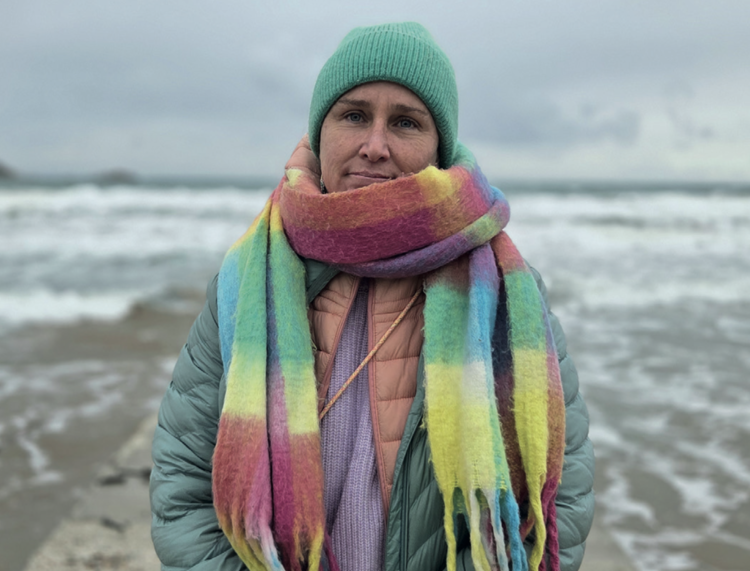
On a cliff above the village of Arillas, on the northwestern edge of Corfu, Sophia Michalopoulou looked out into rough winter water and asked the obvious question. ‘Who would want to destroy something so beautiful and so unique?’
Below us, surfers were being tossed around in a cold Ionian swell. Offshore, the sea darkened towards the horizon. Somewhere out there lies Block 2, the deep-water concession where a consortium led by ExxonMobil is preparing what would be Greece’s first exploratory offshore drilling campaign in more than four decades. For ministers in Athens, that prospect speaks of energy security, geopolitical relevance and the promise of domestic gas. For Michalopoulou and a growing number of local campaigners, it looks more like a test of what Greece is willing to sacrifice in the name of all three.
Enjoying this article? Check out our related reads…
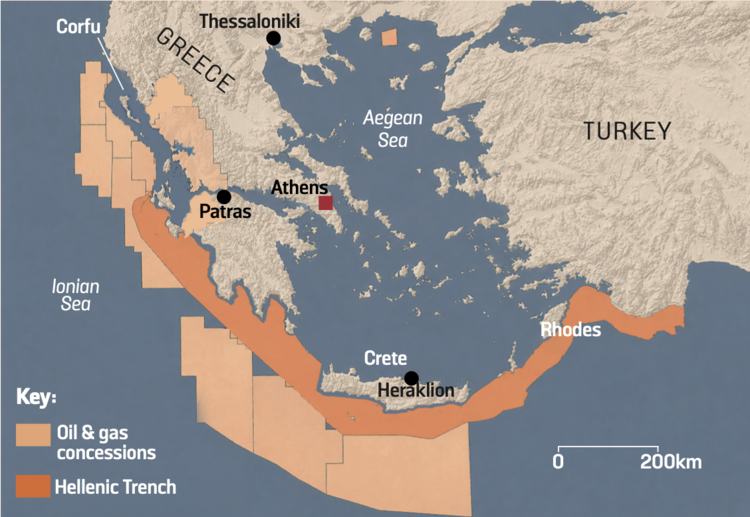
For years, Greece seemed to be moving in another direction. It expanded wind and solar, talked up the energy transition and positioned itself as part of Europe’s cleaner future. Yet the country is now reopening an offshore hydrocarbons story many assumed had been left in the 20th century. In November 2025, Athens signed a landmark agreement with ExxonMobil, Energean and HELLENiQ Energy to explore for gas west of Corfu. In April 2026, the consortium moved a step closer by signing with Stena Drilling for a well in Block 2, expected to begin in 2027. Meanwhile, Chevron and HELLENiQ have signed lease agreements for four more offshore blocks south of Crete and the Peloponnese.
The scale of Greece’s move isn’t lost on anyone involved. This isn’t simply a technical energy story. It sits at the intersection of climate politics, the war in Ukraine, Europe’s attempt to end dependence on Russian gas, and a wider struggle over who gets to define the future of the eastern Mediterranean. It’s also, in places such as Corfu, a local story about tourism, fishing, fragile marine ecosystems and a long-standing suspicion that enormously consequential decisions are made far away and then presented as faits accomplis.
Athens frames the new push as realism. Since Russia’s full-scale invasion of Ukraine, Europe has scrambled to rewire its energy map. The EU’s strategy is now explicitly to eliminate Russian gas imports by the end of 2027. In that environment, every potential source of supply in the Mediterranean has acquired greater strategic value. Greece, once regarded as the edge of the continental grid, now wants to be an energy hub – a place where gas can be landed, stored, traded and moved northwards through the Balkans. Ministers say offshore exploration belongs within that wider ambition.
There is logic to the argument. Greece’s geography does make it a natural hinge between the eastern Mediterranean and southeastern Europe. The country has expanded liquid natural gas (LNG) infrastructure and has pitched itself as part of a ‘vertical corridor’ that could move gas onward to Bulgaria, Romania, Moldova and beyond. From that vantage point, offshore exploration isn’t a nostalgic return to fossil fuels so much as an attempt to embed Greece more firmly in Europe’s new security architecture.
But realism isn’t the same as inevitability, and that’s where the backlash begins. Critics don’t merely object to drilling on climate grounds. They also dispute the economics, the transparency and the politics of the whole enterprise.
The bluntest version of their case is this: Greece risks locking itself into a high-cost, high-risk fossil fuel project just as the continent claims to be accelerating away from fossil fuels.
At WWF Greece’s offices in Athens, lawyer Anna Vafeiadou argued that the Greek government has failed to treat the new offshore programme with the seriousness its risks demand. ‘Before green-lighting the investments, the Greek authorities failed to fully check the danger to the environment,’ Vafeiadou explained. ‘Especially to the marine ecosystems and the protected areas. In our opinion, there was systemic collusion to downplay the risks.’
Environmental groups say that parts of the concessions overlap, or sit close to, ecologically sensitive areas, including protected zones associated with the Hellenic Trench – one of the most important habitats in the Mediterranean for sperm whales and other endangered cetaceans. They accuse the government of pushing ahead without properly assessing the cumulative impact of seismic surveys, drilling noise, shipping traffic and potential spills on marine ecosystems that are already under pressure.
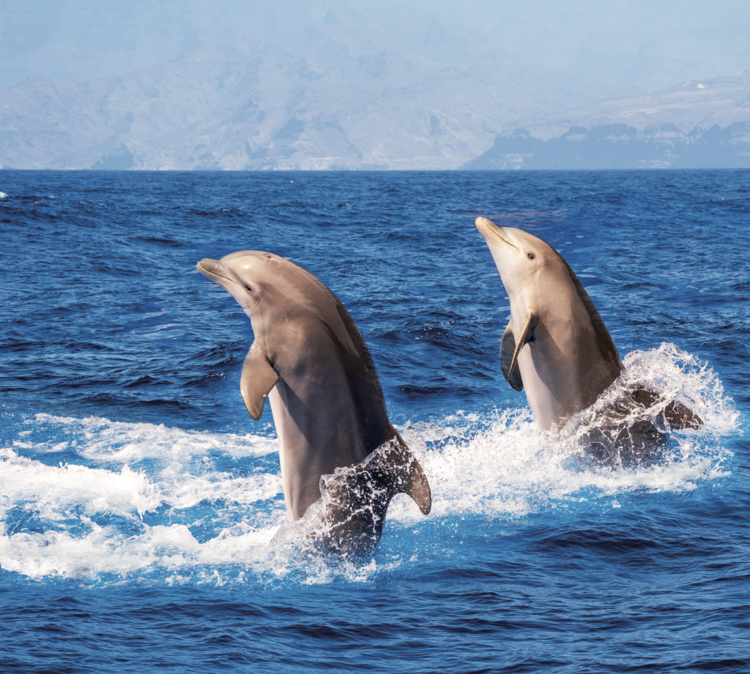
Their concern isn’t abstract. The Hellenic Trench isn’t just another stretch of sea on a licensing map. It’s a deep and biologically rich zone that’s used by everything from sperm whales, Cuvier’s beaked whales and striped dolphins to monk seals and sea turtles. Scientists and campaigners have long warned that underwater noise can disrupt feeding, breeding and migration. Environmentalists argue that new offshore activity in or near such areas is fundamentally at odds with Greece’s own conservation commitments.
There’s also the awkward matter of timing. Greece has promoted marine protected areas and has tried to present itself internationally as serious about climate adaptation on one of Europe’s most climate-exposed front lines. Wildfires, drought and heat already shape the national conversation. In 2023, renewables and hydro supplied a record share of the country’s electricity generation. Against that backdrop, the optics of reopening offshore hydrocarbons are, at the very least, politically jarring.
Campaigners insist the contradiction runs deeper than optics. In their view, this isn’t a bridge to a cleaner future but a distraction from one. Gas development takes years, demands large sunk costs and creates constituencies that then lobby to prolong the life of fossil fuel infrastructure. Even a successful well in Block 2 wouldn’t produce immediate relief for households facing high bills. Exploration first has to prove there is commercially viable gas in the ground. Then comes appraisal, investment and infrastructure. The political benefits are immediate; the supposed energy dividends are distant and uncertain.
That uncertainty is one of the less glamorous but more important parts of the story. Offshore exploration always trades in probabilities, not guarantees, and some people close to the debate in Greece privately question how commercially exciting the most talked about prospects really are. Public estimates have floated the possibility of substantial reserves west of Corfu, but those remain estimates. The hard truth is that a country can spend years courting offshore hydrocarbons only to discover far less than hoped, or to find that what’s there no longer makes economic sense in a world of volatile prices, carbon constraints and rising renewable capacity.
Locals on Corfu grasp the imbalance instinctively, even if many haven’t followed every detail. When I walked the streets of Corfu Town, most people I stopped were unaware of the impending drilling plans. That lack of awareness alarms Giorgios Stelios, a chemical engineer involved in the Environmental Protection Association of Corfu, but doesn’t surprise him. Greece, he said, has spent years in overlapping states of crisis – financial, political, social, and environmental. People are tired. Mobilisation takes energy, and energy is scarce.
‘We need to make people aware of what is about to take place,’ he told me. ‘We don’t have much time. Well-meaning organisations must come together and start forming new alliances – and not only on Corfu. Our environment is facing a serious threat.’
Yet passivity isn’t the whole picture. Corfu has a recent memory of environmental mobilisation, including opposition to a wind development that locals felt had been imposed without consent. That episode matters because it reveals something often missed in shorthand portrayals of such battles. Resistance isn’t necessarily resistance to any form of development. Often it’s resistance to distance, opacity and hierarchy – to the feeling that local communities are expected to absorb the costs of projects designed elsewhere.

That feeling runs strongly in Arillas, where Dimitras Kourkoulos, who runs a beach taverna and an association of local entrepreneurs, sees the offshore plans through the lens of vulnerability rather than strategy. Corfu’s economy depends heavily on tourism. The island’s appeal lies in clean water, dramatic coastlines and the idea of an idyll set apart from industrial life. Even without an accident, offshore drilling changes the mental map of a place. Add the risk of leaks, chronic pollution or ecological decline, and the threat becomes existential. ‘After the ecosystems, we are the next in line,’ he said.
Such concerns are easy for central governments to dismiss as emotional or parochial. But they point to a bigger question: who exactly stands to gain if Greece’s offshore bet succeeds? Ministers speak of national benefit, geopolitical upgrade and energy sovereignty. Environmental lawyers counter that any extracted hydrocarbons would belong to corporate concessionaires, that prices would still be set by markets, and that ordinary Greeks would bear the environmental risks without guaranteed public reward. In that framing, the promise of cheap domestic energy begins to look more like a political slogan than an economic certainty.
The politics of all this extend well beyond Corfu. South of Crete, where Chevron and HELLENiQ have signed for four offshore blocks, the story becomes inseparable from the tense geopolitics of the eastern Mediterranean. Maritime boundaries, rival energy visions, and the region’s unresolved conflicts hover over every concession map. That doesn’t mean that new drilling is impossible. It does mean that, here, hydrocarbons are never just about hydrocarbons. They are instruments of alignment, leverage and statecraft.
That’s one reason Washington’s role has drawn such attention. The US isn’t merely a friendly ally cheering from the sidelines. Its companies are central players in Greece’s offshore ambitions, while the broader US-Greek energy relationship has deepened around LNG, infrastructure and regional supply routes. Seen from Athens, this strategic convergence. Seen by critics, it’s a transfer of dependency – away from Russian gas and towards a different external power and a different fossil fuel system.
That critique can be overstated. Europe does need energy, transitions are messy, and no government governing in real time can operate on rhetoric alone. Even countries serious about decarbonisation still worry about price shocks, industrial competitiveness and geopolitical coercion. Greece isn’t irrational to think about resilience. The question is whether offshore gas really provides it, or whether it simply offers the symbolism of control while deepening exposure to the risks of another era.
Back on the cliffs near Arillas, that abstract debate comes down to a simpler moral intuition. Michalopoulou spoke of erosion, warming seas and dwindling fish. Others worried about whales, monk seals and the degradation of a coastline that underpins local identity as much as local income. What united them was less ideology than disbelief – disbelief that, in a decade defined by fires, floods and heat, the answer could still be more drilling.

And yet that’s precisely what makes Greece so revealing. It isn’t an outlier but a condensed version of a wider European paradox. Even as the continent talks of a green transition, it continues to make room for new gas in the name of security. Even as it celebrates renewables, it hedges against the future with fossil infrastructure. Even as it promotes marine protection, it tolerates industrial encroachment into ecologically sensitive seas. Greece, exposed to climate impacts and rich in sun and wind, should be one of the places where that contradiction becomes impossible to sustain. Instead, it has become one of the places where the contradiction is most openly managed.
Whether Block 2 ultimately produces gas may matter less, in the end, than what the project already signifies. It marks a choice about the story Greece wants to tell about itself. Is it a country using the turbulence of the present to accelerate towards a genuinely post-fossil future? Or is it one that, under pressure, has reached for the old language of extraction, leverage and great-power backing?
For now, the sea off Corfu remains what it has long been – a borderless expanse onto which different interests project very different futures. To the state, it’s a reservoir of strategic possibility. To energy companies, it’s a frontier. To those who live along its edge, it’s livelihood, beauty and inheritance. Greece’s new offshore frontier may yet prove commercially disappointing, legally embattled or politically unsustainable, but the argument it has opened – about climate, sovereignty and the value of a living sea – is only just beginning.